

Tracing an Item From the Erickson Historic Residence
by joyce bavlinka, m. ed., liac
1201 EAST HAYWARD AVENUE
The Foundation maintains the Erickson Historic Residence located at 1201 East Hayward Avenue in Phoenix. The Ericksons moved there in 1970. Dr. Erickson maintained an office in the guest house that sits on the property.
“The Milton and Elizabeth Erickson Museum: Collection Description” brochure describes 136 artifacts displayed in the home and guest house/office. Included in the collection are items that the Ericksons acquired over the years, family treasures, gifts received, and family memorabilia.
ITEM 14. SMALL BOOK [Letter from Mrs. Erickson to Jeffrey Zeig, 1999]
Mrs. Erickson recalls wanting to find a book that Dr. Erickson had autographed and finally finding one. She writes:
“I ran acrossss this little book which I want you to have – “A Letter to a Friend.” When I worked for Milton as a lab assistant the summer of 1935, this was one of the first books he assigned me to read, saying that it was a perfect example of a highly intelligent schizophrenic. I was personally intrigued by the book, because in high school my best English teacher told us the line ‘A rose-red city half as old as time’ is/was one of the most perfect lines of poetry in the English language.
Petra is one of the remote places I intend to visit someday --- and I came very near to signing up for a tour of Jordan.”
The book “A Letter to a Friend” includes the poem and is signed by Milton Erickson. The book measures 4.5 inches by 6” inches and was published by The Open Court Publishing Co. in 1928. The publisher had offices in Chicago and London. The book includes the poem, a postscript, and another poem, “The Search for the Other Wise Man.”
THE AUTHOR
John William Burgon [1813 – 1888] was a poet, a biblical scholar, and a university administrator. He was born in what is now Turkey. In 1845, Burgon won the prestigious Newdigate Prize for his poem Petra. He had not been to Petra but romanticized about the beauty of the location. In 1876, Burgon was appointed Dean of Chichester Cathedral where he became known for his powerful preaching.
THE POEM
The poem can be found on the International Archive website in the book “Petra.”
https://archive.org/details/petrapoemtowhich00burgrich/page/14/mode/2up
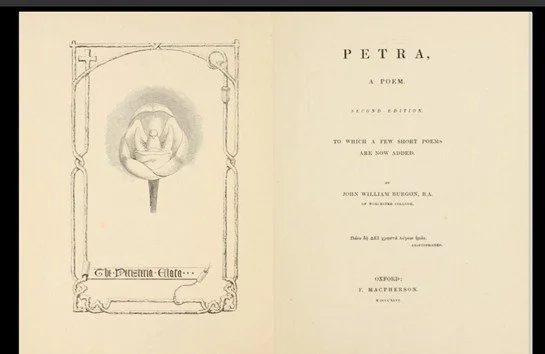
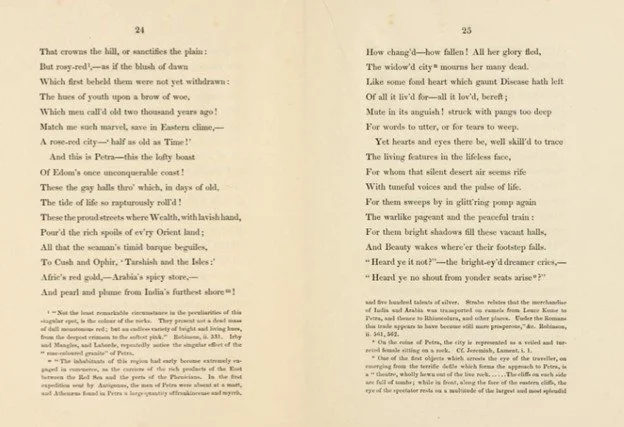
The poem speaks to the beauty of the “rose-red city” and the romantic nature of the architecture. There is the timelessness of the city, contrasting the old with the new, the times gone by, the ruins and yet the beauty of today. There is a mystical aura around the city. There is the intrigue of ancient, unknown lands and the beauty of the ruins. It is a powerful reminder of vanished/lost civilizations and the sublime power of nature.
PETRA
UNESCO has named Petra one of the 7 wonders of the world.

An AI request for the history of Petra generated the following:
“Petra is one of the most remarkable archaeological sites in the world and a symbol of Jordan’s rich cultural heritage. Located in southern Jordan, Petra is often called the “Rose City” because of the pink and red colors of the stone from which it is carved. The city was established as early as 7000 BC by the Nabataeans, an Arab people who were skilled traders and engineers. Today, Petra is recognized as a UNESCO World Heritage Site and is considered one of the New Seven Wonders of the World, attracting visitors from across the globe.
Petra’s historical importance lies in its role as a major trading hub in the ancient world. The Nabataeans controlled important trade routes that connected Arabia, Egypt, Syria, and the Mediterranean. As a result, Petra became a wealthy and powerful city. The Nabataeans were also advanced in water engineering; they built an intricate system of channels, dams, and cisterns that allowed them to collect and store water in the desert environment.
In the 4th century BC, Petra was annexed by the Roman Empire, which further influenced its architecture and culture.
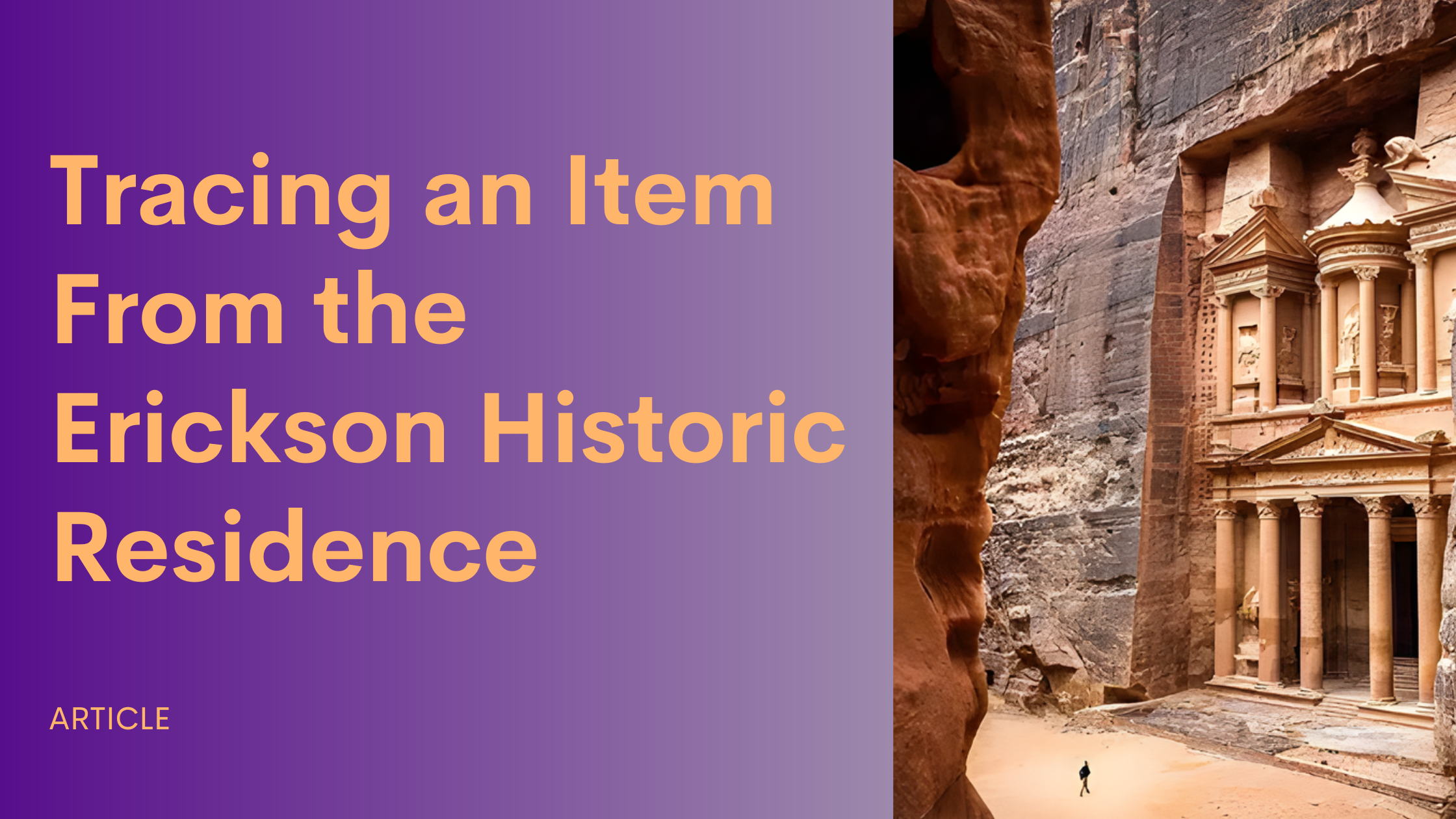
One of the most famous structures in Petra is Al-Khazneh, also known as the Treasury, a grand façade carved directly into the rock face [pictured above]. Although it is called the Treasury, historians believe it was likely a royal tomb. Petra remained relatively unknown to the Western world until it was rediscovered in 1812 by the Swiss explorer Johann Ludwig Burckhardt. Since then, it has become an important site for historical study, tourism, and cultural preservation.”
There will be more write-ups on items that are in the Erickson Historic Residence.
You may also like …

by David Keith
Type: Softcover
Carl Whitaker was one of the most influential family therapists of the 20th century. He had his loyal following, including David Keith. He also had critics, such as one therapist who shortly after Whitaker’s death in 1995 called him a Crazyman. Not far from the truth Keith would say, though he defines Crazyman this way: a full-fledged human being: thoughtful, imaginative, down-to-earth, curious, spiritual, smart, playful, inconsistent, tough, tender, ironic, supportive, rebellious, self deprecating, loving, and generous.
Whitaker was a longtime friend, teacher, mentor, co-therapist and collaborator. Their connection lasted 33 years. Whitaker embodied therapeusis, that elusive complex, energetic, and abstract core of psychotherapy. And with this book, Keith calls for a higher order — the reinvigorating of clinical minds in accord with therapeusis. He proposes that therapists listening be more nuanced, and that they playfully and energetically use language in all its forms irony, syntax, metaphor, etc. rather than relying solely on evidence-based methods. Irony, especially, commands Keith s full attention because overregulation he suggests leads to squelched spirits, impaired by irony deficiency.
Keith champions semiotics, offering an analogy of a forest: alive, recycling, blossoming, growing, consuming. If not for the heartless Empire of Overregulation with its lifeless language of business-eze, bureaucracy, and bottom-lines, therapists could more freely pursue their passion for truly helping others. Carl Whitaker took giant steps in this direction, and David Keith continues making the case. Like a marathon runner, Keith has taken up the torch of therapeutic freedom, adding essential perspectives to the real meaning of caring for patients. This is an endlessly rich and creative process in which patients may actually be guided to greater well-being and therapists may avoid the pitfalls of burnout and resignation.

William Glasser (2000) uses role-play with Marie who is simulating Paul, a male client from her place of employment. Paul has marriage problems. Marie, as Paul, is asked to role-play his wife. Glasser highlights choices, examines the client’s thinking, and focuses on responsible behavior. After the demonstration Glasser explains his work.
Educational Objectives:
To describe the actual differences between therapies.
To describe what the therapist does that is unique to his/her therapy.

Personal Perspectives
by Jeffrey Zeig
An Epic Life Vol. II is the second biography on Milton H. Erickson written by Jeffrey Zeig. The first volume features professional perspectives on Erickson and this book offers a personal lens, as seen through Erickson’s family, friends, neighbors, students, secretaries, and patients. The reader gains access into the dynamic personal world of Milton Erickson, who was a one-of-a-kind communicator of unparalleled brilliance.
Erickson was known to work with patients to elicit in them the innate ability to “connect the dots” to discover their adaptive potentials. Readers will delight in also being able to connect the dots, piecing together the professional aspects of Erickson in the first volume with the personal ones in this volume. For Erickson, the line between his professional life and personal life was blurred. He was doctor, teacher, friend, and neighbor all at the same time. Readers will see how his therapy methods carried over into his personal life. Or was it perhaps the other way around?
An Epic Life II draws upon decades of interviews with those who knew Erickson on a more personal level. The incisive perspectives are interlaced with commentary from Zeig to clarify and contextualize. The images of Erickson that emerge are congruent, divergent, and myriad. In the end, readers will have a more complete picture of the man, his commitment, and his work. There is nothing simple in what is conveyed, and yet the impression it makes is coherent – and lasting.
Zeig prepares us for this stimulating journey by providing a comprehensive history of Erickson’s lineage, and background on the many contexts mentioned in the book.
Erickson was one of the greatest psychotherapists of the 20th century and the father of modern hypnosis and brief therapy. His professional contributions continue to influence the field and its practitioners and his personal life is inspirational.
As we strive to evolve personally and professionally, we should do as Erickson did: Leave the world a better place.

Mary Goulding (1995) demonstrates with three volunteer clients. The first is disturbed because his mother did not spend much time with him during childhood. Next Dave is concerned about his distant relationship with his son. The third, Diane describes problems with her mother who is now a widow and overly critical. Goulding explains her work.
Educational Objectives:
To list three viable contracts for change by the patient.
To describe the use of early child scenes in making changes in the present.
