

Home Sweet Home
A PICTORIAL STUDY
32 WEST CYPRESS
1201 EAST HAYWARD
PHOENIX, ARIZONA
MOVING TO PHOENIX AND THE ARIZONA STATE HOSPITAL
“An Epic Life”, by Jeffrey Zeig, Ph.D., recounts the family’s move to Phoenix in 1948, after Dr. Erickson experienced health problems while living in Michigan. Phoenix was a town of just over 100,000, experiencing significant population growth after World War II. It was emerging from a farming town.
32 WEST CYPRESS
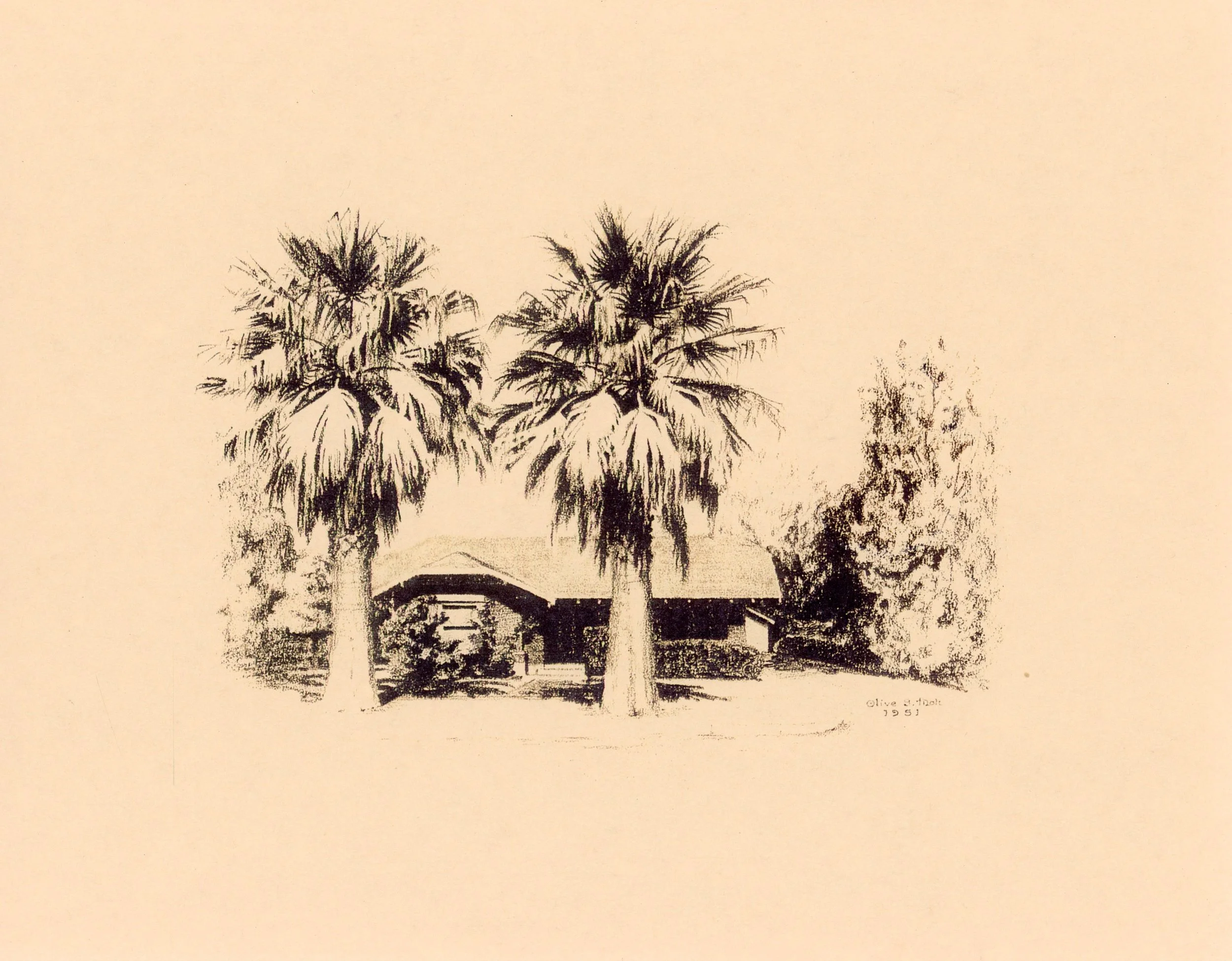
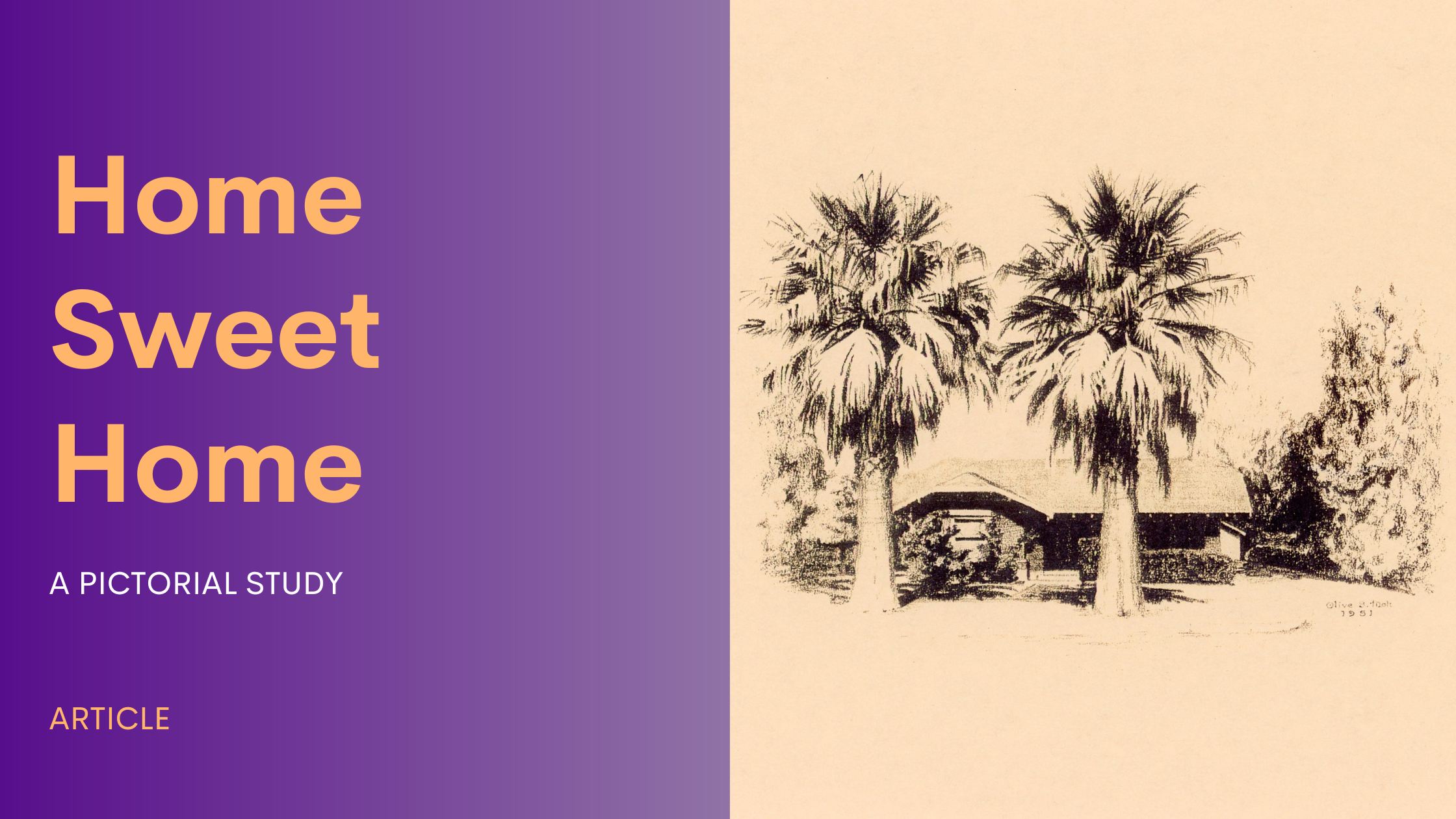
Sketch of 32 West Cypress, artist unknown. From the Milton H. Erickson Foundation Archives.
Erickson joined his friend Dr. Larson at the Arizona State Hospital and lived on the grounds with his family until he bought 32 West Cypress in the Las Palmas/Willo neighborhood of Central Phoenix. On December 12, 1948, the Arizona Republic ran a classified advertising 32 West Cypress Street as a “$6.50 Sq. Ft. Bargain.” The classified read:
“Live in amicable, old shaded perfectly landscaped home. Red brick. One block off of Central Ave. Just Imagine! 4 brs., 2,000 sq. ft. with wood floors. 12 x 23 sq. ft. living room with fireplace, insulated with Ferro-Term alloy steel sheets…. Over $5,000 has been recently expended to redecorate this grand old modern looking home…. Lot with pecans, dates and other trees. Total price will amaze you.”
Marbut, O’Hair and Asher were the realtors who handled the listing. At $6.50 per sq. ft. the house would have sold for approximately $13,000.
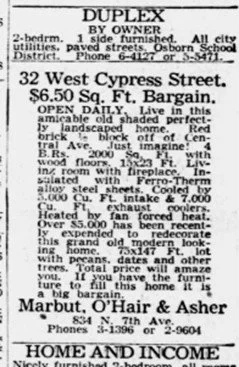
Ad from The Arizona Republic for 32 West Cypress, 1948.
Irwin A. Pasternack, AIA, filed an architectural drawing for the property:
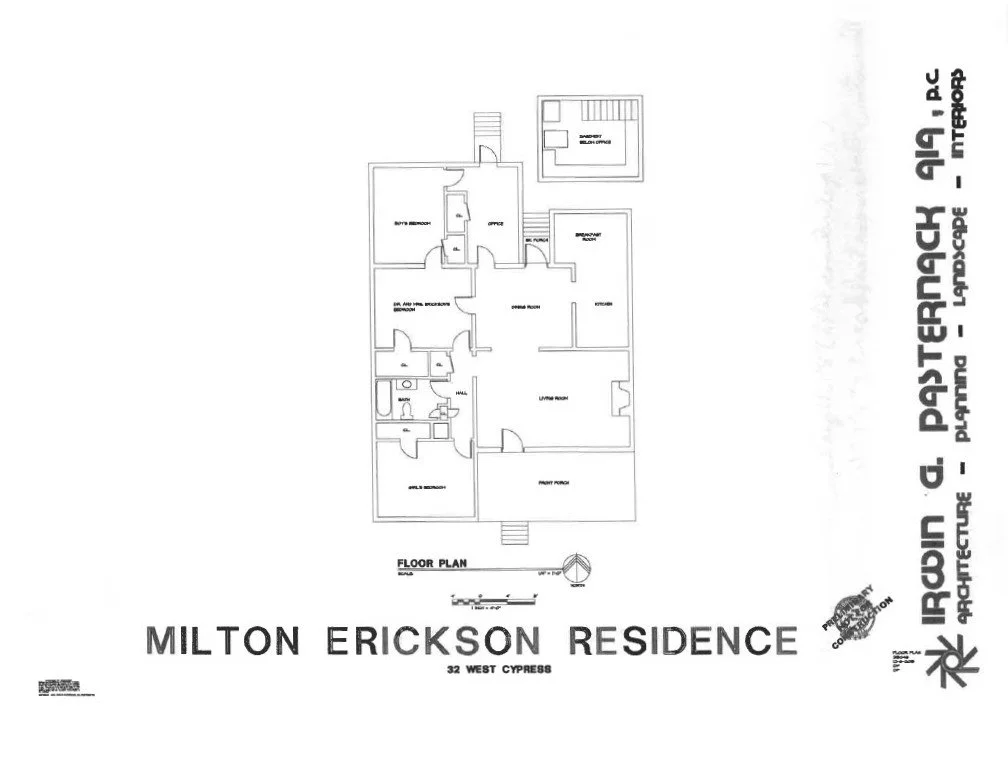
Architectural Drawing for 32 West Cypress by Irwin Pasternack. From the Milton H. Erickson Foundation Archives.
Dr. and Mrs. Erickson closed on the property April 8, 1949, and the Warranty Deed was filed with the Maricopa County Recorder April 20, 1949. The property was purchased from E. F. Wurl and Bonnie Mae Wurl and the Warranty Deed identifies the property as part of Las Palmas subdivision. It was part of the Willo neighborhood, between Central and 7th Avenues, from east to west, and between Thomas Road and McDowell, from north to south. The area had been a citrus grove. The neighborhood consisted of Craftsman bungalows, Spanish Colonial, Mediterranean Revival and Ranch homes. The homes were mostly two-bedroom, one bath houses with swamp coolers. Air conditioning did not become popular until the early 1950’s. Today, most Willo homes have been restored, and it is a vibrant historic neighborhood.
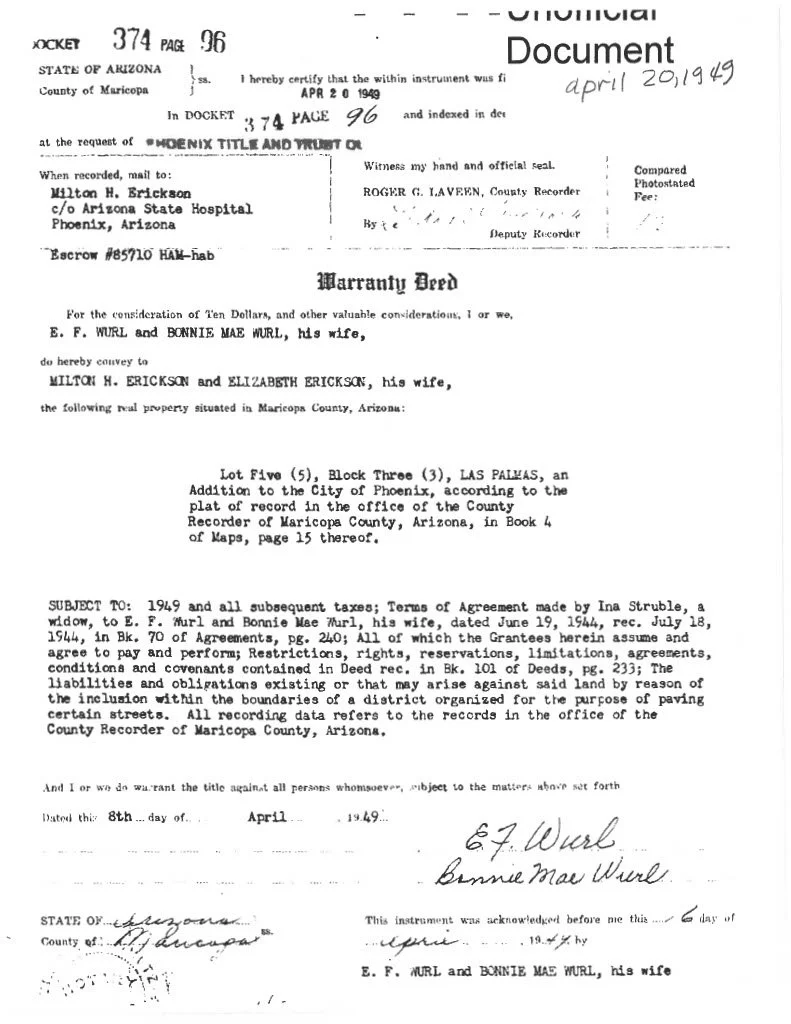
Warranty Deed for 32 West Cypress, 1949.
32 West Cypress was originally a 2-bedroom home with a dining room, living room and front porch. The house was later expanded by the previous owner to add two bedrooms and a breakfast room. According to Robert Erickson, the home was built in 1925. The front bedroom served as the girls’ bedroom and the rear bedroom served as the boys’ bedroom. The one bathroom served up to 6 children and 2 adults. The rear, interior bedroom was converted to an office for Dr. Erickson. The corner/rear bedroom could only be entered through Dr. and Mrs. Erickson’s bedroom or the office. [See attached plan.] The house was both home and office, and patients, at times, mixed with the Erickson children.
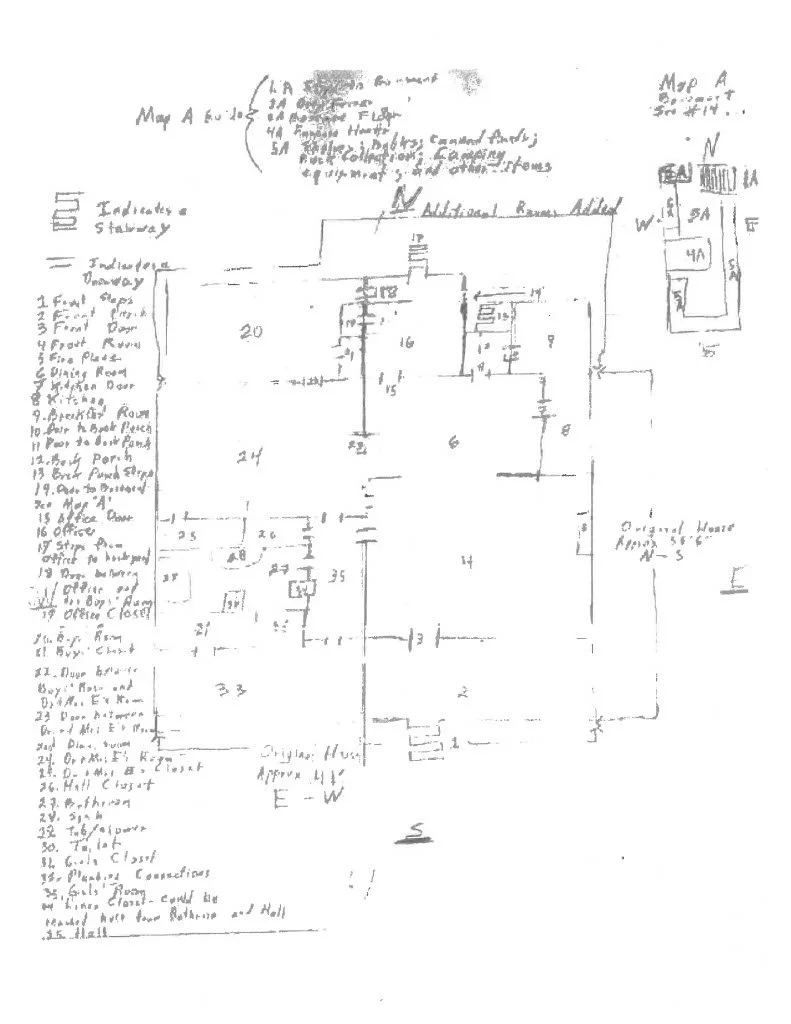
Drawing of 32 West Cypress by Robert Erickson. From the Milton H. Erickson Foundation Archives.
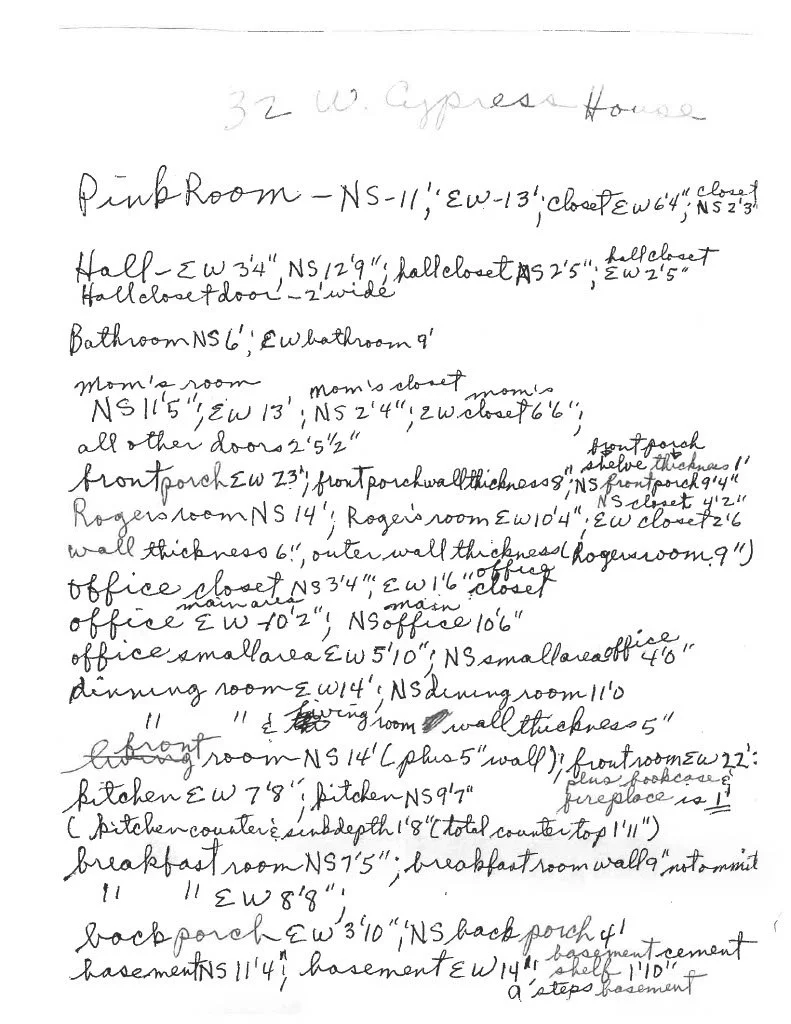
Notes accompanying drawing of 32 West Cypress Street by Robert Erickson. From the Milton H. Erickson Foundation Archives.
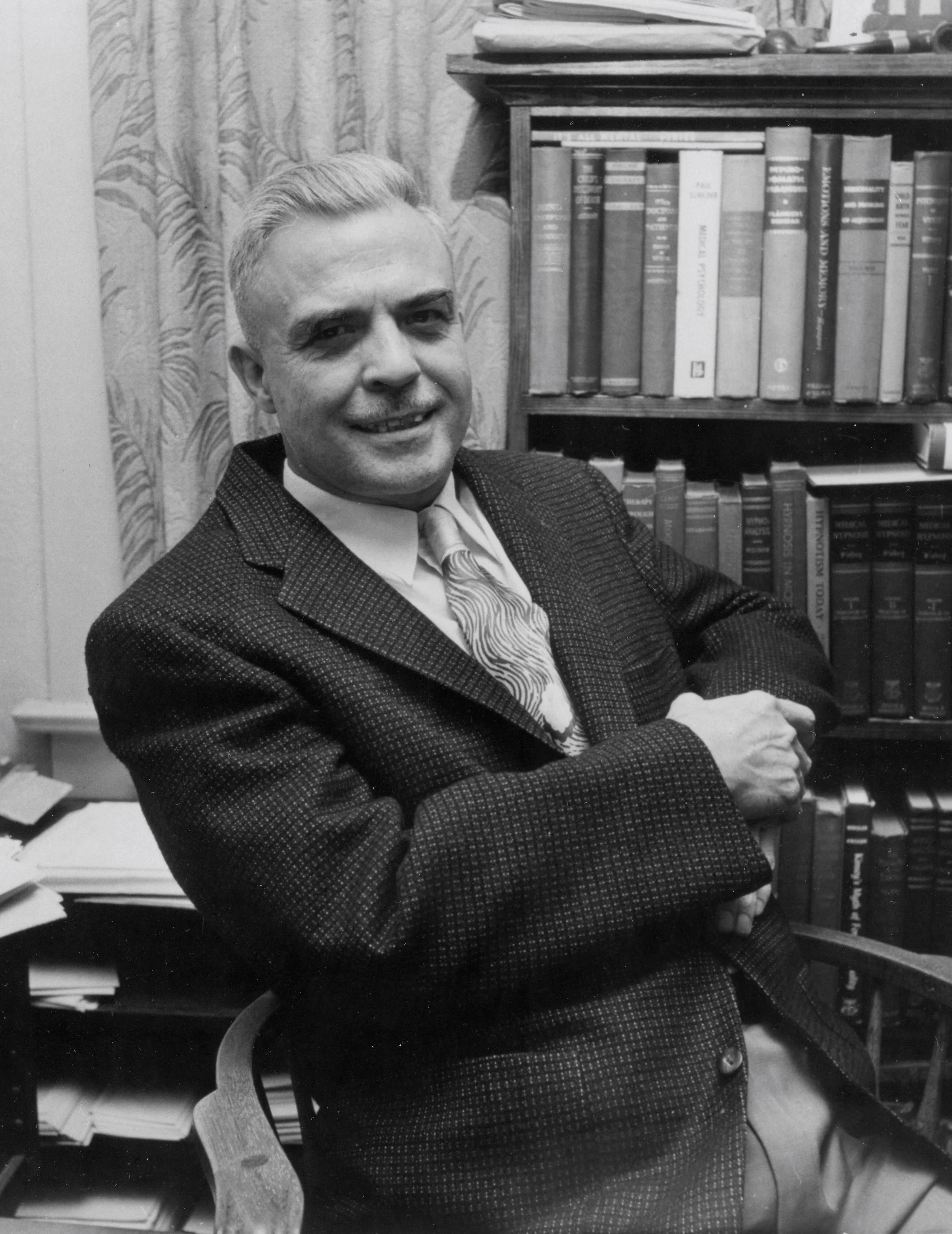
Milton H. Erickson in his office on Cypress Street, 1956. From the Milton H. Erickson Foundation Archives.
Sarah Clinebell, Foundation Archivist, supplied us with “A Tour of the Cypress Street House with Mrs. Erickson,” dated May 12, 1989, conducted by Jeff Zeig, Ph.D. Mrs. Erickson explains:
“Then we decided to buy a house and Milton left the hospital to go into private practice. Initially he expected to have an office in a medical office building, but we set aside a room in this house and found that it was much more practical, considering his disabilities... This house was in a nice location. The area was residential and just beginning to get a little commercial development. Office use was allowable provided you did not post a sign out front.”
Over the years, the garage was expanded, a fishpond, a rock garden and a barbeque were added. The roof consisted of cedar shingles, and the Erickson boys oiled the shingles with linseed oil. There was a small basement that contained the furnace and a hot water heater.
According to “An Epic Life II,” “Erickson’s secretary took dictation and typed in the corner of the dining room and the dining table was often stacked with professional papers.” Patients and family shared one bathroom. The house also served as the headquarters for the American Journal of Clinical Hypnosis.
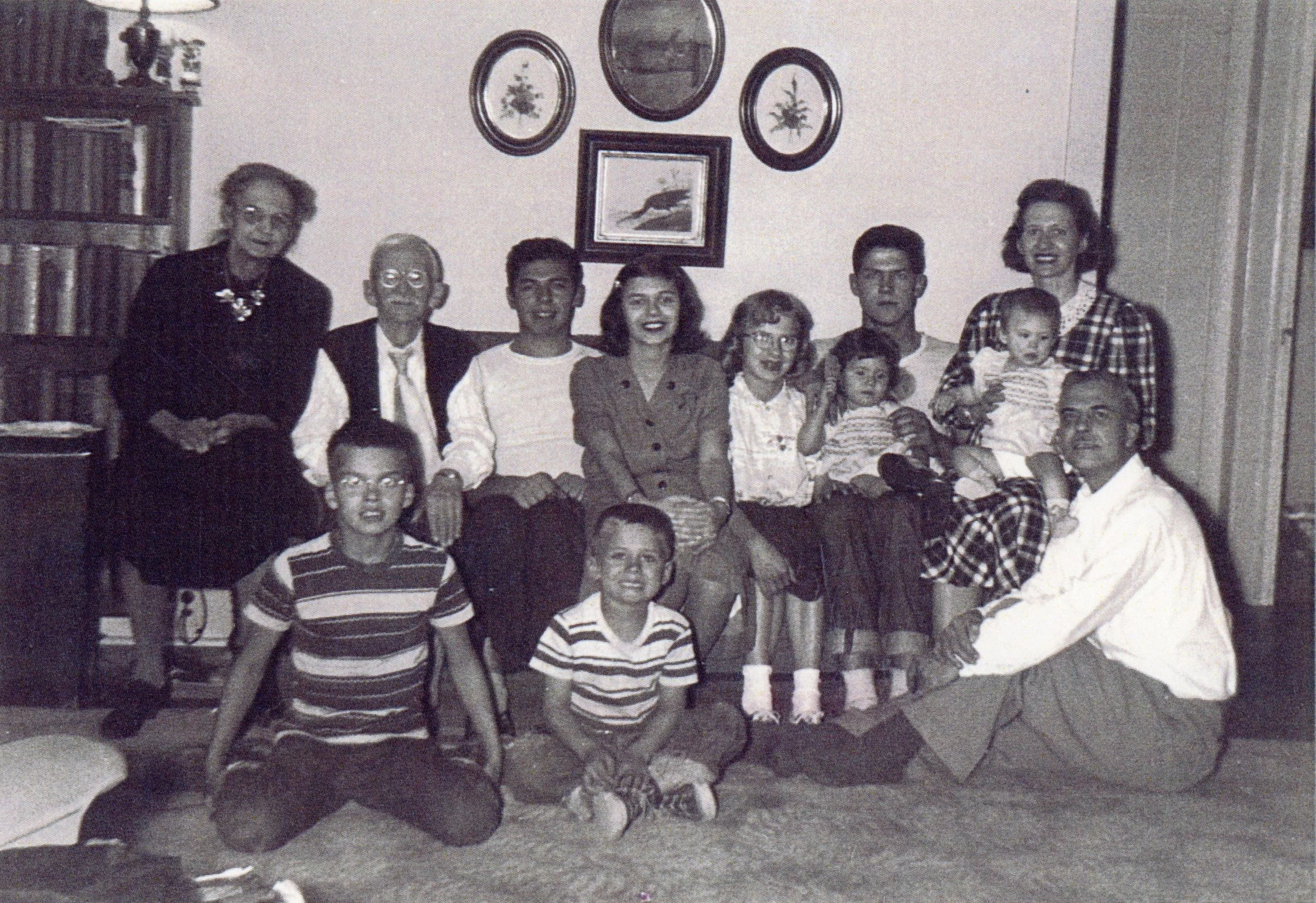
The Erickson family in the living room on Cypress Street, 1952. From the Milton H. Erickson Foundation Archives.
The home was across the street from the Heard Museum. “An Epic Life II,” recounts, “Mrs. Erickson was an early supporter of the museum, and the family often visited the museum, which is dedicated to Southwest indigenous culture…. The first dance studio in Arizona was two houses to the east of Erickson’s house. Ballet was taught every Saturday and a parade of girls could be seen walking to class that day.”
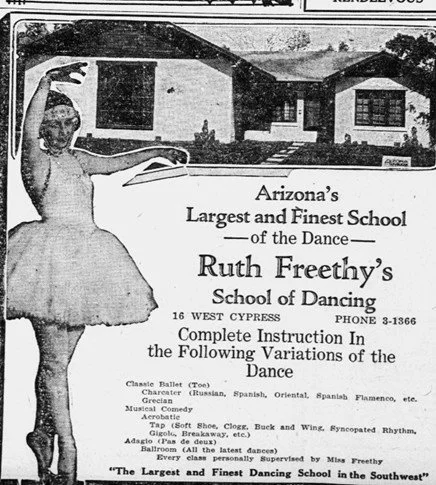
Ad for Ruth Freethy’s School of Dancing from The Arizona Republic.
Ruth Freethy claimed to be “the largest and Finest Dancing School in the Southwest” providing classic, musical comedy, tap, soft shoe, syncopated rhythm, and ballroom dance.
The Erickson home was later used by Toby House, a mental health agency providing residential and support services for emotionally disturbed individuals. An Arizona Republic article published on May 20, 1976, describes the agency as offering:
“mentally or emotionally disturbed individuals, whether a former state hospital patient or not, a haven where mental and emotional adjustments may be made, Phoenix psychiatrists say. In addition, it … provides in-house training in a variety of domestic fields. This enables Toby House residents to become self-supporting, a major factor in any mental rehabilitation program”
The property then became part of a larger commercial project and was paved as a parking lot.
Some of the items from Cypress and other items gifted to Dr. Erickson are on display at the Historic Residence on Hayward.
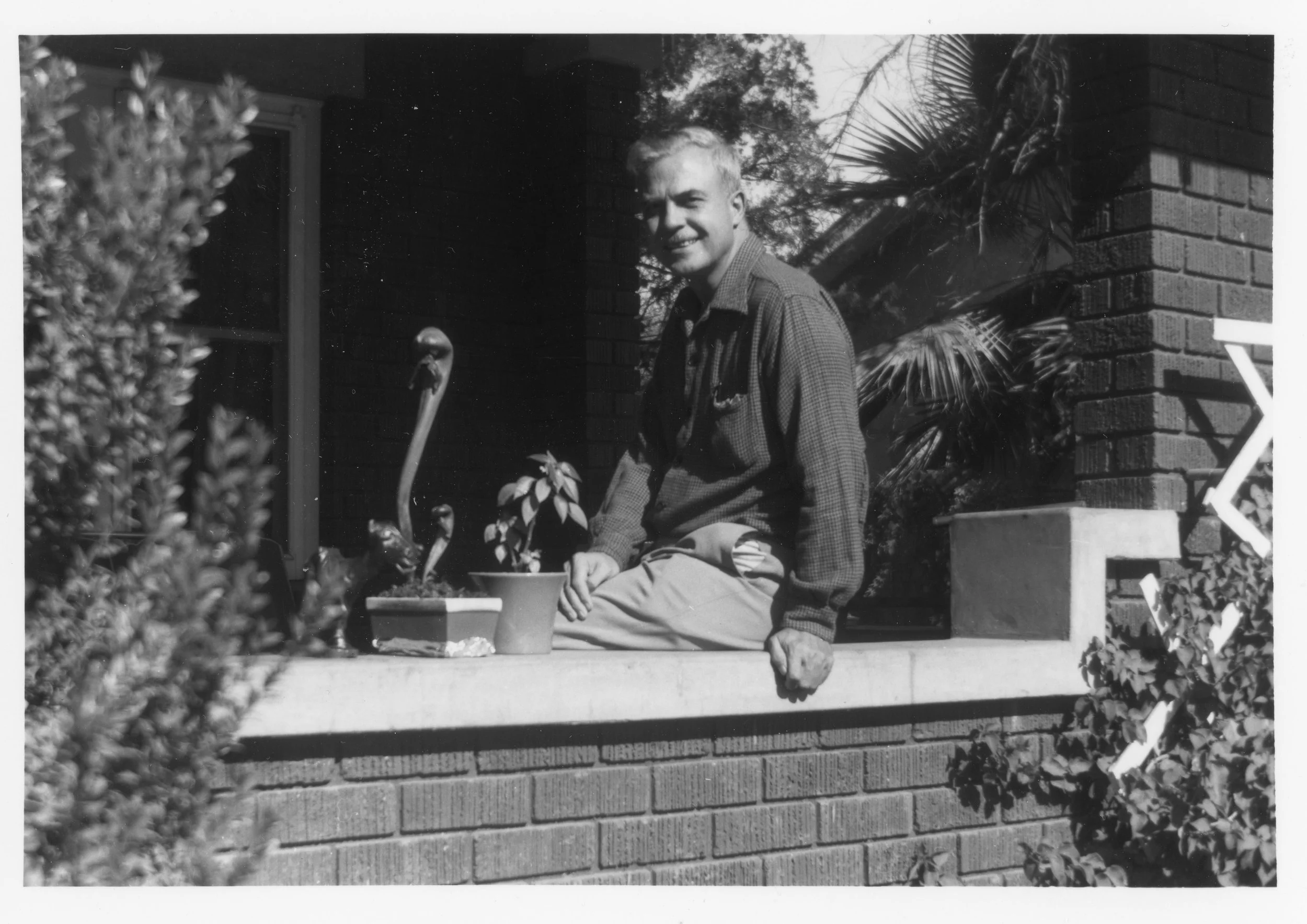
Milton H. Erickson on his porch at 32 West Cypress, undated. From the Milton H. Erickson Foundation Archives.
ERICKSON’S WORKS WHILE LIVING AT 32 WEST CYPRESS
“An Epic Life II,” outlines Erickson’s milestones including the following:
1949 Lectures at Phoenix College and Arizona State University
1950 Collaborates with Linn Cooper on “Time Distortion”
1953 Meets with Jay Haley
1954 Co-authors “Time Distortion” with Linn Cooper
1957 Founder and president of American Journal of Clinical Hypnosis
Serves as editor for ten years
1961 Senior author with Seymour Hershman and Irving Sector of
“Practical Application of Medical and Dental Hypnosis”
97 of Erickson’s 170 professional papers were written/published while he resided at 32 West Cypress from 1949 to 1970. The following articles are published in various volumes of the “Collected Papers of Milton H. Erickson” edited by Ernest Rossi, Ph.D.
1950 “A Therapeutic Double-bind utilizing the patient’s resistance”
1954 “Special techniques of brief hypnotherapy”
1954 “A clinical note on indirect hypnotic therapy”
1955 “Clinical and experimental observations on hypnotic amnesia”
1958 “Naturalistic techniques of hypnosis”
1961 “Historical note on the hand levitation and or ideomotor techniques”
1964 “The burden of responsibility in effective psychology”
1964 “The confusion technique in hypnosis”
1966 “Hypnotherapy: The patient’s right to both success and failure”
This is one of 15 articles published that year.
1967 “An introduction to the study and application of hypnosis for pain control”
In 1958 Erickson authored 5 articles and provided 43 seminars and trainings at medical professional conferences, colleges and on cruises. He delivered several keynotes at General Practitioner trainings throughout the United States.
During his years at Cypress, Erickson met with Margaret Mead, Jay Haley and Gregory Bateson. “Epic Life II” recounts, ‘When anthropologist and family friend Margaret Mead visited, one of the children would relinquish their bedroom and sleep in the living room.’
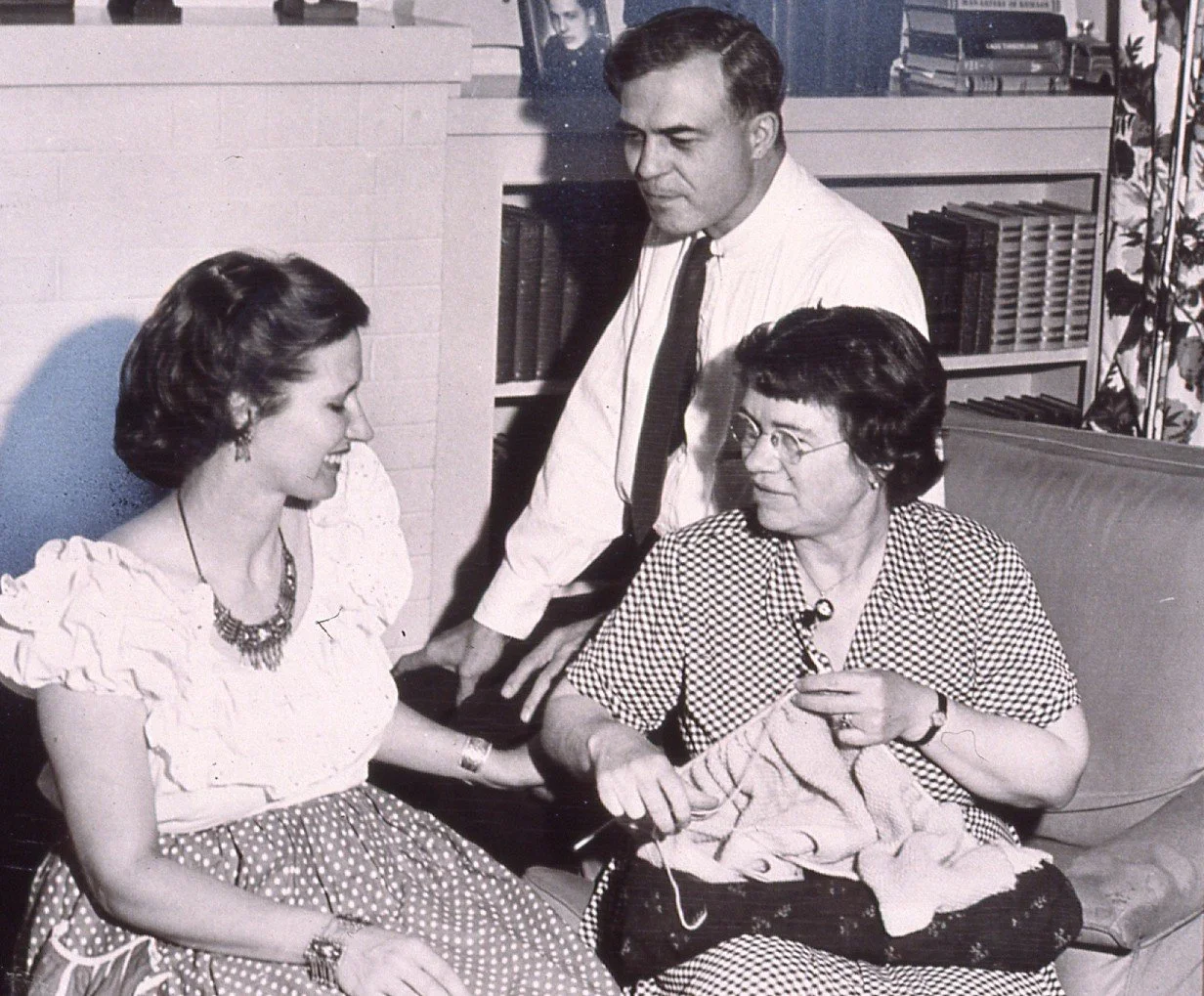
L to R: Elizabeth Erickson, Milton Erickson, Margaret Mead at 32 West Cypress Street, 1950. From the Milton H. Erickson Foundation Archives.
DRIVE-IN THERAPY: THE DRIVEWAY AS A THERAPEUTIC SETTING
Erickson had some unusual clients and would always meet them where they were at, even when they wanted to do therapy in Erickson’s driveway without Erickson being present. Sidney Rosen, Ph.D. in “My Voice Will Go with You” recounts an “auto-hypnosis” patient who came to see Erickson and told him that she was very neurotic and that she didn’t have the nerve to tell him about the problem. She said she would be having Erickson as her therapist and that the therapy would be conducted while she was alone in her car in his driveway and that:
“around eleven o’clock, I’ll drive over and park in your driveway and imagine you’re in the car with me. Then I’ll think about my problem…. She paid for two consultations. I don’t know how many times she spent the night, until around 4 a.m. in my driveway working on her problem. She worked out her problem and only paid me for two sessions….”
Sid Rosen states, “In this case we have a literal example of Erickson’s dictum, “it’s the patient who does the therapy. She obviously could not treat herself without a therapist.”
1201 EAST HAYWARD
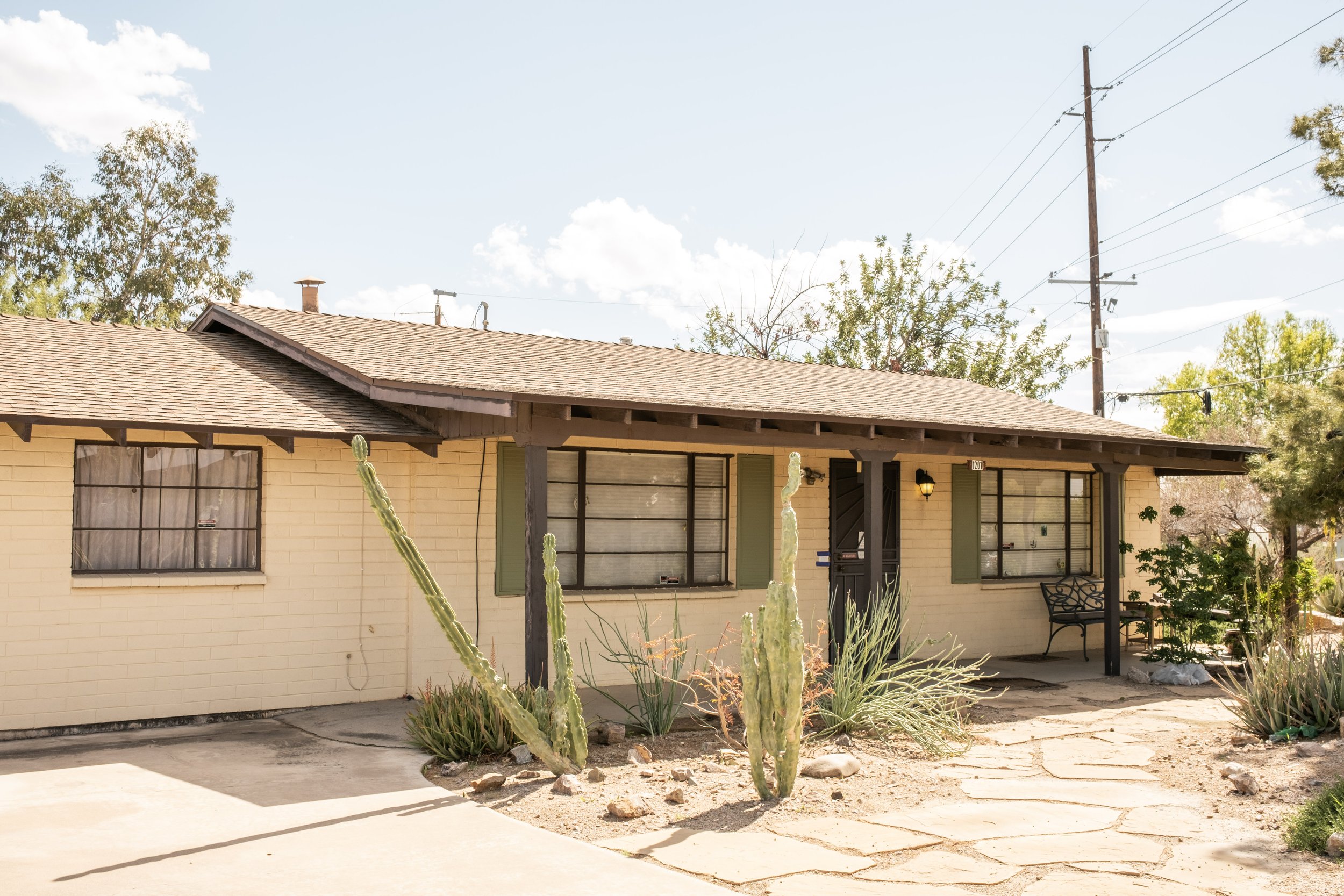
The Historic Residence at 1201 East Hayward, 2021. By Film is Dead Studio. From the Milton H. Erickson Foundation Archives.
In 1970, Erickson moved to 1201 East Hayward at the foot of Piestewa Peak, [at the time known as Squaw Peak.] The house was originally a two-bedroom home and the former architect-owner was in the process of adding a den. Ramps and a wheelchair-accessible bathroom were added to accommodate Erickson’s wheelchair.
There is a guest house that the former owner rented out. The guest house had a bedroom, a living/kitchen area and an office where Erickson saw patients. The waiting area included a dictionary. Teaching seminars were conducted at the guest house known as “The Little House.”
See pictures of the residence and the office building at:
https://www.erickson-foundation.org/historic-residence
ADDITIONAL RESOURCES ABOUT 1201 EAST HAYWARD
TOURS: take a tour of the Milton H. Erickson Historic Home and Office.
Schedule tour by calling 602-956-6196
Most tours are led by Erickson’s youngest son Robert
More photos of Hayward:
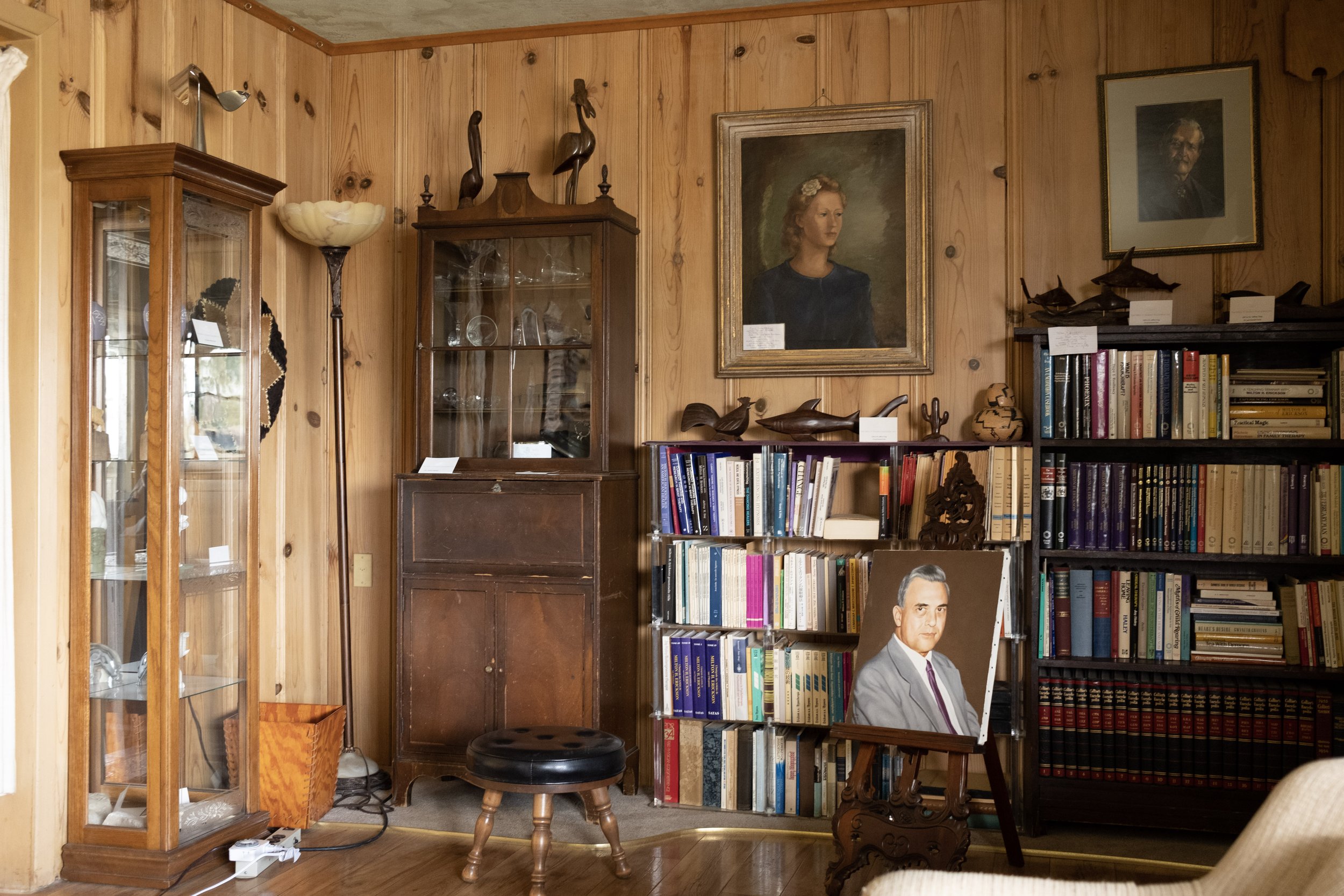
The Historic Residence at 1201 East Hayward, 2021. By Film is Dead Studio. From the Milton H. Erickson Foundation Archives.

The Historic Residence at 1201 East Hayward, 2021. By Film is Dead Studio. From the Milton H. Erickson Foundation Archives.
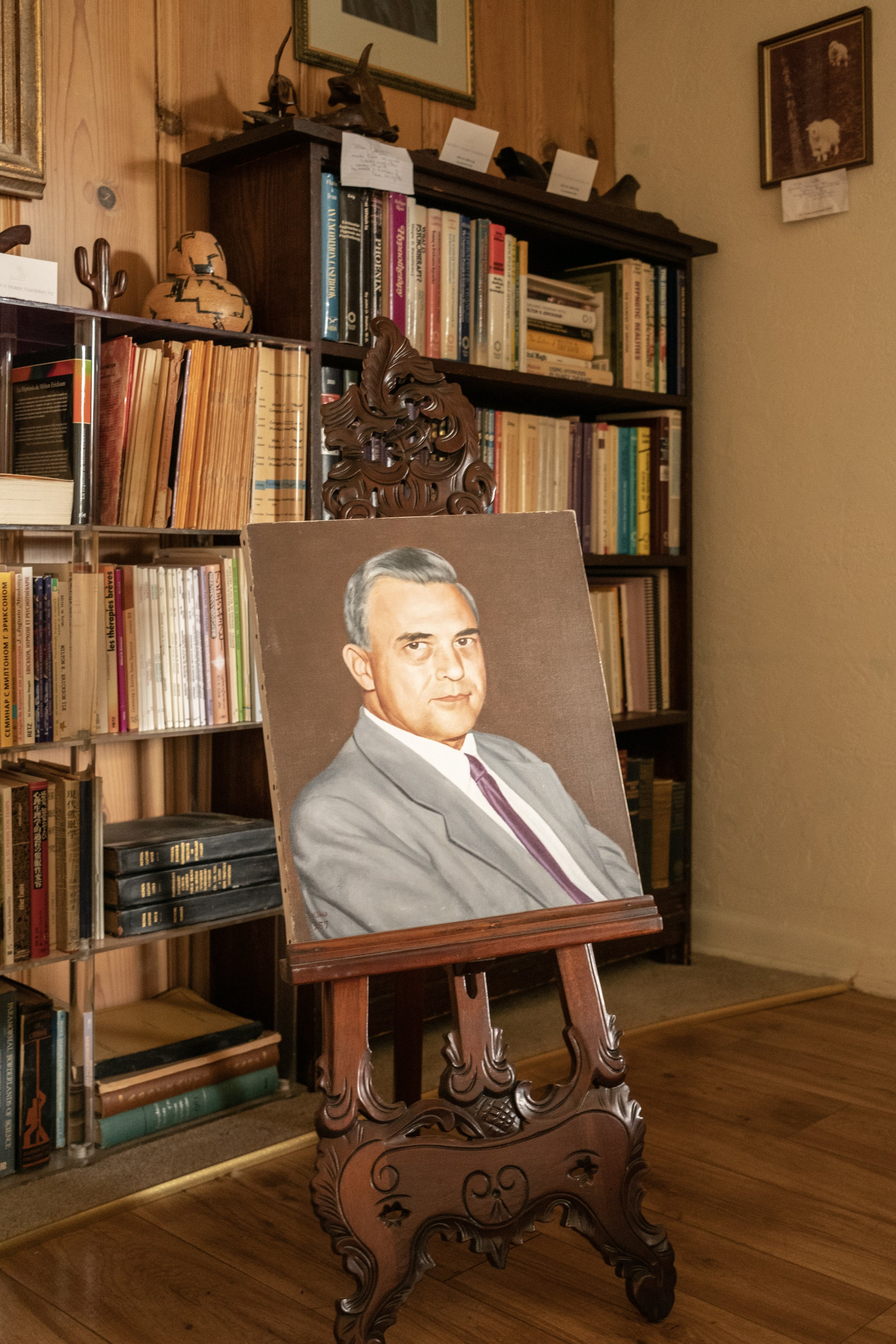
The Historic Residence at 1201 East Hayward, 2021. By Film is Dead Studio. From the Milton H. Erickson Foundation Archives.
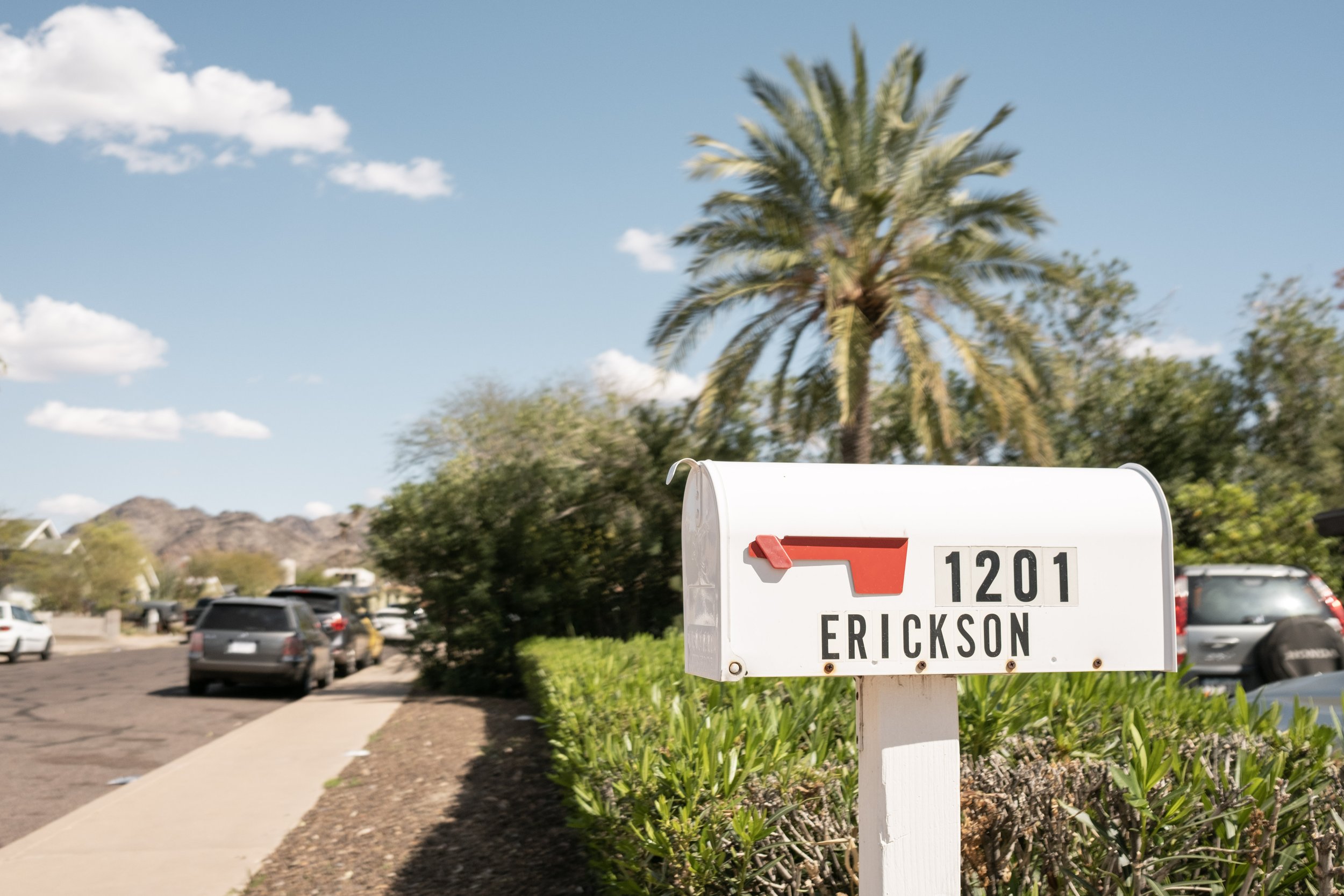
The Historic Residence at 1201 East Hayward, 2021. By Film is Dead Studio. From the Milton H. Erickson Foundation Archives.
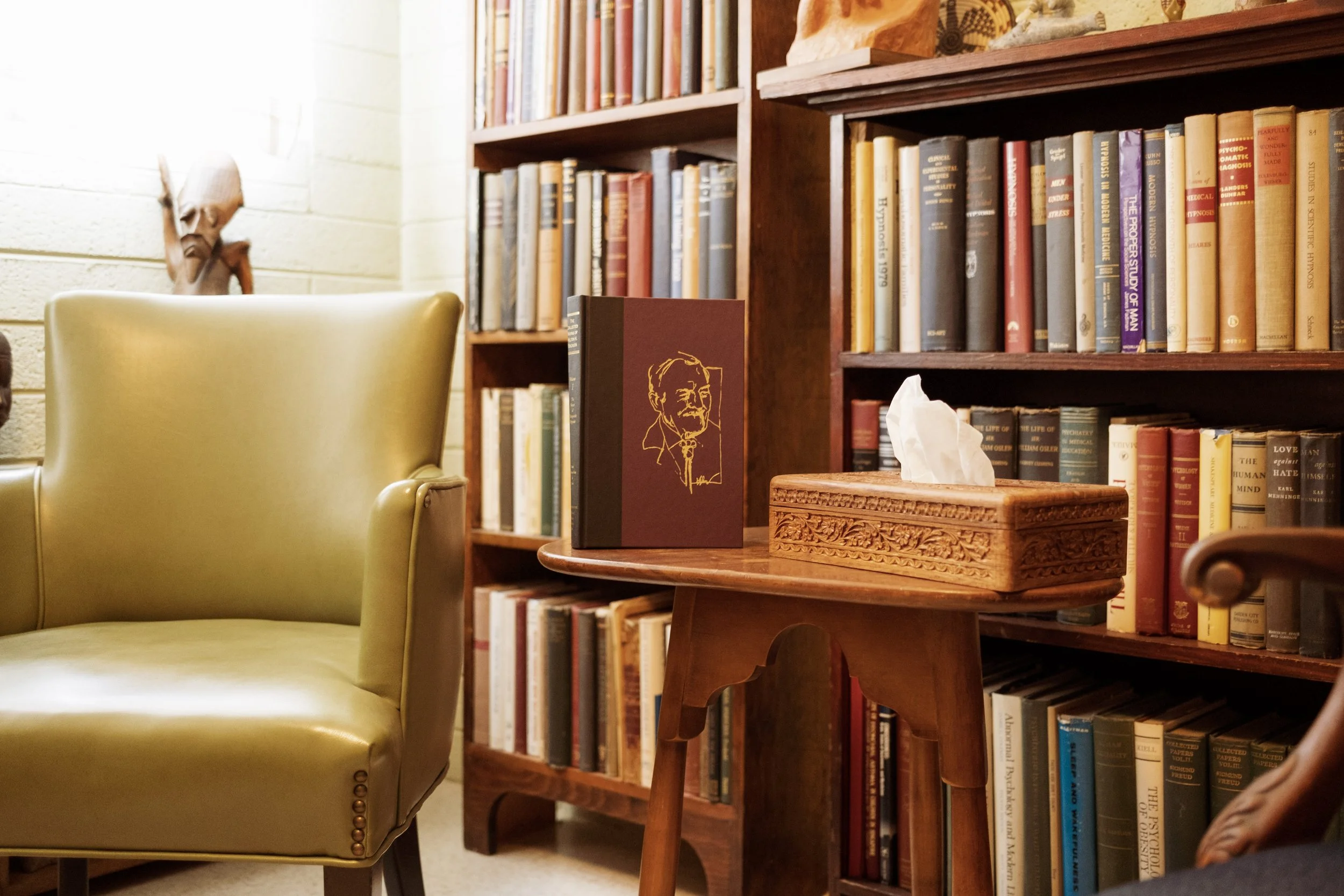
Milton H. Erickson’s office in “The Little House” at 1201 East Hayward, 2021. By Film is Dead Studio. From the Milton H. Erickson Foundation Archives.
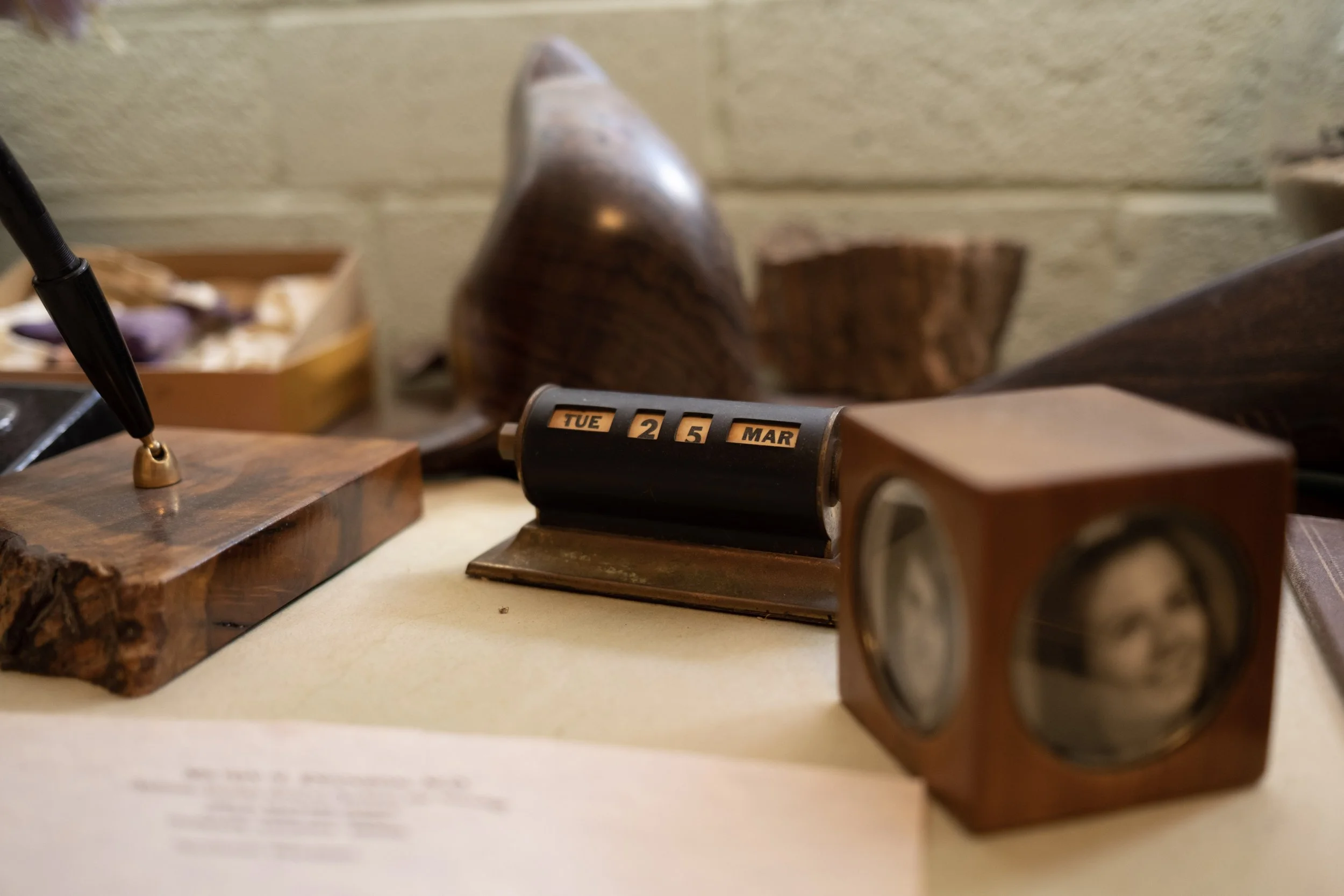
Milton H. Erickson’s desk in “The Little House” at 1201 East Hayward, 2021. By Film is Dead Studio. From the Milton H. Erickson Foundation Archives.
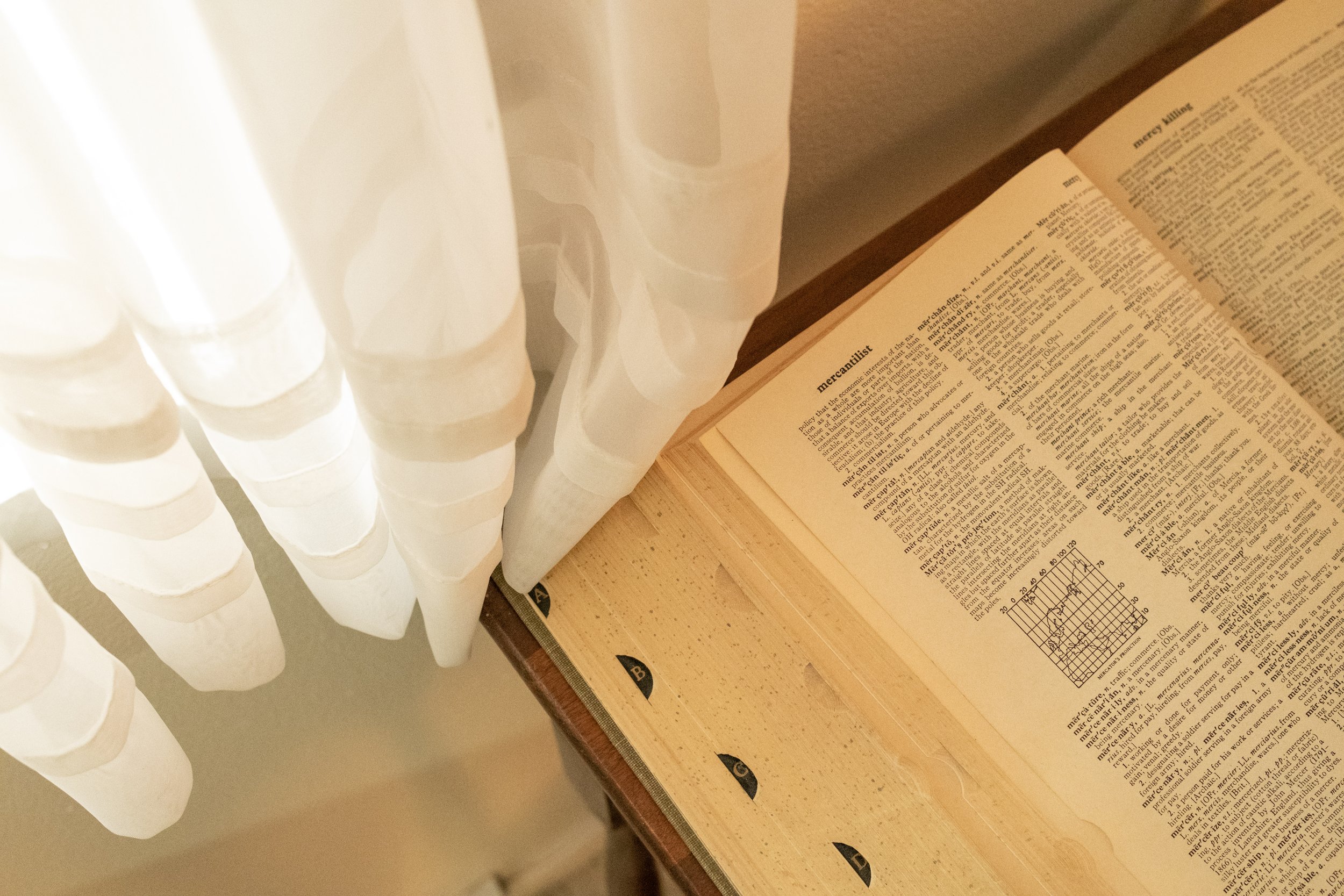
Dictionary by the door of “The Little House” at 1201 East Hayward, 2021. By Film is Dead Studio. From the Milton H. Erickson Foundation Archives.
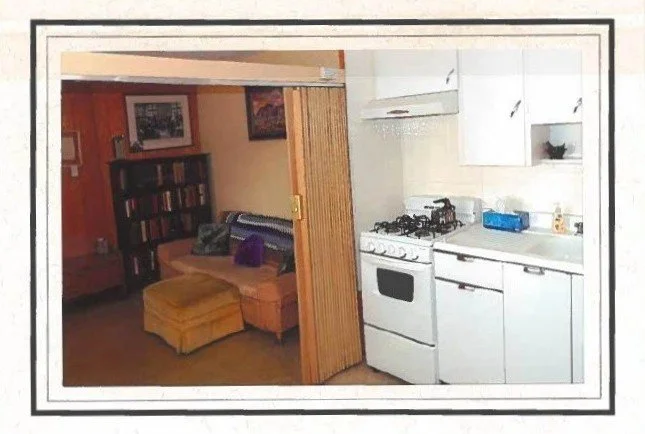
Promotional notecard. The Historic Residence at 1201 East Hayward, ND. From the Milton H. Erickson Foundation Archives.
joyce bavlinka, M.Ed., LIAC
joyce@erickson-foundation.org
Photos curated by Joyce Bavlinka and Sarah Clinebell, Foundation Archivist
You may also like …
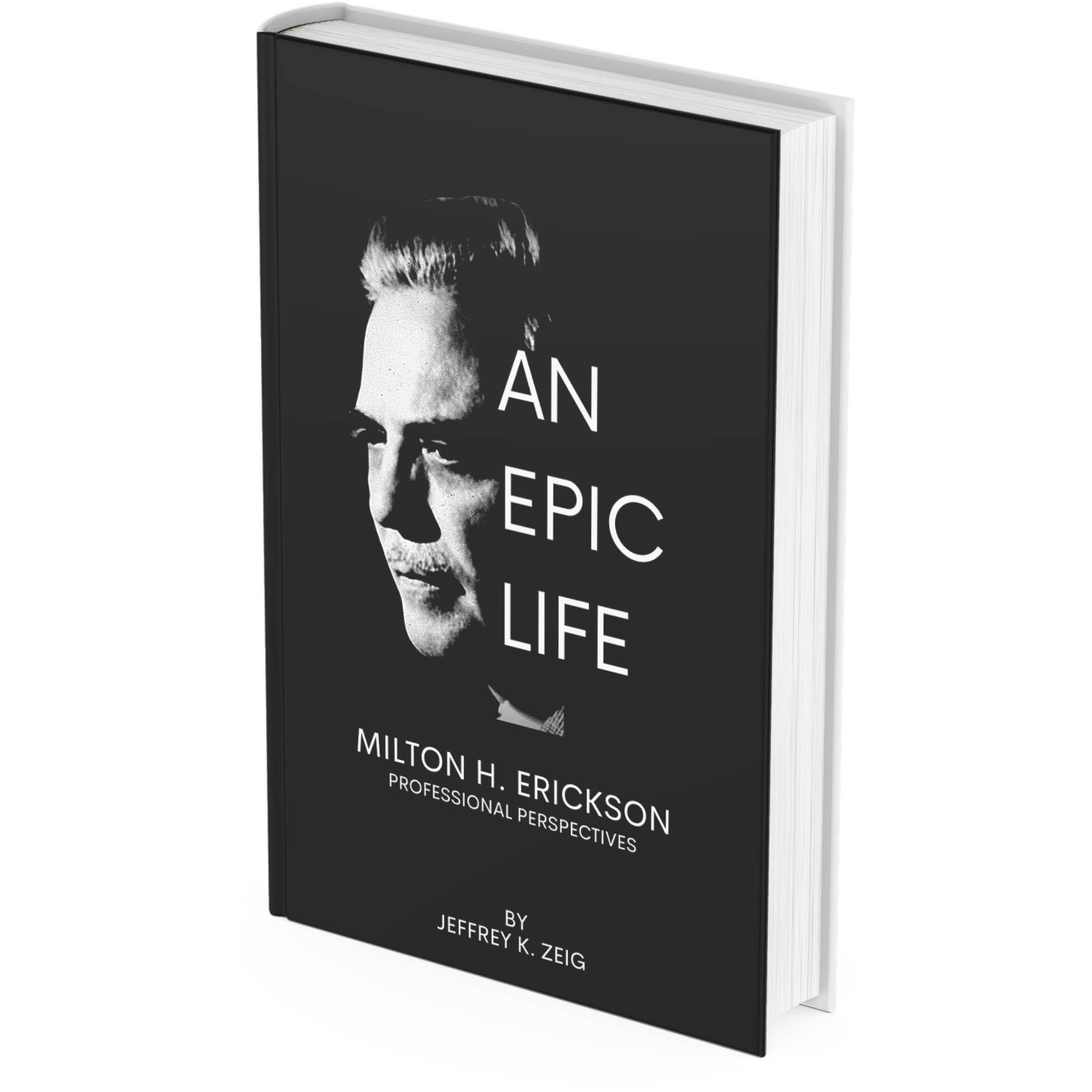
Professional Perspectives
by Jeffrey Zeig, PhD
An Epic Life is a biography written by many authors. Throughout his professional life, Milton H Erickson attracted a diversity of critics and supporters, and this book gives all a voice. Erickson was known to work with patients to elicit in them the innate ability to “connect the dots” to discover their adaptive potentials. Readers will delight in being able to connect the dots too, piecing together a portrait of an extraordinary and complex figure, as they look through the eyes of the men and women who met him at important junctures.
An Epic Life draws upon four decades of interviews with professionals who knew Erickson. The incisive perspectives are interlaced with commentary from Jeffrey Zeig to clarify and contextualize. The images of Erickson that emerge are congruent, divergent, myriad. In the end, readers gain unusual access to the man, his commitment, and his work. There is nothing simple in what is conveyed, and yet the impression it makes is coherent — and lasting.

by Roxanna Erickson Klein, RN, PhD, Ernest Rossi, PhD and Kathryn Rossi, PhD
This volume is a rare record of Milton H. Erickson's pioneering genius in facilitating the evolution of new patterns of consciousness and identity in a young woman. It is the only completely documented report of an entire hypnotherapeutic case from the middle phase of Erickson's career, when his innovative approaches were being developed. It brilliantly illustrates the actual words and methods used by Erickson that are currently transforming the meaning and essence of the entire field of psychotherapy. Therapists of all persuasions will appreciate the detailed commentaries offered by Erickson himself on the whys, ways, and means of his naturalistic and permissive approaches to healing. This intimate portrait will be treasured by all who seek to grow along with one of the most humane therapists of our time.

Personal Perspectives
by Jeffrey Zeig
An Epic Life Vol. II is the second biography on Milton H. Erickson written by Jeffrey Zeig. The first volume features professional perspectives on Erickson and this book offers a personal lens, as seen through Erickson’s family, friends, neighbors, students, secretaries, and patients. The reader gains access into the dynamic personal world of Milton Erickson, who was a one-of-a-kind communicator of unparalleled brilliance.
Erickson was known to work with patients to elicit in them the innate ability to “connect the dots” to discover their adaptive potentials. Readers will delight in also being able to connect the dots, piecing together the professional aspects of Erickson in the first volume with the personal ones in this volume. For Erickson, the line between his professional life and personal life was blurred. He was doctor, teacher, friend, and neighbor all at the same time. Readers will see how his therapy methods carried over into his personal life. Or was it perhaps the other way around?
An Epic Life II draws upon decades of interviews with those who knew Erickson on a more personal level. The incisive perspectives are interlaced with commentary from Zeig to clarify and contextualize. The images of Erickson that emerge are congruent, divergent, and myriad. In the end, readers will have a more complete picture of the man, his commitment, and his work. There is nothing simple in what is conveyed, and yet the impression it makes is coherent – and lasting.
Zeig prepares us for this stimulating journey by providing a comprehensive history of Erickson’s lineage, and background on the many contexts mentioned in the book.
Erickson was one of the greatest psychotherapists of the 20th century and the father of modern hypnosis and brief therapy. His professional contributions continue to influence the field and its practitioners and his personal life is inspirational.
As we strive to evolve personally and professionally, we should do as Erickson did: Leave the world a better place.

Although our complete set of Volumes 1 through 16 is no longer in stock, we are excited to offer a limited selection of the remaining volumes from this renowned series! Immerse yourself in a wealth of knowledge and insight, meticulously curated in each volume. This is a rare opportunity to add these valuable editions to your personal collection.
Included in this collection -
Collected Work Volume 3
Collected Work Volume 4
Collected Work Volume 5
Collected Work Volume 6
Collected Work Volume 7
Collected Work Volume 8
Collected Work Volume 9
Collected Work Volume 10
Collected Work Volume 11
Collected Work Volume 12
