

July Book of the Month
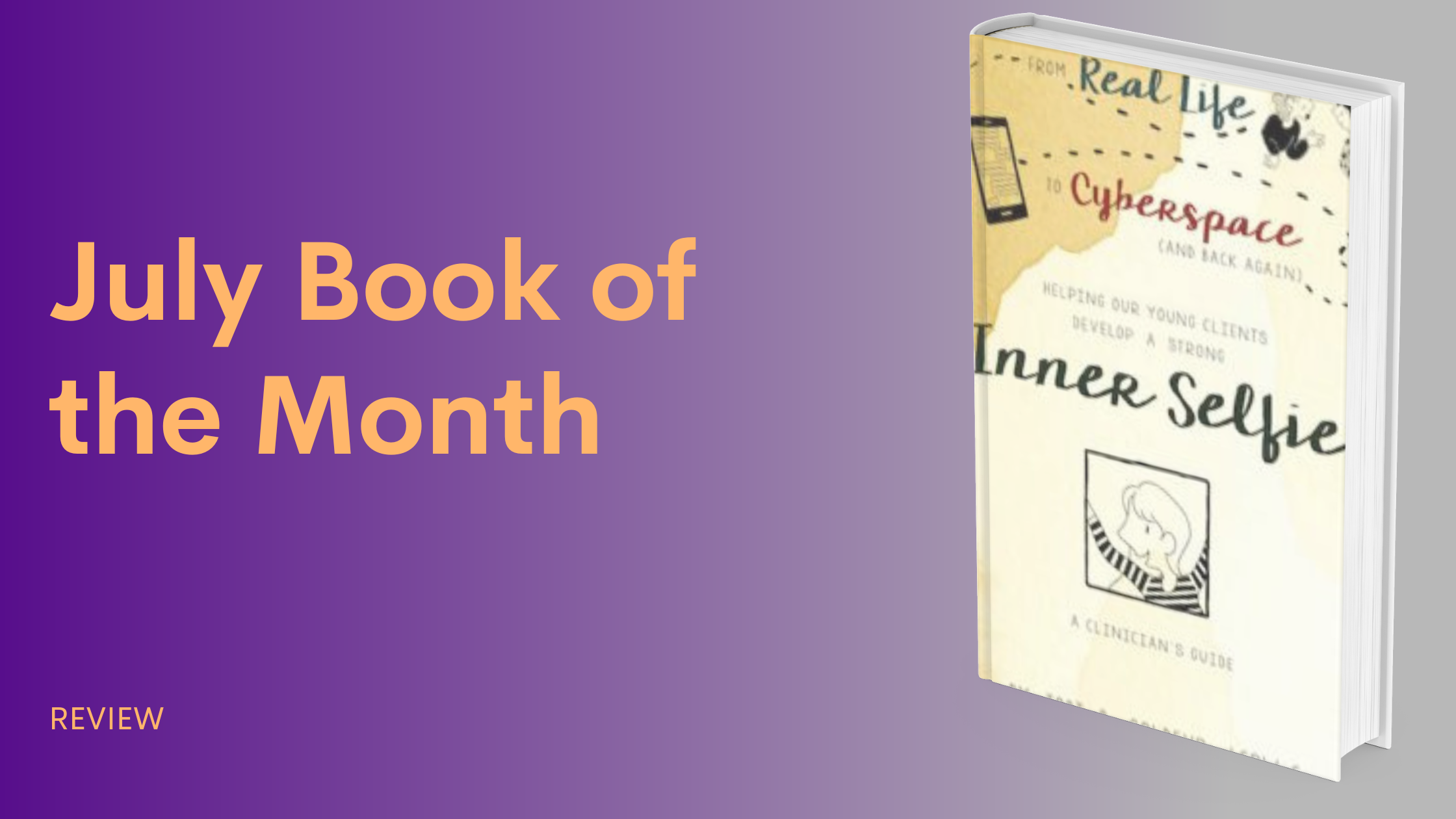
From Real Life to Cyberspace (and Back Again): Helping Our Young Clients Develop a Strong Inner Selfie
by Tobi Goldfus, MSW
Zeig, Tucker & Theisen Publishers (2016)
Book Review By: Taylor Watson
As our world becomes increasingly digital, psychotherapists are continually invited to expand not only the settings in which we work, but also the languages we use to understand healing and the human experience.
In From Real Life to Cyberspace, Tobi Goldfus, MSW, offers a timely and thoughtful exploration of this evolving landscape. Rather than viewing virtual identity and technology as separate from the therapeutic process, why not invite it in. Goldfus invites clinicians to recognize the digital self as another aspect of the whole person. The “Whole One” that is deserving of curiosity, compassion, and clinical understanding.
One of the most meaningful themes woven throughout the book is a conversation that continues to emerge across generations of therapists: the relationship between old language and new language. In many ways, what Goldfus highlights mirrors ongoing discussions within the Ericksonian community regarding theory and terminology. Whether one speaks of ego states, parts work, or Internal Family Systems, the underlying principles often remain remarkably similar. The names may change, but the clinical intentions remain the same: helping clients access greater health, integration, and well-being.
For clinicians who may be newer to the field or unfamiliar with Ericksonian psychotherapy, therapy is less about rigid adherence to a particular model and more about understanding how people organize their experiences and helping them access their own resources for change. Ericksonian work emphasizes flexibility, collaboration, and tailoring interventions to the individual. Rather than imposing a single framework, it seeks to speak the client's language and utilize whatever strengths, metaphors, identities, experiences or virtual realities are meaningful to them. In that sense, many contemporary approaches share common roots and goals even when they use different terminology.
As students of Erickson we recognize that flexibility and utilization have always been central to effective therapy. Milton H. Erickson met clients where they were, speaking their language rather than insisting they adopt his. Goldfus extends this principle beautifully into the modern era. She demonstrates that understanding the language of contemporary culture–social media identities, avatars, online communities, and digital relationships–is not abandoning traditional wisdom, but rather applying timeless therapeutic principles in a new context.
This bridge between generations of thought is perhaps one of the book’s greatest strengths. Too often, clinicians become divided by terminology, debating which model is “correct” when, in reality, many approaches share common foundations. Goldfus reminds us that understanding one another’s language–whether that of classical theorist, modern practitioners, or even the internal language clients use to describe themselves–is essential for meaningful therapeutic connection. The book gently encourages readers to move beyond labels and towards deep understanding.
Healing has always involved honoring the entirety of the person–the conscious and unconscious mind, the stories people tell themselves, their relationships, values, and environments. Goldfus expands this vision by acknowledging that for many individuals today, one part of that whole person exists online. Our digital and social selves are not separate from who we are; they are extensions of our identities, our relationships, and the ways in which we seek meaning and belonging.
What makes From Real Life to Cyberspace especially valuable is that it does not position technology as either the villain or the savior, the firefighter or the manager, the parent or the child. Instead, Goldfus approaches the subject with curiosity and balance. She combines wisdom with present-day vocabulary, creating a framework that feels both familiar and refreshingly relevant. Readers may find themselves reflecting not only on their clients’ experiences, but also on the changing ways we communicate, connect, and understand ourselves.
From Real Life to Cyberspace serves as a reminder that while the world around us continues to evolve, the heart of psychotherapy remains unchanged. Regardless of the language we choose or the medium through which we connect, healing still begins with understanding, relationship, and the willingness to meet people exactly where they are–even when one of those places happens to be virtual.
For readers eager to explore this journey in even greater depth, Tobi Goldfuls' From Real Life to Cyberspace offers a compelling companion worth picking up. Copies can be purchased through the Milton H. Erickson Foundation website here: https://www.erickson-foundation.org/books/p/from-real-life-to-cyberspace
Taylor Watson, Licensed Professional Counselor Associate, is Supervised by Malton Cook LPC-S and wrote this article under the support and supervision of Roxanna Erickson-Klein Phd. LPC.
You may also like …

Helping Our Young Clients Develop a Strong Inner Selfie
by Tobi Goldfus
Type: Softcover
“Tobi Goldfus tackles a challenging topic — how to reach young people who have embraced the digital age and help them develop a strong inner “selfie.” She begins with an excellent assessment tool (the Social Media Assessment Form) to evaluate the impact of the digital world on an individual client. The major pathway of this book involves using this information to help her young clients develop a strong, resourceful, core self. She offers highly effective tools to achieve this goal, including practice of the relaxation response, identifying resources available in real life as well as in cyberspace, and introducing brief trances called “trancettes” to help access down-regulated states. Of particular interest are Goldfus’ “7 stages of smartphone attachment” and her strategies to improve self-regulation and sharpen an observer self. There is a well-crafted chapter on using hypnosis as the lens for work with “parts” or ego states to achieve “cyberpresence,” and throughout her book, she is masterful at utilizing and including agendas and practices of young digitized clients, while deftly dealing with ethical issues. I strongly recommend From Real Life to Cyberspace (and Back Again): Helping Our Young Clients Develop a Strong Inner Selfie to practitioners who are mystified and even resentful of youthful preoccupation with the digital world. This is a valuable resource to bring the increasingly important connection of young people and cyberspace into therapy as a catalyst for change.”
— Maggie Phillips, Ph.D., Healing the Divided Self (with Claire Frederick) and
Finding the Energy to Heal, Reversing Chronic Pain, and Freedom from Pain (with Peter Levine)
“Tobi Goldfus, LCSW-C, has bravely taken on one of the toughest challenges therapists treating young people can face: restoring common sense and a sense of humanism to those who are spending (too) much of their lives living in an untamed cyberspace. Goldfus rises to the challenge by providing insight and supportive practical advice that every therapist trying to re-direct their young clients’ attention away from a screen temporarily will appreciate. Put down your smartphone for a while and read this book!”
— Michael D. Yapko, Ph.D., clinical psychologist and author of The Discriminating Therapist and Depression is Contagious.
“With the same empathy and encouragement that she offers adolescents and young adults in her practice, Tobi Goldfus helps therapists to value and utilize the ever-influential cyberworld of our younger clients. This book is rich with concrete ideas that help us combine all we know about connection, boundaries, intimacy, and development with the complexities and benefits of the digital world. If you want to better understand how to use experiential and hypnotic approaches to teach young adults the need for balance and authenticity, then this is the book to read.”
— Lynn Lyons, LICSW, author of Anxious Kids, Anxious Parents and Using Hypnosis with Children: Creating and Delivering Effective Interventions.
“I saw Tobi Goldfus teaching about the world of kids and adolescents a few years ago and immediately invited her to present at two major congresses in Germany. Now her excellent book upgrades the knowledge of therapists toward a better understanding of the (cyber)world that adolescents are living in. Tobi Goldfus’ idea of developing the “inner selfie” of her young clients is a stroke of genius. Therapists from all backgrounds will enjoy and benefit from this perspective.”
— Bernhard Trenkle, Dipl.Psych., President-Elect International Society of Hypnosis ISH.
“The book and accompanying Social Media Assessment tool teaches the clinicians how to join young clients in assessing where they are on a continuum from healthy use of social media to more compulsive, addictive online behaviors. The therapeutic approach outlined in the book is both multidimensional and flexible in order to help bring clients into the space of being present IRL, building internal awareness, and guiding them in self-regulation skills and relationship building with others and themselves. The goal: integrating their digital and real-world selves by finding and making friends with their Inner Selfie.”
— Linda Thomson, Ph.D., APRN, Past President of ASCH, NESCH, NMSCH, author of Harry Hypnopotamus Tales and creator of Stress Free Surgery.
About the Author: In addition to her active private practice, Tobi B. Goldfus presents nationally and internationally on the impact of cyberspace on young people and finding a healthy balance between online life and real life. She has served on numerous faculties, including: the Society of Clinical and Experimental Hypnosis the American Association of Clinical Hypnosis, the European Hypnosis Society, the International Hypnosis Society, the Milton H. Erickson Foundation of South Africa, the Brief Therapy Conference(s), the Ericksonian International Congress(es), and the Center for the Advancement and Training of Clinical Hypnosis. She has served as a guest lecturer at the University of Johannesburg Department of Psychology, Johannesburg, South Africa.

Helping Our Young Clients Develop a Strong Inner Selfie
by Tobi B. Goldfus, LCSW-C
Type: eBook
Format: .epub
“Tobi Goldfus tackles a challenging topic — how to reach young people who have embraced the digital age and help them develop a strong inner “selfie.” She begins with an excellent assessment tool (the Social Media Assessment Form) to evaluate the impact of the digital world on an individual client. The major pathway of this book involves using this information to help her young clients develop a strong, resourceful, core self. She offers highly effective tools to achieve this goal, including practice of the relaxation response, identifying resources available in real life as well as in cyberspace, and introducing brief trances called “trancettes” to help access down-regulated states. Of particular interest are Goldfus’ “7 stages of smartphone attachment” and her strategies to improve self-regulation and sharpen an observer self. There is a well-crafted chapter on using hypnosis as the lens for work with “parts” or ego states to achieve “cyberpresence,” and throughout her book, she is masterful at utilizing and including agendas and practices of young digitized clients, while deftly dealing with ethical issues. I strongly recommend From Real Life to Cyberspace (and Back Again): Helping Our Young Clients Develop a Strong Inner Selfie to practitioners who are mystified and even resentful of youthful preoccupation with the digital world. This is a valuable resource to bring the increasingly important connection of young people and cyberspace into therapy as a catalyst for change.”
— Maggie Phillips, Ph.D., Healing the Divided Self (with Claire Frederick) and
Finding the Energy to Heal, Reversing Chronic Pain, and Freedom from Pain (with Peter Levine)
“Tobi Goldfus, LCSW-C, has bravely taken on one of the toughest challenges therapists treating young people can face: restoring common sense and a sense of humanism to those who are spending (too) much of their lives living in an untamed cyberspace. Goldfus rises to the challenge by providing insight and supportive practical advice that every therapist trying to re-direct their young clients’ attention away from a screen temporarily will appreciate. Put down your smartphone for a while and read this book!”
— Michael D. Yapko, Ph.D., clinical psychologist and author of The Discriminating Therapist and Depression is Contagious.
“With the same empathy and encouragement that she offers adolescents and young adults in her practice, Tobi Goldfus helps therapists to value and utilize the ever-influential cyberworld of our younger clients. This book is rich with concrete ideas that help us combine all we know about connection, boundaries, intimacy, and development with the complexities and benefits of the digital world. If you want to better understand how to use experiential and hypnotic approaches to teach young adults the need for balance and authenticity, then this is the book to read.”
— Lynn Lyons, LICSW, author of Anxious Kids, Anxious Parents and Using Hypnosis with Children: Creating and Delivering Effective Interventions.
“I saw Tobi Goldfus teaching about the world of kids and adolescents a few years ago and immediately invited her to present at two major congresses in Germany. Now her excellent book upgrades the knowledge of therapists toward a better understanding of the (cyber)world that adolescents are living in. Tobi Goldfus’ idea of developing the “inner selfie” of her young clients is a stroke of genius. Therapists from all backgrounds will enjoy and benefit from this perspective.”
— Bernhard Trenkle, Dipl.Psych., President-Elect International Society of Hypnosis ISH.
“The book and accompanying Social Media Assessment tool teaches the clinicians how to join young clients in assessing where they are on a continuum from healthy use of social media to more compulsive, addictive online behaviors. The therapeutic approach outlined in the book is both multidimensional and flexible in order to help bring clients into the space of being present IRL, building internal awareness, and guiding them in self-regulation skills and relationship building with others and themselves. The goal: integrating their digital and real-world selves by finding and making friends with their Inner Selfie.”
— Linda Thomson, Ph.D., APRN, Past President of ASCH, NESCH, NMSCH, author of Harry Hypnopotamus Tales and creator of Stress Free Surgery.
About the Author: In addition to her active private practice, Tobi B. Goldfus presents nationally and internationally on the impact of cyberspace on young people and finding a healthy balance between online life and real life. She has served on numerous faculties, including: the Society of Clinical and Experimental Hypnosis the American Association of Clinical Hypnosis, the European Hypnosis Society, the International Hypnosis Society, the Milton H. Erickson Foundation of South Africa, the Brief Therapy Conference(s), the Ericksonian International Congress(es), and the Center for the Advancement and Training of Clinical Hypnosis. She has served as a guest lecturer at the University of Johannesburg Department of Psychology, Johannesburg, South Africa.

by Frances E. Steinberg and Richard E. Whiteside
Type: Softcover
Do you feel burnt out? Have you lost some of your enthusiasm for work? Are you becoming increasingly frustrated with clients, co-workers, yourself? Are you interested in being extraordinary instead of ordinary? Do you want to increase inspiration and decrease perspiration? If the answer to any of the above is YES, Becoming Dragon will help you back on your path and have you dancing into work.
In this fascinating new book, you will learn how to infuse your work with skill, aesthetics, wisdom, humor, intent, passion, discipline, and focus. Using classic role-playing persona, the authors help you follow the paths of The Artisan, The Sage, The Fool, The Healer, and The Warrior – and turn your job into a vocation, and reignite your career.
Frances E. Steinberg, Ph.D., psychologist, acupuncturist, martial artist, received her doctorate from The Johns Hopkins University in 1975. She was appointed Assistant Professor at the University of New Mexico where she received the Outstanding Teacher of the Year award. Frances has worked in a variety of settings including special schools for emotionally disturbed students, private practice, and rape crisis centres. Frances currently serves on the advisory board of Fetal Alcohol New Zealand and delivers keynote addresses and training workshops on a variety of topics for mental health professionals, educators, and social workers across New Zealand and internationally. She produced the AD/HD video, Getting it Right and is the author of the novel, The Pocket Messiah and the accompanying storybook, Tales from The Pocket Messiah. In addition to her training as a psychologist, Frances has a degree in Traditional Chinese Medicine and has been head teacher for a number of martial arts schools.
Richard G. Whiteside received his Masters in Social Work from Atlanta University in the United States in 1977, followed by post-graduate training at the Family Therapy Institute with Jay Haley and Cloe Madanes. After moving to New Zealand in 1994, Rick developed the Family Therapy Team at Waitemata DHB where he was the first non-psychiatrist appointed as Service Clinical Director for Child, Youth, and Family Mental Health. Rick is currently a board member of ANZJFT, an Approved Supervisor for AAMFT, and served on the Practitioner’s Reference Group of the NZ Mental Health Commission. Rick is the author of The Art of Using and Losing Control: Adjusting the Therapeutic Stance and with Frances Steinberg has written Whispers from the East, When Your Lover Leaves You, Working with Difficult Clients, Creating Partnerships, Positive Positioning, and Becoming Dragon.

The Art & Practice of Relationship
by Magali Peysha
Type: Softcover
With the right map, it only takes one person to change a relationship for the better. Your love life can be transformed in as little as ten minutes a day by adding new powerful patterns. This simple, direct approach will activate the lover inside you. Discover how much happier you can be.
An innovative new voice in the field of relationship coached. Learn and grow with these creative relationship strategies.
— Tony Robbins
Seriously, Magali is a genius coach! My heart just melts and heals everytime I hear her teach coaching strategies.
— Susana
I saw the beauty and the love that Magali is shining from the heart. She sees through the soul. Years of therapy couldn’t do that. And I felt my inner child
be happy finally.
— Tara
Magali is one of the calmest, kindest and most powerful expressions of female energy I have ever felt. She approaches issues with a sense of patient purpose to bring out the best in people. By using the language of the heart, she surpasses all imposed beliefs and brings out the true gentle power lying dormant in each of us.
— Ivan
These really simple techniques move so much forward! They have helped me, my relationship with my husband, my children, and my coaching.
MAGALI PEYSHA
— Anne Marie
Magali has helped thousands of people find and build the romantic relationship they want. She is the bestselling author of the Strategic Intervention Handbook, founder of The Relationship Coaching Academy, and has trained over 10,000 Life Coaches. Dedicated to empowering others, she specializes in a creative, heart-centered method. She has been married to her college sweetheart Mark Peysha for twenty-five years, and they have five wonderful children together.
