

When Milton Erickson asked ME for Help!

By Sandy Sylvester, Ph.D.
Estimated Reading Time: 4 minutes, 53 seconds
Since I was a doctoral student at the University of Arizona in Tucson, I have been interested in clinical hypnosis and the power of the mind. I studied hypnosis independently with a professor who recommended that I attend the American Society of Clinical Hypnosis seminar held in Phoenix. At the seminar, I met Kay Thompson, Bob Pearson, Marion Moore, and Joe Barber. At lunch, Thompson and Pearson were discussing their demonstration of deep trance phenomena and demonstration hypnoanesthesia which they were teaching that afternoon. I asked whether or not I could volunteer for the demonstration, but Kay Thompson firmly replied ¨No!” explaining that “Dr. Erickson will be there and we want to make sure that all will go well, so we will have a member of the faculty help us.”
Kay and Bob conducted the most bizarre demonstration I had ever seen. They sat on an empty stage, looked at an imaginary TV, and commented as they “watched.” In their conversation, the audience (we) disappeared. As I watched, I became very confused and questioned the distinctions between “deep trance” and “delusional psychosis.” As I puzzled about this, the demo concluded and Bob walked off the stage. This further confused me because he was to be part of the next demonstration.
As the topic of hypnoanesthesia was announced Kay invited Joe Barber to volunteer. Joe was known for his expertise in pain management, but he declined the offer.
“That’s OK,” Kay responded, “because we have another volunteer who doesn’t know she is a volunteer.” The next thing I knew, I was walking up to the stage.
Kay thanked me and asked if I knew that I was already in a trance. The demonstration included my insertion of a 20 gage, 1-1/2 inch needle into my hand. The experience was painless even though I could experience the entire length of the needle.
I could even control whether or not to bleed.
On completion of this amazing demonstration, I headed toward my seat in the audience. Milton Erickson inquired just as I bent to sit down. “Sandy, are you aware of how still you were on stage?” Standing up again, I reflected on this question. I was animated in my outward behavior on stage but there was definitely a quality of stillness within, so I replied, “Yes, Dr. Erickson.” Again I said, “Isn’t ‘doubt’ wonderful?” I stood up thought about how I thought I ‘knew’ I should bleed from the puncture, but wondered if it could be possible not to. I challenged myself by saying “I choose not to bleed” but didn’t think that that could actually happen. I merely replied, “Yes, Dr. Erickson.”
Then Dr. Erickson said, “Sandy, don’t you want to sit down?” I replied, “Yes, I did want to sit down.” I began to sit down when Dr. Erickson said something else to me, and I began to stand up again. I couldn’t actually hear what he was saying because by then the other participants had begun to laugh. Then Dr. Erickson asked ¨Have you ever watched a dog lie down?” Replying affirmatively, he asked me, “How does a dog lie down?” I described that a dog finds a place to lie down and then turns in a circle and then lies down.
Erickson replied, “That’s right. Why don’t you try that?” I turned around in a circle and sat down, by now I was so relieved that I said, “Oh, thank you, Dr. Erickson!” Then Mrs. Erickson spoke up: “What are you thanking him for?” The entire room broke out in loud laughter.
The following day I was invited to Dr. Erickson’s house. We spent the afternoon together in his living room, he in a stuffed chair in front of the TV, and I in his wheelchair. We talked about a lot of things. In the afternoon, one of Dr. Erickson’s patients came with a pot of hot soup that she had prepared that day. I remember thinking how unusual and nice it was for a patient to drop by, visit, and give him soup. That evening I left to drive home to Tucson. Dr. Erickson said we would be in contact.
A couple of weeks went by, and I received a call from Dr. Erickson, wanting to know if I could come to Phoenix. He said the two hours and 15 minutes it would take me to drive wasn’t good enough; he arranged for a ticket to be waiting at the airport.
Inside Erickson’s office was a young girl with Crohn´s disease. Erickson explained to me that the girl had been through a great deal of trauma in the diagnosis and treatment of her disease and that she had developed a fear of male physicians. By having me teach the girl’s mother self- hypnosis, the mother could in turn help her daughter to deal with the chronic pain of the disease.
I stayed in Phoenix for almost two weeks — sleeping in Erickson’s daughter’s bedroom and wearing a loaned nightgown. Marion Moore was videotaping Dr. Erickson’s teachings and I was fortunate to join in. These were special times. It took more than 20 years for me to figure out that Dr. Erickson didn’t really need my help. He often had worked with difficult and resistant patients. He was more than capable of helping this young patient without my help. As I reflect back on “why” he flew me to Phoenix to “help” him, I see my own resistance. He knew I would never have come to Phoenix on my own. He also knew that I would never refuse to be of help if I were asked.
What I gained from studying with Dr. Erickson continues to surprise me. I contained a depth that continues to bring me new understanding and appreciation for his unique talents.
This excerpt has been extracted from Volume 26, Issue No. 2 of The Milton H. Erickson Foundation Newsletter.
You may like…

by Brent B. Geary and Jeffrey K. Zeig
Type: Softcover
"The fascinating thing about Milton Erickson’s work is that his originality is not contained in any attempt to differ from others, but simply is a matter of his own pursuit of the new, within his own work.
— Margaret Mead
In these letters there are aspects of Erickson’s life that have never before been revealed publicly. Herein, we are privy to Erickson, the man, in a way that provides new insights into his awesome power as a clinician, a researcher, a theorist, and an individual.
As a reader, you will meet the luminaries with whom Erickson interacted, both in the field of psychiatry and in related disciplines. Sit in on Erickson as he consults on cases with renowned psychoanalysts, exchanges views with Gregory Bateson and Margaret Mead, and discusses research issues with Stanley Milgram. Read firsthand Erickson’s advice to patients, colleagues, and students.
But these letters offer more than a fascinating slice of history, more than an intriguing bit of biography, more than a glimpse of a giant’s legacy. Through these letters we have a portal to the future.
Erickson’s contributions to psychology have been described as encompassing five main streams – strategic psychotherapy, the Mental Research Institute, solution-focused therapy, the psychobiological approach of Ernest Rossi, and the Neo-Ericksonians, including Michael Yapko, Stephen Gilligan, and Carol and Stephen Lankton. The fields of individual, couples, and family psychotherapy continue to reverberate as a result of Erickson’s influence.
Current heirs continue to refine, experiment, and extend the heritage. And the upcoming generation will reach beyond present thinking. In Volume I of The Erickson Letters we gain access to the man and his work through his own words, unfiltered and unencumbered. The rich and vast intellect of a creative genius emerges – not to show us up, but to show us out of the prison of mediocrity.
In a man’s letters, his soul lies naked.
— Samuel Johnson
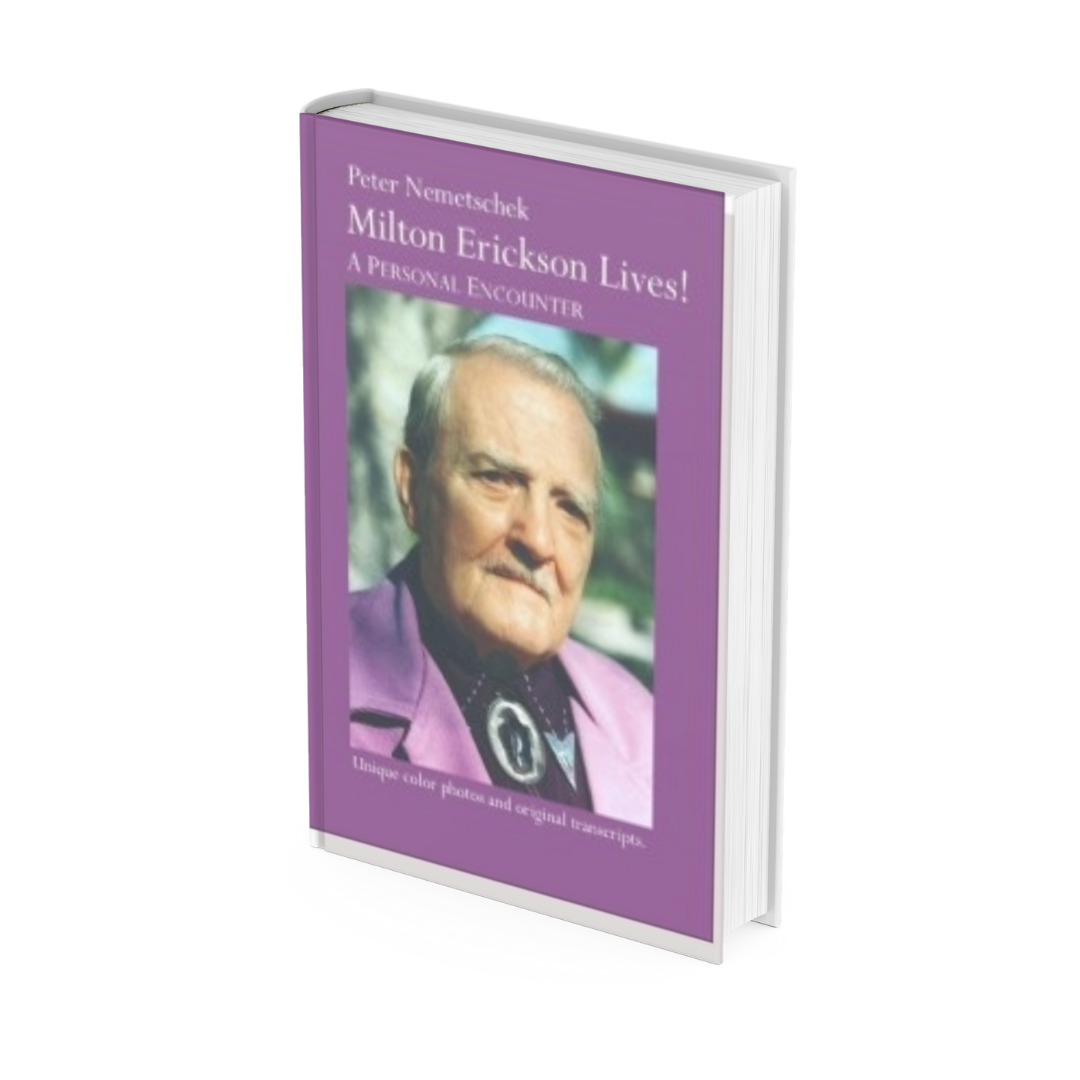
A Personal Encounter
by Peter Nemetschek
Type: Softcover
Milton H. Erickson Lives has the feel of an impressionist painting. In its details and broad strokes, the book focuses on an unusual man - from the perspective of an unusual ma. Original transcripts, rare photographs, and the special tone and palette on memory draw the reader into the vid experience of what is being described. It was an exciting moment for Milton H. Erickson and those who surrounded him, a moment of great clarity, intellectual explosion, a paradigm-shifting investigation-a moment that continues to reverberate powerfully beyond the parameters of that specific period.
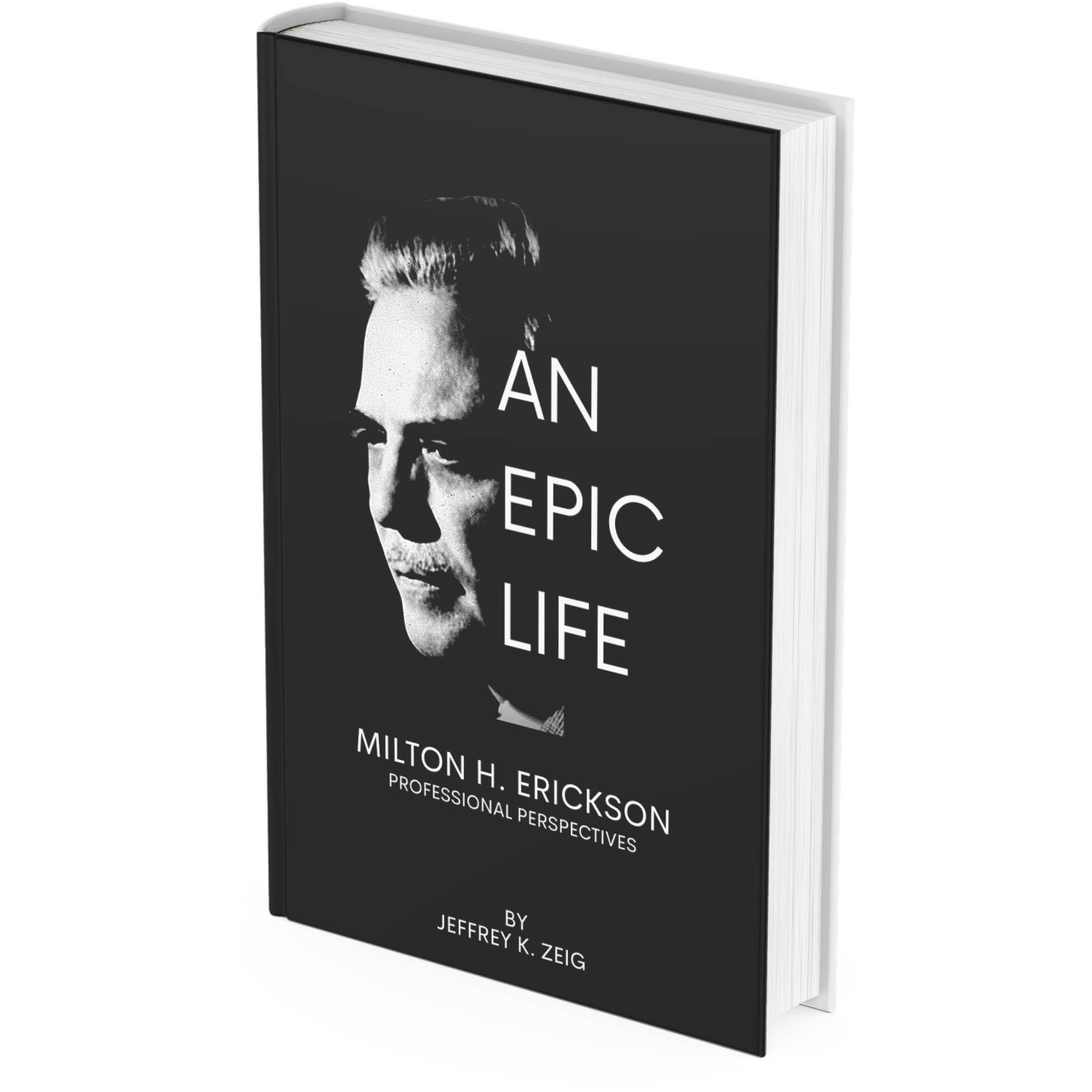
Professional Perspectives
by Jeffrey Zeig, PhD
An Epic Life is a biography written by many authors. Throughout his professional life, Milton H Erickson attracted a diversity of critics and supporters, and this book gives all a voice. Erickson was known to work with patients to elicit in them the innate ability to “connect the dots” to discover their adaptive potentials. Readers will delight in being able to connect the dots too, piecing together a portrait of an extraordinary and complex figure, as they look through the eyes of the men and women who met him at important junctures.
An Epic Life draws upon four decades of interviews with professionals who knew Erickson. The incisive perspectives are interlaced with commentary from Jeffrey Zeig to clarify and contextualize. The images of Erickson that emerge are congruent, divergent, myriad. In the end, readers gain unusual access to the man, his commitment, and his work. There is nothing simple in what is conveyed, and yet the impression it makes is coherent — and lasting.
The Master Class with Jeffrey K. Zeig, PhD
by Jeffrey K. Zeig
Type: Hardcover
Milton Erickson was my mentor intermittently for more than six years; he was also an inspiration in creating the Master Class. At his essence, Erickson was experiential. He was the most radically experiential therapist to ever practice. Creating transformative experiences is a component in many schools of therapy, including rational emotive behavior therapy and cognitive behavior therapy, but for Erickson being experiential was not merely a component; it was most of his therapeutic work. Hypnosis is essentially an experiential technique. The subtext of hypnosis is this: “By living this experience, you can be different.” Hypnosis is not a means of providing information.
This book is an opportunity to study single-session therapies that are based in experiential methods. The learning from these methods is primarily stimulated by the client living the change, not by intellectual understanding of how to change. The participants declare what they are going to do differently and the sessions are designed to create experiences that foster the accomplishment of stated goals. Participants have solved complex problems and have made significant life changes. They have overcome writer’s block and then completed a book; they are happier in their jobs and relationships; they rebalance work and life; and they surmount childhood trauma.
The transcripts contained here offer opportunities to sit in on live interactions between therapist and client. An extraordinary adjunct to the transcripts are the participants’ — all stellar professionals themselves — notes on the sessions. They are able to articulate their understandings and impressions in such powerful ways that upon reading their perspectives I also took away something new.
Jeffrey K Zeig