

Building Bridges

Between Rogers and Erickson
By Mike Moss, MBACP
I recently presented a workshop called “Building Bridges,” held at a conference organized by the UK Association for Solution Focused Practice. As a counselor and psychotherapist trained in solution-focused brief therapy and person-centered therapy, I felt compelled to offer a workshop that would explore an imagined bridge with Milton Erickson on one side and Carl Rogers on the other. Although there are differences between these two master therapists, I wanted to focus on their similarities, to try and understand how they inform my practice. In this article I hope to offer a taste of some of the concepts I explored.
Sidney Rosen’s book, My Voice Will Go With You: The Teaching Tales of Mil- ton H. Erickson, offers a good analogy. (Rosen, 1982) I imagine Erickson on one side of a bridge calling out to his patients, “My voice will go with you.” And on the other side of the bridge, Rogers calling out to his clients, “Your voice will go with you!”
Both men grew up on farms in the Midwestern United States and seem to have had a similar view of the natural order of things. (Gunnison, 2003) As a child, Rogers once observed potatoes stored in a shed, and with no apparent source of light, the potatoes were still able to grow spindly shoots. This impressed him, and he knew it was an example of the potential of life. He began to believe in an inherent growth-promoting force, which he later described as the “actualizing tendency.” (Rogers, 1961) Erickson also had rural experiences. When he was a boy he came across a horse that suddenly appeared outside his family farm. Erickson was able to easily lead the horse back to its owner because he trusted that it would know the way, which it did. He utilized the obvious, observing, and embracing the situation in a creative and unique way. He trusted the instincts of the horse, which later helped him to understand and trust his patients. When a patient seemed lost, he trusted that he or she would also eventually find the way home.
Both Rogers and Erickson discovered something in life that they could trust and which made sense to them, and they brought these simple ideas to their work as psychotherapists. And even though their approaches were different — Rogers could be described as non-directive and Erickson as directive — both men were linked by a fundamental desire to help clients find their own resources to promote change.
“Both [Erickson and Rogers] emphasized and sensed the uniqueness of each living thing and prized above all those differences.” (Gunnison, 2003)
Rogers likened Erickson’s understanding of the unconscious to the “actualizing tendency,” and noticed that although there were differences in their work, both relied on a directional tendency of the patient toward change, and both believed that the patient would have the wisdom to make beneficial choices. (Gunnison, 2003)
Rogers believed there was a tendency that exists in every individual which can be buried under layers of psychological defenses that “awaits only the proper conditions to be released.” (Rogers, 1961) And Erickson’s view of the unconscious has also been described as “…the core or center of the person” where there is “…a repository of all past experiences and learning” where the source of growth lies mostly beneath the unconscious level. (Rosen, 1982)
I sometimes use visualization in my work, and more recently I also close my eyes with some clients. I ask permission to be alongside them in their imagined world and offer Rogers’ core conditions in a profound way. My experience in doing this can be described as entering an imagined world where I feel a powerful, deep empathic resonance. It’s as if there is a new realm where both the client and I are active agents in the territory of the imagination. The depth of this kind of therapeutic relationship can provide access to a bridge from the unconscious to awareness where we can both meet and there is potential for healing and growth. This connection during hypnotic trance feels like a person-centered approach in action.
Looking at Rogers and Erickson on the same bridge reveals that there could have been a kind of creative guidance, with both doing what they intuitively felt was right. They both experienced a directional flow of potential or actualization in their therapy to promote healing in others. And perhaps by just holding an awareness of the possibility that there is a directional flow or presence which helps us to connect with change and growth from our own potential to facilitate healing may reveal there is greater wisdom guiding us.
In his book, A Way of Being, Rogers maintains that the human organism’s potential for change is connected to what he calls an “evolutionary flow,” which he recognized as “…part of a formative tendency in our universe.” (Rogers, 1980) And, that there may be an energetic current of potential in the universe flowing toward growth, which can somehow be accessed within the self. This could be similar to Erickson’s use of utilization, whereby he makes use of what is present in the therapeutic encounter, both in him and in the client and beyond, and within the power of the imagination, that can be accessed and used as a creative force for change. (Leva, 1987). And, this energy stored up in all of us is waiting to be released.
The “actualizing tendency” from both Rogers’ and Erickson’s perspectives may be described as the process of becoming whole. The client is continually in this process, guided by innate wisdom and utilization, moving in a creative direction inspired by both therapist and client, which seems to fit and connect to the client’s unique way of becoming the person he or she desires. I believe this “greater wisdom” may be experienced as a presence for both therapist and client — of there being something more in the therapeutic relationship. I have written about this sense of there being something more and have called it “directional presence.”
By the very nature of our intention to help, I believe something may emerge, assisted by being in an in-depth relationship, where more than we know maybe helping the process in which all is being attended.
The power of the imagination is well understood in both cognitive and humanistic therapies, however, I would suggest there is perhaps the potential of an untapped resource, whereby direct contact by client and therapist can be made in the realm of the imagination. And I wonder, like Rogers and Erickson meeting on a bridge, if there is an opportunity for therapists of both approaches to begin a dialogue where we can discover new elements in working closely with clients, utilizing the unconscious using the core conditions, and accessing the imagination through person-centered visualization. Perhaps we are all on the same bridge, with some of us in the middle or closer to one side, and that’s okay because we are all traveling from one side to another and we all know the way.
References
Rosen. S. (1982) My Voice Will Go With You: The Teaching Tales of Milton H. Erickson. W.W. Norton & Co
Gunnison. H. (2003) Hypnocounseling: An Eclectic Bridge Between Milton Erickson and Carl Rogers. PCCS Books
Rogers. C.R. (1961) On Becoming a Person. London Constable. Rogers. C.R. (1980) A Way of Being Houghton & Miflin Co. Psychotherapy: The Listening Voice. Rogers & Erickson
Moss. M (2017) “On Becoming More, in the Therapeutic Relationship: An exploration of directional presence” COSCA Counseling in Scotland, Journal (Spring Ed.)
Mike Moss is a full-time counselor for Children and Young People, West Lothian Council. He lives in Edinburgh, Scotland, and has a small private practice offering supervision and training. Moss can be contacted at mike.moss@outlook.com
Ed. Note: At the 1985 Evolution of Psychotherapy Conference, Carl Rogers compared himself with Erickson and Kohut. The audio is available for streaming at catalog.erickson-foundation.org/speaker/carl-rogers
You may like…
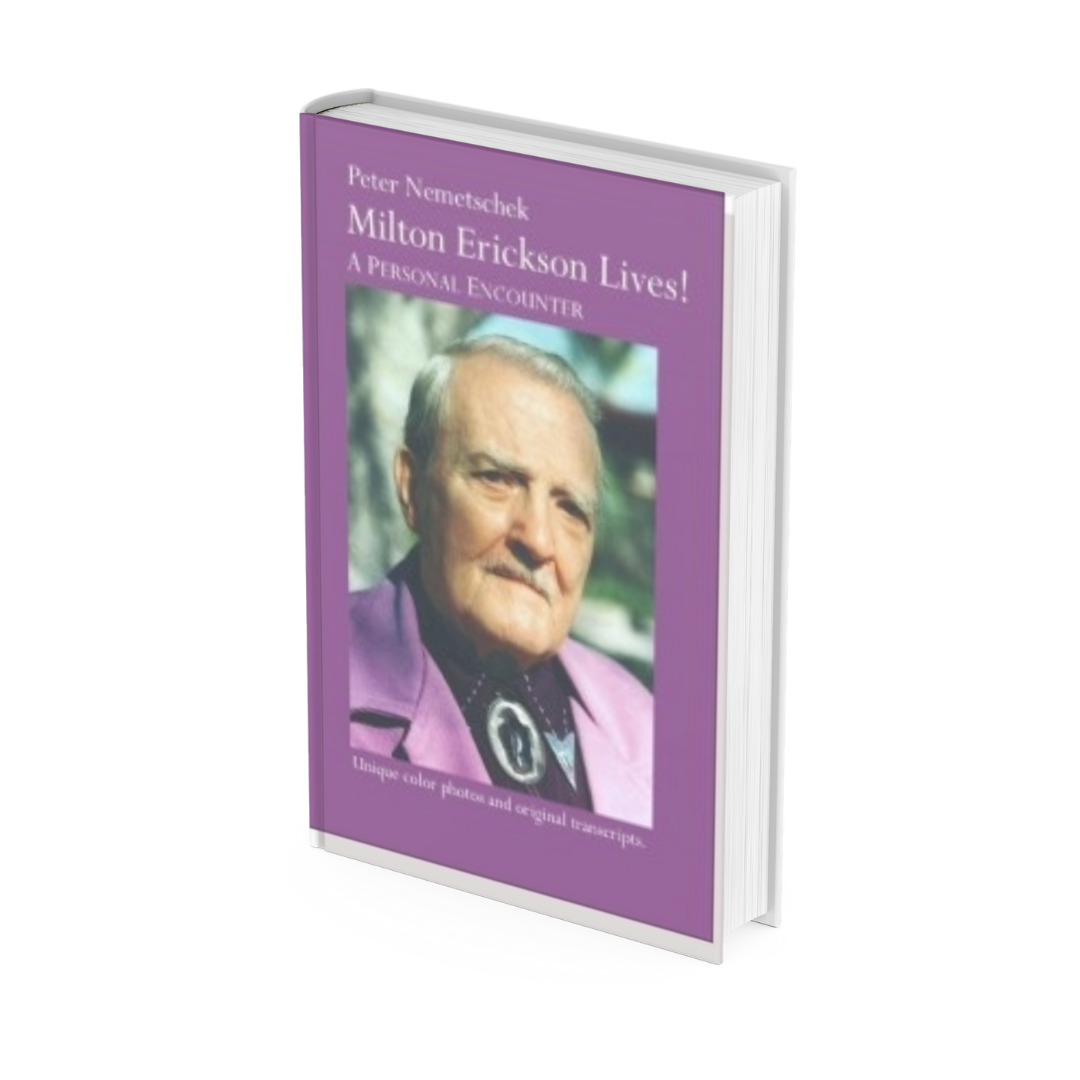
A Personal Encounter
by Peter Nemetschek
Type: Softcover
Milton H. Erickson Lives has the feel of an impressionist painting. In its details and broad strokes, the book focuses on an unusual man - from the perspective of an unusual ma. Original transcripts, rare photographs, and the special tone and palette on memory draw the reader into the vid experience of what is being described. It was an exciting moment for Milton H. Erickson and those who surrounded him, a moment of great clarity, intellectual explosion, a paradigm-shifting investigation-a moment that continues to reverberate powerfully beyond the parameters of that specific period.

by Brent B. Geary and Jeffrey K. Zeig
Type: Softcover
"The fascinating thing about Milton Erickson’s work is that his originality is not contained in any attempt to differ from others, but simply is a matter of his own pursuit of the new, within his own work.
— Margaret Mead
In these letters there are aspects of Erickson’s life that have never before been revealed publicly. Herein, we are privy to Erickson, the man, in a way that provides new insights into his awesome power as a clinician, a researcher, a theorist, and an individual.
As a reader, you will meet the luminaries with whom Erickson interacted, both in the field of psychiatry and in related disciplines. Sit in on Erickson as he consults on cases with renowned psychoanalysts, exchanges views with Gregory Bateson and Margaret Mead, and discusses research issues with Stanley Milgram. Read firsthand Erickson’s advice to patients, colleagues, and students.
But these letters offer more than a fascinating slice of history, more than an intriguing bit of biography, more than a glimpse of a giant’s legacy. Through these letters we have a portal to the future.
Erickson’s contributions to psychology have been described as encompassing five main streams – strategic psychotherapy, the Mental Research Institute, solution-focused therapy, the psychobiological approach of Ernest Rossi, and the Neo-Ericksonians, including Michael Yapko, Stephen Gilligan, and Carol and Stephen Lankton. The fields of individual, couples, and family psychotherapy continue to reverberate as a result of Erickson’s influence.
Current heirs continue to refine, experiment, and extend the heritage. And the upcoming generation will reach beyond present thinking. In Volume I of The Erickson Letters we gain access to the man and his work through his own words, unfiltered and unencumbered. The rich and vast intellect of a creative genius emerges – not to show us up, but to show us out of the prison of mediocrity.
In a man’s letters, his soul lies naked.
— Samuel Johnson

by Stephen R. Lankton
Type: Hardcover
A compilation of essential contributions that span a period of 17 years, this volume highlights the extraordinary breadth of Stephen Lankton’s unique therapeutic approach, its techniques, protocols, and frameworks. The sections include Ericksonian Hypnosis and Therapy, Brief Therapy, Metaphor, Anxiety and Trauma. Within each section readers will discover an array practical and potent material that is certain to enhance the power of therapy, whether or not the therapist is working within an Ericksonian paradigm.
Praise for Assembling Ericksonian Therapy: Collected Papers of Stephen Lankton
“Stephen Lankton’s lucid and readable prose puts the principles and applications of Ericksonian Therapy easily within the grasp of his readers.”
Alexander A. Levitan, M.D., M.P.H.
“This collection reveals why [Lankton] has been at the forefront of the fields of hypnosis and brief, goal-directed psychotherapies for more than two decades. These papers provide readers with an opportunity to share his wisdom.” —
Michael D. Yapko, Ph.D.
“The ideas [are] both practical and imaginative, dealing with hypnotic technique as well as such areas as family violence. This is an expansive presentation of papers ranging from the ideology of Erickson to using therapeutic metaphor in social work.” —
Jay Haley.

by Dvorah Simon and Stephen Gilligan
Type: Softcover
"This book is a mosaic masterpiece of beauty, heart, and vision. It is a must for clinicians wishing to transcend the mechanics of therapy and open their inner pathways toward becoming healers. Beautifully landscaped, each teaching is a blessing, not only to be read, but more important, to be soulfully experienced."" -- Joyce C. Mills
author/co-author of seven books, including
Therapeutic Metaphors for Children and the Child Within
""Walking in Two Worlds is a rich and stimulating book. It is filled with examples illustrating the profound and wide-reaching applications of Gilligan's work. The many varied articles, written by students and practitioners of the Self Relations approach, demonstrate how generative and deeply healing Self Relations concepts and skills can be for therapists, coaches and consultants. I myself have been deeply influenced by Gilligan and his work and recommend this book for anyone who wants to learn more about how to better bring together heart, mind, and spirit in the service of healing and helping others."" -- Robert Dilts
author of From Coach to Awakener and
Changing Belief Systems With NLP
""Steve Gilligan and Dvorah Simon have put together the leading edge theorists and practitoners of Self Relations, an artful blend of Milton Erickson, spirituality, Jungian work, and the best of depth-oriented brief therapy approaches. The contributions are diverse, interesting and, in some cases, provocative. Reading this book will help broaden and deepen your ability to connect with your most challenging clients so that you may help them change more rapidly and effectively. It will touch your head and your heart."" -- Bill O'Hanlon
author/co-author of 21 books, including
Do One Thing Different and Thriving Through Crisis"