

The Power of Two

Paul Ekman and his Daughter, Eve Ekman
By Dan Short, PhD
At the December 2017 Evolution of Psychotherapy Conference, I had the pleasure of hearing several talks delivered by the renowned researcher, Paul Ekman, Ph.D., and his daughter, Eve Ekman, Ph.D., MSW, who is also a researcher of emotion. Their back-and-forth discussion during the lectures helped illuminate multiple perspectives from which each concept could be considered. The energy that they shared seemed extra special — the kind you only see with people who have a deep and secure connection. Even as they stood on stage in front of a large audience, it did not matter if one disagreed with the other. Each remained flexible and interested in the other’s thinking. For these reasons, I was all the more delighted when the Ekmans graciously agreed to sit down with me for an interview at breakfast.
As the father of a 15-year-old daughter, my first question was an earnest request for information. I wanted to know what Paul Ekman thought was important in giving children opportunities, but not overshadowing or pressuring them. His response was that he always sought to understand his daughter, Eve. He also made a conscious effort to empower her with self-confidence. As Paul put it, “You can’t be a shrinking violet. You take the world and you shake it a bit. That’s how I lived my life.” Eve agreed that he had taught her a great deal about self-confidence and about finding her own way in the world of science. As Eve explained, “For so many years, I have learned so much from my dad about life, about ideas, and about research. When I became old enough to conduct research, when I finally got to that point, to have my dad as my senior research advisor and have him tell me absolutely the opposite of what everyone else was telling me, was phenomenal.” Illustrating what he meant by not being a shrinking violet, Eve explained, “He would tell me that if people don’t like it, you are on the right track. Don’t listen to them. You don’t need all the fancy equipment, just observe, watch, notice, and be a good observer. That was invaluable advice.”
Watching Eve speak, I could see that she had tremendous respect for her father and that she valued his influence. As Eve put it, “In some ways, my dad is really such a hard-nosed empiricist. I don’t think that is my natural proclivity. But representing his legacy and being able to describe emotion in a way that fits with the work he did, has influenced me. In some ways I see this legacy working through me and I’m trying to push that forward. And, it is kind of arresting to me sometimes to feel that continuity going on, watching the process of aging, and how challenging that is. It is its own lesson for me.” Having grown up with a father who has always been a strong leader, Eve made another interesting observation.
Looking at her father, she commented, “I think our roles are shifting a bit.” She then went on to explain how she is becoming protective of her father and how she spends more time thinking about him and his care. With a look of love and admiration she continued, “That role is definitely sweet and it’s really hard.” This role that she was seeking to describe was different from the relationship shared between a husband and wife who both grow old together. It was something that is exclusive to an aging father and a devoted child. Eve went on to explain, “It’s a role that I value. It means a lot to me. I feel a lot of empathy for my dad, for him losing the ability to feel okay in his body. He has so many physical pains and so much physical degradation. There is a sweetness in getting to see and know all these phases in his life. And, there is a lot of sorrow. Not overwhelming, but definitely present.”
Turning to his daughter, Paul related, “I was 46 when you were born. So I was definitely an older parent. Now I’m about to turn 84. That is a big gap, a bigger gap than you usually find.” Paul was proud of the fact that he and his wife are celebrating 38 years of marriage. Then he explained that this is his fourth marriage. So, when he entered into this marriage, he felt determined and eager to have a child. Turning again to his daughter, Paul confessed, “I thought that time was running out. I really wanted to have a child. I don’t think that it was only so that I could prove I could be the parent that my father could not be, but that was certainly part of it.”
Having started our conversation with the question of how to be a good parent, Paul lamented, “I had the two worst parents I could imagine. My mother committed suicide when I was 14, after asking me to save her. This was in 1948. She was bipolar. How was I able to save her? There wasn’t even medication for bipolar disorder.” He then explained how this tragic event determined his vocation. Paul told me, “After her suicide, I decided I would spend my career trying to learn things that would help people like her.”
As if this was not enough to contend with, Paul shared the fact that his father was physically and emotionally abusive. Speaking of his father, Paul added, “He was an impulsive philanderer. And the night before my mother killed herself, she said, ‘Promise me that you will never be unfaithful the way your father was to me on our honeymoon.’” Rather than expressing goodwill for his son’s future, Paul felt cursed by his father. It was not only the destruction of his mother’s sense of self that he had to witness but also a direct assault on his own future. In a moment of disgust, his father told him, “I hope when you grow up you will have a child who will make you as miserable as you’ve made me.”
This difficult past helped explain the extraordinary character of the connection I was witnessing between these two adults. Only a handful of people will come as close to influencing the world as Paul Ekman has done. However, his proudest accomplishment in life was sitting right next to him. Still speaking of his father, and still clearly determined to defy this curse, Paul added, “He did not live long enough to see that that was not what happened. I was a very different person than him.” Paul made it clear that he had always been faithful in marriage and a deeply devoted parent. I stated the obvious: “You did not let him affect your parenting of your daughter.” To which Paul replied, “Not a bit!”
Again, taking up her role as someone seeking to add value to her father’s experiences, Eve made the comment that, “Last year on Father’s Day, my dad told me that my grandfather was the only pediatrician who would serve patients of color in New Jersey. His patients really loved him. He had a strong dedication to this cause. And that’s the thing I see in me—this strong dedication to truly helping people, especially those who are vulnerable.” As if being brought back from a darker place, Paul followed his daughter’s comments with a more sympathetic appraisal of his father, “He was a first-generation American. His parents were immigrants. I never liked him, but I admired his intelligence and dedication to service. And, I am grateful for inheriting those things from him.”
More than just a researcher, I could see that Paul Ekman had found a way to apply his extensive knowledge of emotions and act as a sort of human shield. He was buffering his daughter from the fiery abuse and mental anguish to which he and his parents had likely been exposed. If there ever was a time that he had been angry or harsh with her, it did not show in his daughter’s face, or in her gentle self-confidence. Having witnessed so many psychologists who failed to apply the lessons of their craft to their own family or personal development, I felt doubly impressed by Paul Ekman’s psychological achievements.
Switching to a lighter topic, I asked Paul about the TV series, Lie to Me, which was inspired by Paul Ekman’s research and its practical application in forensics and government security. In this show, the lead character is the world’s foremost authority on reading facial expressions and detecting lies. Another similarity is that the lead character has a mother who committed suicide, he has a history of trouble in marriage, and he is an older father with a young daughter. I already knew that Paul had worked closely with the script writer during season one as a scientific advisor. So I was curious to find out which part of this TV drama paralleled real-life interactions between him and his daughter.
Asking about this fictional psychologist, I quoted him as stating that he would never use his lie-detecting skills on his daughter because he felt this would be an unfair violation of her privacy. I asked Paul, “Did you have this rule for yourself?” To which he replied, “That was my line. I told them that.” Focusing again on his desire to be a good parent, Paul added, “I certainly think I did abide by that. I tried to never put Eve in a position where she would be tempted to lie to me. That was the key.”
Smiling as he looked at his daughter, Paul added, “But if I thought she was concealing something, I never called her on it. You know that’s a different role. That is the parent as a policeman. Back in the days when I used to lecture her when she was still a child, I used to say, ‘I don’t want to be the policeman. And I don’t want to be your friend.’ Neither of these are the role of a parent. The parent’s role is closer to the role of a teacher than it is a policeman or friend.” Pausing for reflection, Paul added, “But it’s not the role of teacher either. The teacher does not have the same emotional investment and does not make any big sacrifices.” After hearing himself say that it was his role to make big sacrifices for his daughter, Paul looked over at Eve and confessed that he did not feel like he had ever had to make any sacrifices for her. The two of them laughed as he asked her when she was going to ask for a sacrifice. Eve jokingly warned, “It’s coming!”
Our discussion continued with Paul commenting on historical figures in psychology, illuminating social research, and recent political events. I tried to get Paul to tell me what he read in President Trump’s face but he stuck to his policy of not remarking on sitting government leaders. He and Eve did get into a disagreement over whether or not contempt can be seen on a certain celebrity’s face. Paul challenged his daughter to show him the physical evidence, and Eve gladly accepted, “As soon as we get home!” Watching these two smile and laugh, even as they came into conflict, I experienced a sudden realization. When your central cause is to understand someone at deep emotional levels, then the best aspects of humanity emerge in every form of interaction—even conflict and disagreement. It seems to me that the mistreatment of others represents a low emotional I.Q. And thus, the scientific accomplishments of Paul and Eve Ekman are something we could all benefit from knowing.
You may like…

Deciphering the Social Matrix in Psychotherapy
by Dan Short
Type: Softcover
Transformational Relationships is a vital resource for therapists who want state-of-the-art information on what works in psychotherapy. To navigate successfully the complex demands of individualized treatment, a therapist needs to recognize the social matrix against which the course of treatment is plotted. To this end, Dr. Short shares the most essential aspects of the therapist-patient relationship and how this powerful bond produces lasting transformation.
Readers will discover a unique and compelling narrative of science and clinical wisdom. The first section deciphers key dynamics of social complementarity, including dominance and submission, reciprocity, affective attunement, verification, and attachment. In the second section the reader will learn how relational beacons facilitate complex interpersonal maneuvering. The process of transformation begins long before the treatment ends.
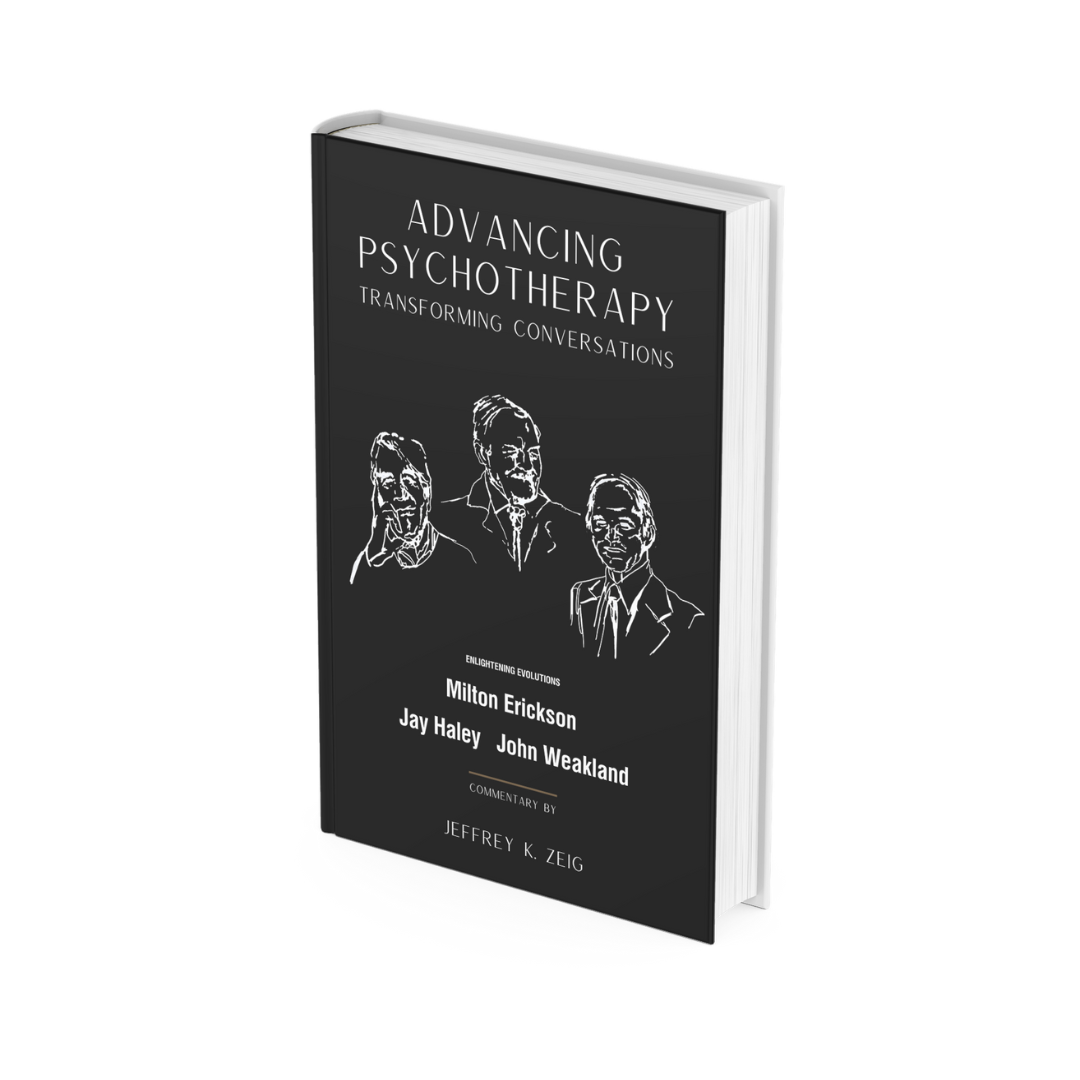
Transforming Conversations
by Jeffrey Zeig
Type: Softcover
When great minds meet, we are privileged to learn from their explorations…
As part of a communications project conducted in the mid-1950s and spearheaded by anthropologist Gregory Bateson, Jay Haley, and John Weakland went to Phoenix, Arizona to learn from and collaborate with Milton Erickson.
The meetings of these three great minds were recorded. Their explorations together both advanced the Bateson Project’s Double Bind Theory and helped to develop more effective approaches in psychotherapy.
Advancing Psychotherapy is a glimpse into an important time in the history of the field and a rare opportunity to learn from those who shaped the future of psychotherapy. Its content will improve your practice of psychotherapy.

by James F. Masterson
Type: Softcover
The culmination of 40 years of research into the personality disorders, this book documents the breakthrough integration that has brought Dr. Masterson’s theory into its fullest possible dimension. Initially descriptive, it evolved into a developmental theory, then into a developmental object relations theory, and, finally, into a developmental self and object relations theory. Now, with the recent emergence of attachment theory and the theory of the neurobiologic development of the self, the picture is complete and a clear and comprehensive statement to depict the origin and development of the personality disorders has taken shape.
Dr. Masterson and his fine team of coauthors have assembled a rich and comprehensive volume that features discussions of transference and countertransference, consciousness, mother-infant attachment, the psychotherapy of trauma, and therapeutic neutrality under challenge, among many other important topics. The members of the team are Margot T. Beattie, Barbara L. Short, Donald D. Roberts, Ken Seider, Steven K. Reed, Joseph Farley, Jerry S. Katz, and Judith Pearson.

A Memoir
by Cloé Madanes
Type: Softcover
Honest, clear, brilliant … Cloé Madanes tells her own story, and, in the process, explains how a psychotherapist is born, develops and contributes. She weaves a tapestry of her personal history, her social context and the politics of the time. The book is a gift to all who hope to understand the role of the past in who we become.
Not By Accident reflects Madanes’ conviction that free will and a system that follows its own rules exist simultaneously, and that the human spirit has the capacity to triumph in the face of all kinds of adversity. This conviction is central to Madanes’ account of her own life journey. In Not By Accident, she shows us how her therapy strategies evolved from her unshakeable belief in the power of people to drive each other sane and the power of words to change the world.
The book is a no-nonsense exploration of the hard truth about how Madanes went about constructing her own life. She captures contradiction, paradox and the complexity of the human experience in ways that will resonate with her readers’ own experiences and life stories.