

Rock, Paper, Scissors
Learning from Erickson’s Use of Pen and Paper in Therapy
by Annette Poizner, MSW, Ed.D., RSW
I’m remembering recess in the schoolyard. We are in the process of deciding who gets to go first and we play the game of Rock-paper-scissors. Each child assumes a hand posture resembling either a rock, a piece of paper, or scissors. According to the rules of the game, each of these items “can “defeat” one of the other items and the remaining one is the winner. For example, scissors “beat” paper; rock “beats” scissors. These relationships make perfect sense, given that scissors cut paper, and rocks can smash scissors. Yet, one of the relationships spelled out in this childhood game is counter-intuitive: paper rules over rock. But doesn’t a heavy rock rule paper? An anonymous comment on the Internet sheds light on this issue: Paper rules rock because paper represents the realm of higher knowledge. We master the world of physicality symbolized by the rock, by using principles of higher knowledge. Ah yes, paper does, in fact, rule rock!
Given the importance of paper, we shouldn’t be surprised that pen and paper are useful in the therapeutic endeavor, despite the fact that most therapists limit its use to process notes. In fact, Erickson frequently brought pen and paper into the therapy process. At times, he would have his patients journal their life story, or he would give homework assignments, having a bed wetter woken up early in order to practice handwriting. Other times, Erickson would utilize automatic writing, wherein hypnotic subjects would respond to hypnotic suggestions to produce meaningful writing or drawings, all outside of conscious awareness. One fascinating case bears reviewing.
Erickson and Kubie (1938)1 reported the case of a 24-year-old woman who volunteered to be a hypnosis subject. She explained that in recent months she had been overcome with feelings of agitation, and simultaneously found herself mindlessly drawing pictures and doodling whenever she was studying or sitting in class. She was puzzled by this new habit, and by her agitated state, and she wished to find meaning in her illustrations.
In a subsequent interview, she recounted her history. She was raised as an only child in a happy home with two loving parents. She reflected that the only problems on her mind of late were feelings of resentment about the growing emotional distance between her and her best friend from childhood. Throughout the interview, the woman nervously doodled.
Erickson scheduled a follow-up appointment and gave her specific hypnotic suggestions: that her unconscious mind would organize the material she hoped to access, while her conscious mind would be busy with school and social activities. She would report on her conscious activities when she attended her next appointment. Feeling incredibly well at the next appointment, the woman described the storyline of a novel she had been reading. While giving a verbal report of the book, she picked up a pen and doodled, first penning the usual scattering of lines and shapes, but ultimately making a singular, unified drawing that integrated all the elements that she had been randomly drawing. Yet, she was not able to interpret the picture for Erickson. In response to questioning, she gave Erickson a pack of matches from her pocket, then left abruptly. Of note, these matches advertised a local hotel.
Over the next several weeks, the young woman dropped by for a series of visits. Erickson recounts the gradual process by which the woman retrieved awareness of the meaning of the drawing, ultimately leading to a revelation: Her father was having an affair with her girlfriend. Father had been bringing matches home from the hotel where he had frequent encounters with his mistress and all this was ultimately confirmed by the girlfriend, who was eventually brought to a meeting with Erickson!
The case report documents the nuanced way people first hide, then later reclaim knowledge that is difficult to bear. In this particular case, the revelation brought an end to the young woman’s agitation. The case also demonstrates the use of pen and paper in therapy. Clients can spontaneously draw or write material, which can then be analyzed to better access material that has been, for one reason or other, hidden from consciousness.
In the end, we may learn a thing or two from the game of Rock-paper-scissors. It can be a reminder that the seemingly innocuous sheet of paper is more powerful than it looks. It can serve as a proverbial blank slate, and much can be achieved if we will bring it into the clinical context.
Annette Poizner, MSW, Ed.D, RSW serves on the Board of Directors of the Milton H Erickson Institute of Toronto and is the author of “Clinical Graphology: An Interpretive Manual for Mental Health Practitioners” published by Charles C Thomas Publishers.
Resources
Erickson, Milton & Kubie, Lawrence (1938). Psychoanalytic Quarterly, 7, pp. 443-466.
You may like…
The Master Class with Jeffrey K. Zeig, PhD
by Jeffrey K. Zeig
Type: Hardcover
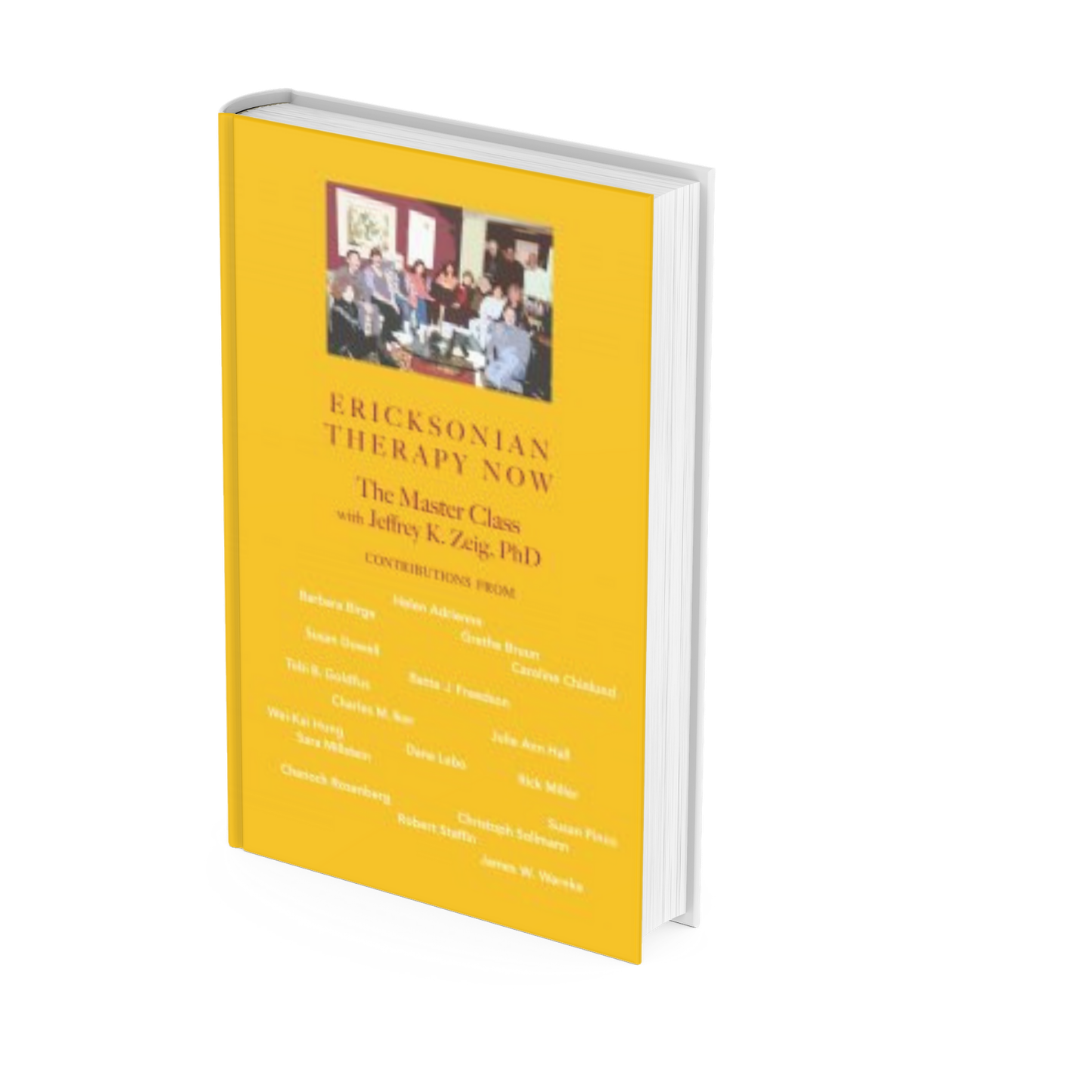
Milton Erickson was my mentor intermittently for more than six years; he was also an inspiration in creating the Master Class. At his essence, Erickson was experiential. He was the most radically experiential therapist to ever practice. Creating transformative experiences is a component in many schools of therapy, including rational emotive behavior therapy and cognitive behavior therapy, but for Erickson being experiential was not merely a component; it was most of his therapeutic work. Hypnosis is essentially an experiential technique. The subtext of hypnosis is this: “By living this experience, you can be different.” Hypnosis is not a means of providing information.
This book is an opportunity to study single-session therapies that are based in experiential methods. The learning from these methods is primarily stimulated by the client living the change, not by intellectual understanding of how to change. The participants declare what they are going to do differently and the sessions are designed to create experiences that foster the accomplishment of stated goals. Participants have solved complex problems and have made significant life changes. They have overcome writer’s block and then completed a book; they are happier in their jobs and relationships; they rebalance work and life; and they surmount childhood trauma.
The transcripts contained here offer opportunities to sit in on live interactions between therapist and client. An extraordinary adjunct to the transcripts are the participants’ — all stellar professionals themselves — notes on the sessions. They are able to articulate their understandings and impressions in such powerful ways that upon reading their perspectives I also took away something new.
Jeffrey K Zeig

• Covers with soft-touch coating
• Cover weight: 10.38 oz/yd² (352 g/m²)
• Page weight: 2.62 oz/yd² (89 g/m²)
• Metal wire-o binding
• 140 dotted pages
• Size: 5.25″ × 8.25″ (13 × 21 cm)
• Blank product sourced from the US

by Jeffrey Zeig, PhD
Type: Hardcover
Books included in this bundle:
Letters of Milton H. Erickson, M.D.
The Handbook of Ericksonian Psychotherapy
TranceForming Ericksonian Methods
Ericksonian Therapy Now

by Stephen R. Lankton
Type: Hardcover
A compilation of essential contributions that span a period of 17 years, this volume highlights the extraordinary breadth of Stephen Lankton’s unique therapeutic approach, its techniques, protocols, and frameworks. The sections include Ericksonian Hypnosis and Therapy, Brief Therapy, Metaphor, Anxiety and Trauma. Within each section readers will discover an array practical and potent material that is certain to enhance the power of therapy, whether or not the therapist is working within an Ericksonian paradigm.
Praise for Assembling Ericksonian Therapy: Collected Papers of Stephen Lankton
“Stephen Lankton’s lucid and readable prose puts the principles and applications of Ericksonian Therapy easily within the grasp of his readers.”
Alexander A. Levitan, M.D., M.P.H.
“This collection reveals why [Lankton] has been at the forefront of the fields of hypnosis and brief, goal-directed psychotherapies for more than two decades. These papers provide readers with an opportunity to share his wisdom.” —
Michael D. Yapko, Ph.D.
“The ideas [are] both practical and imaginative, dealing with hypnotic technique as well as such areas as family violence. This is an expansive presentation of papers ranging from the ideology of Erickson to using therapeutic metaphor in social work.” —
Jay Haley.