

What a Storm Called Derecho Brought into My Life

By Maria Escalante de Smith, MA
Estimated Reading Time: 3 minutes, 5 seconds
It was Monday, August 10, 2020. The weather began to worsen. It was nearly 2 p.m. in Cedar Rapids, Iowa when strong winds began to bend trees dramatically and the noise got louder and louder.
It was time to go downstairs to the basement – a safer place – to wait out the storm.
When it finally passed, I went upstairs to survey the damage. It was huge. According to the meteorological service the wind reached 140 mph. I ventured outside to see how the neighbors were doing. People were walking around in awe and disbelief. There was fear, sadness, and perhaps a sense of relief and gratefulness for surviving Derecho. I took a ride around the neighborhood to see some of the fallen trees, with roots completely exposed. So many gorgeous maples were now gone.
I met a neighbor for the first time who I will call Nancy, and she introduced me to Buddy, her three-legged yellow Labrador Retriever, a rather sweet fellow who loves to be petted. And that made me feel relief like things will eventually return to normal.
As I walked around the neighborhood and spoke with friendly people, I remembered Milton Erickson’s advice regarding how as human beings we all have the resources to resolve the problems we encounter in our lives. This experience also taught me about the wide array of emotions that can arise during a storm like the one we had in Iowa. I saw shock, fear, panic, anxiety, and later sadness – all human emotions that connect us.
I realized that after the experience I was in a freeze mode. I suffered insomnia, remembering the loud noises and brute force of the hurricane-type derecho wind uprooting trees and slamming them into the earth. I could still hear the sound of my maple tree falling.
The power lines in our area were damaged, and consequently, we had a blackout and had to borrow a generator from generous neighbors next door.
Things are slowly and steadily getting back to normal. A crew of tree service people came to remove the debris from the trees. The maple that had grown in my garden could not be saved. I never felt so sad to see a tree being removed.
This experience has also been a good opportunity to practice the remarkable “future rehearsal” technique by Dr. Erickson. The idea is to imagine a future when the problem has been solved and things are going well. I pictured a garden with a young, healthy apple tree, and I was enjoying the sweet and juicy apples it yields.
During the aftermath of this event, I noticed how my attention was wandering as I became absorbed in my own experience. In Hypnotic Induction, it states: “…being unaware of sights, sounds, odors, touch, or the position of limbs in space” (Loriedo, C., Zeig, J., Nardone, G. 2011, p. 48), and it was almost as if I was in trance.
“Geometrical progression is a cognitive technique designed by Dr. Erickson to justify the patient’s initial investment of energy into the healing process. The technique helps create positive expectations for what eventually can be achieved using a modest beginning.” (Short, D., Erickson, B. A., Erickson-Klein, R., 2005, p. 88)
So, this is exactly what I intend to do in the next few days – to keep my positive expectations alive.
References:
Loriedo, C., Zeig, J. & Nardone, G. (2011). TranceForming Ericksonian methods: 21st-century visions. The Milton H. Erickson Foundation Press.
Short, D., Erickson, B. A., & Klein, R. E. (2005). Hope and Resiliency: Understanding the Psychotherapeutic Strategies of Milton H. Erickson, MD. Crown House Publishing Limited.
This excerpt has been extracted from Volume 40, Issue No. 3 of The Milton H. Erickson Foundation Newsletter.
You may also like…

by Stephen R. Lankton
Type: Hardcover
A compilation of essential contributions that span a period of 17 years, this volume highlights the extraordinary breadth of Stephen Lankton’s unique therapeutic approach, its techniques, protocols, and frameworks. The sections include Ericksonian Hypnosis and Therapy, Brief Therapy, Metaphor, Anxiety and Trauma. Within each section readers will discover an array practical and potent material that is certain to enhance the power of therapy, whether or not the therapist is working within an Ericksonian paradigm.
Praise for Assembling Ericksonian Therapy: Collected Papers of Stephen Lankton
“Stephen Lankton’s lucid and readable prose puts the principles and applications of Ericksonian Therapy easily within the grasp of his readers.”
Alexander A. Levitan, M.D., M.P.H.
“This collection reveals why [Lankton] has been at the forefront of the fields of hypnosis and brief, goal-directed psychotherapies for more than two decades. These papers provide readers with an opportunity to share his wisdom.” —
Michael D. Yapko, Ph.D.
“The ideas [are] both practical and imaginative, dealing with hypnotic technique as well as such areas as family violence. This is an expansive presentation of papers ranging from the ideology of Erickson to using therapeutic metaphor in social work.” —
Jay Haley.
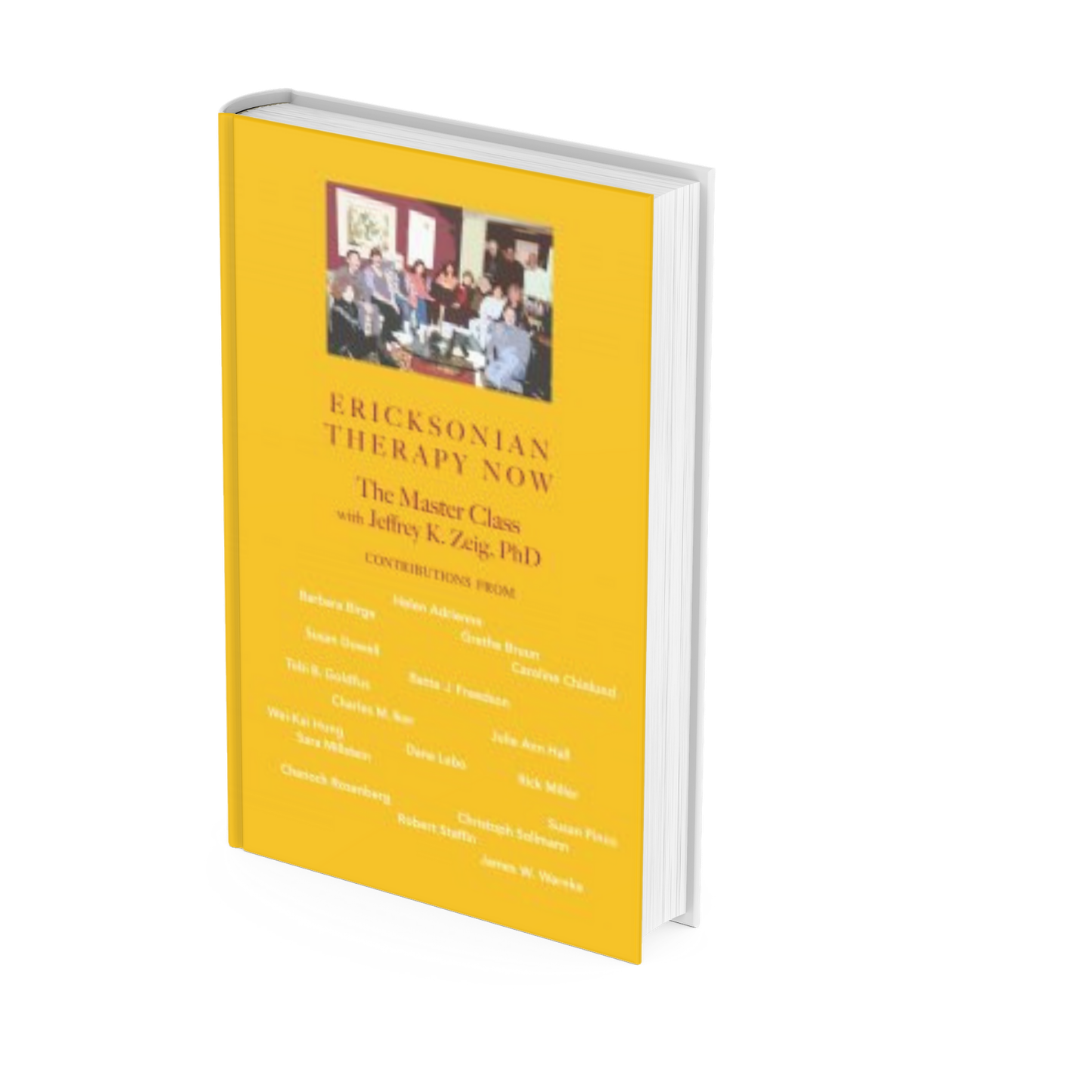
The Master Class with Jeffrey K. Zeig, PhD
by Jeffrey K. Zeig
Type: Hardcover
Milton Erickson was my mentor intermittently for more than six years; he was also an inspiration in creating the Master Class. At his essence, Erickson was experiential. He was the most radically experiential therapist to ever practice. Creating transformative experiences is a component in many schools of therapy, including rational emotive behavior therapy and cognitive behavior therapy, but for Erickson being experiential was not merely a component; it was most of his therapeutic work. Hypnosis is essentially an experiential technique. The subtext of hypnosis is this: “By living this experience, you can be different.” Hypnosis is not a means of providing information.
This book is an opportunity to study single-session therapies that are based in experiential methods. The learning from these methods is primarily stimulated by the client living the change, not by intellectual understanding of how to change. The participants declare what they are going to do differently and the sessions are designed to create experiences that foster the accomplishment of stated goals. Participants have solved complex problems and have made significant life changes. They have overcome writer’s block and then completed a book; they are happier in their jobs and relationships; they rebalance work and life; and they surmount childhood trauma.
The transcripts contained here offer opportunities to sit in on live interactions between therapist and client. An extraordinary adjunct to the transcripts are the participants’ — all stellar professionals themselves — notes on the sessions. They are able to articulate their understandings and impressions in such powerful ways that upon reading their perspectives I also took away something new.
Jeffrey K Zeig