

Book Review

More Common Therapy
The experiential psychotherapy of Jeffrey K. Zeig, Ph.D
by Staffin, Robert
American Journal of Clinical Hypnosis
2022. VOL. 64, No. 4, 383
In this book, Robert Staffin, Psy. D., provide a rich and detailed account of Jeffrey Zeig’s approach to experiential psychotherapy. Among many other accomplishments Jeffrey K. Zeig, Ph.D., is the founder and director of the Milton Erickson Foundation. This book is based on Staffin’s 17 years of experience attending Zeig’s master classes. Staffin describes Zeig as, “… likely Dr. Erickson’s most ardent and prolific protégée.” (p.1)
In the introduction he describes his meticulous and evolving note-taking process over the years. His observations of the transformative moments, detailed transcriptions and physical descriptions, and analysis of the larger arc of the sessions is apparent in this work. If you missed class, Robert would be the person from whom you would want to get your notes.
Fortunately, this book is more than a collection of notes. It is similar to a well constructed thematic analysis of a very long transcript. In what must have been a daunting task, Staffin has organized his recorded observations into themes and sub-themes that showcase elements of Zeig’s approach and how they are embodied. Each section describes a little of the session context, often larger theoretical contacts, illustrated with clinical examples and commentary that relates to both the client-student experience and the therapist perspective. The four “Compass Points” that Staffin, identifies are: Communication, Utilization, Interpersonal, and Strategy. Each of these compass points is comprised of a number of short sections (e.g., Allusions, Utilization of Self, Stepping off the Pedestal, Facilitation of Trance, etc.). While the sections are generally one-to-five pages long, they are dense with information of different types. For me, studying them slowly, allowing the descriptions of the clinical examples to manifest in my mind, and then circling back to the theoretical constructs they were intended to illustrate was a fruitful approach to digesting this work.
I was invited to review Staffin’s book as a clinical psychologist who does not have a background in Zeig’s work. However, I am familiar with that desire to capture and hold that ineffable magic wrought by a master therapist. Dr. Staffin’s book, his first, is clearly a tremendous labor of love for and devotion to Zeig’s magic, the effort of which, speaks as much to the inspirational power of its object as a final text does. I can imagine that students of Zeig will find this book to be an observant, extensive, and valuable collage of Zeig’s craft, a book they can return to again and again for inspiration and insight. They will likely find it to be more quickly resonant than those unfamiliar with this approach. This is not an introductory text intended for students new to experiential therapy, and/or to the ideas of Milton Erickson. However, in the right hands, it would be an excellent source, for even the uninitiated will find something of value in Staffin’s book. He invites us to broaden our concepts of how we communicate and relate; what can be used as a valuable source of therapeutic fodder; and the primacy of multimodal experience, intuition, and play in therapeutic transformation.
Bonnie L. Settlage
Saybrook University, Pasadena, CA, USA
bsettlage@saybrook.edu
You may like…

by Robert Staffin
Writing a book is a daunting task. One has to be really motivated. Dr Staffin’s debut is the result of being highly motivated to further disseminate the work of Jeffrey Zeig, to celebrate what he learned in his 17 years of study with Dr Zeig, and to make accessible what is too often chalked up to the charisma or particularity of the teacher. Culling from the live encounters that took place in the NYC Masterclass, Dr Staffin is meticulous in his investigation of Zeig s artistry as it comes through the actual sessions. The hope is that readers will walk away with fresh insight into this experiential way of working and inspiration for expanding their own ways.
Praise for More Common Therapy
With Rob Staffin’s book, you are invited into the therapy room of a great master and what may seem his unattainable artistry in practicing therapy. Dr. Staffin divides his material into clear and accessible elements that readers can bring into their own work in order to practice new skills in limbic resonance with clients. I recommend this book to all therapists who have an interest in refining their presence in therapy — and I recommend daily practice since there is no shortcut to becoming a master.
— Dr. Grethe Bruun
Supervising Psychologist, Denmark
The author writes his introduction: “The greatest challenge in writing this book was how to bring the encounter to life.” This is exactly what Dr. Staffin has achieved. … As a regular participant in the Master Class over years, I was amazed by the high authenticity of the observation and evaluation of the psychotherapeutic process. … In his description, the author is on the cutting edge of current psychotherapy research. According to recent findings, it is not the technique responsible for the healing success, but how the therapist understands how to shape the therapeutic relationship so that the client gives himself or herself permission for personal and emotional change. In this respect, too, Dr. Staffin has succeeded in creating a masterpiece with this book. If you really want to know how hypnotherapy is structured in its core, read this book.
— Dr. Christoph Sollmann
Psychologist and Author, Germany
It is my honor to write an endorsement for Dr. Staffin’s new book. … Dr. Staffin’s ability to identify and utilize Dr. Zeig’s techniques and strategies is beyond my imagination, and I am in awe of what he has written. Through his professional lens, great therapeutic techniques, such as gesture, eliciting meaning, and paraverbal communication came alive, and they dance inside my mind and I can play with these ideas when I do therapy. I highly recommend this book to psychotherapy professionals who wish to improve their abilities and become better therapists.
— Wei Kai Hung, Ed.M.
Clinical Director, Institute of Generative Trance, China
Staffin’s book brings to life his experiences as a participant and his observations of countless other rich clinical experiences in the masterclass sessions, and integrates them with his own clinical wisdom as a psychologist, hypnotherapist, and teacher of hypnosis. The result of this rich process is a book in which the sensory aspects of phenomenological experience, the paraverbal dimensions of communication, and the subtle but robust processes of limbic communication are delineated to the reader through sharing, storytelling, and technical explanation. In this regard, More Common Therapy channels and conveys the process of hypnotherapeutic attunement and utilization: through our sharing of stories, allusions, and suggestions across time and space, we give our patients back a version of themselves that they hadn’t previously been consciously aware of. It is through this relational exchange of experience that ultimately they create the healing that they didn’t even know that they knew that they needed. And it is through that exchange that the old becomes new, and the knew becomes known again.
— Eric Spiegel, Ph.D.
President, American Society of Clinical Hypnosis, 2018-2019

by Brent B. Geary and Jeffrey K. Zeig
Type: Hardcover
Timed to celebrate the 20th anniversary of the Milton H. Erickson Foundation, this volume brings together 40 of the field’s innovators to demonstrate both the breadth of Ericksonian therapy – from pain management to trauma resolution – and the clinical considerations attending its use.
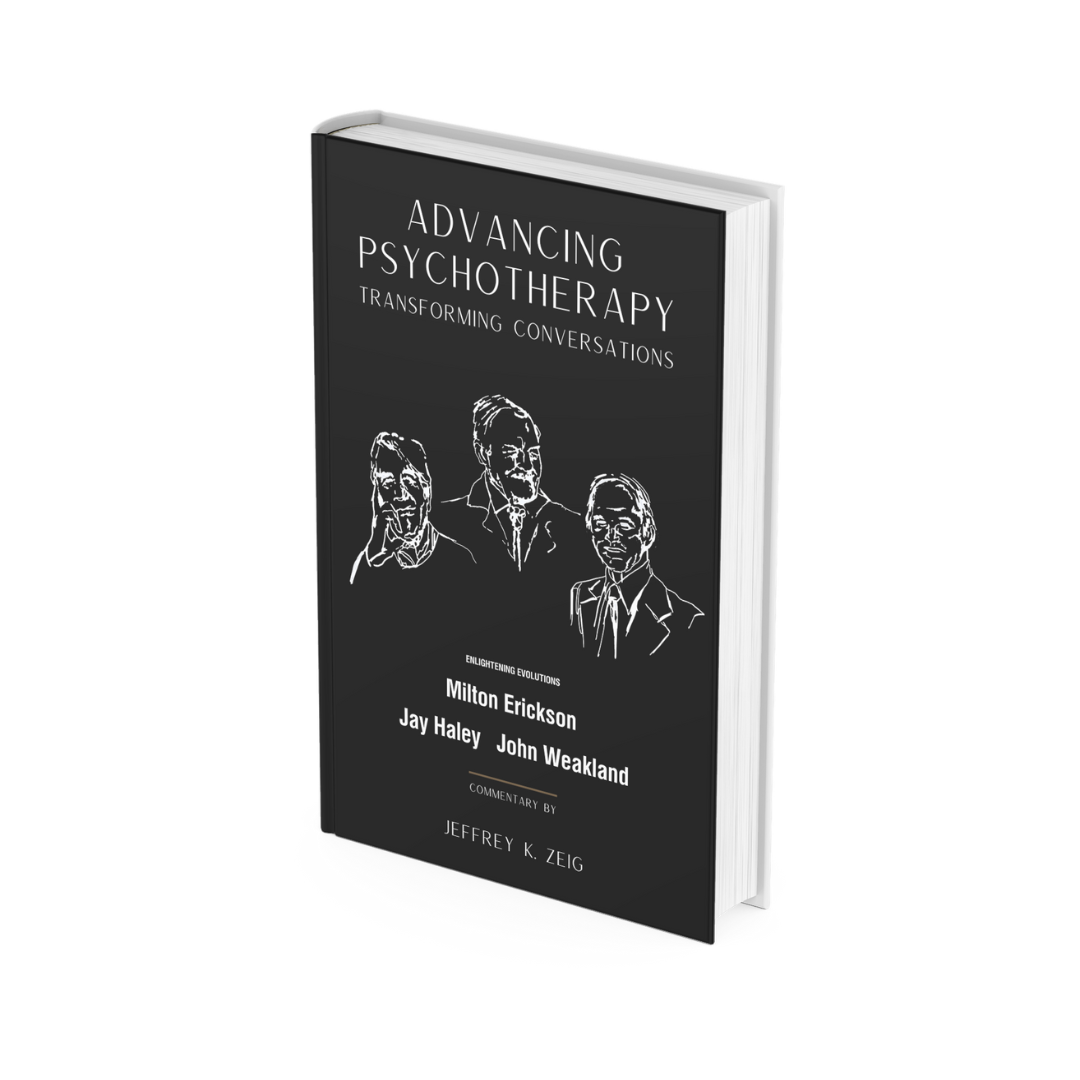
Transforming Conversations
by Jeffrey Zeig
Type: Softcover
When great minds meet, we are privileged to learn from their explorations…
As part of a communications project conducted in the mid-1950s and spearheaded by anthropologist Gregory Bateson, Jay Haley, and John Weakland went to Phoenix, Arizona to learn from and collaborate with Milton Erickson.
The meetings of these three great minds were recorded. Their explorations together both advanced the Bateson Project’s Double Bind Theory and helped to develop more effective approaches in psychotherapy.
Advancing Psychotherapy is a glimpse into an important time in the history of the field and a rare opportunity to learn from those who shaped the future of psychotherapy. Its content will improve your practice of psychotherapy.
