

Video Review

Dr. Erickson and Three Cases of Trauma
Reviewed By: John Lentz, D. Min
Estimated Reading Time: 1 minute, 24 seconds
This is a review of one of the many videos from The Erickson Video Collection.
“I have watched this hour-long video several times now and each time I gleaned more learnings. I am only beginning to grasp the wisdom of Erickson’s understanding of trauma. But despite its complexity, Jeff Zeig makes it much easier to understand with his insightful commentary.
Erickson’s multilevel storytelling was not only for the students’ understanding of trauma but also for their personal benefit. I also experienced meanings that touched me personally as well as helped me to understand better how to deal with clients’ trauma.
I especially liked watching how Erickson addresses issues in such a way that the other students do not know that a particular student is being helped until they realize he is also helping them. The time and effort Erickson spent in communicating not only his professional knowledge but also reaching out to help each individual is a reflection of who he was as a man. His generosity and caring is more than evident. No wonder people from all over the world loved and appreciated him.
Another advantage of this video is that you can also download the transcript so you can learn both cognitively and emotionally. It is a wonderful gem. I intend to teach what I have learned to my students because I believe that this video offers timeless truths, and it can be used to assist people dealing with all kinds of trauma. I highly recommend it.”
The entire Erickson Video Collection can be viewed here.
This video review has been extracted from Volume 40, Issue No. 3 of The Milton H. Erickson Foundation Newsletter.
You may like…
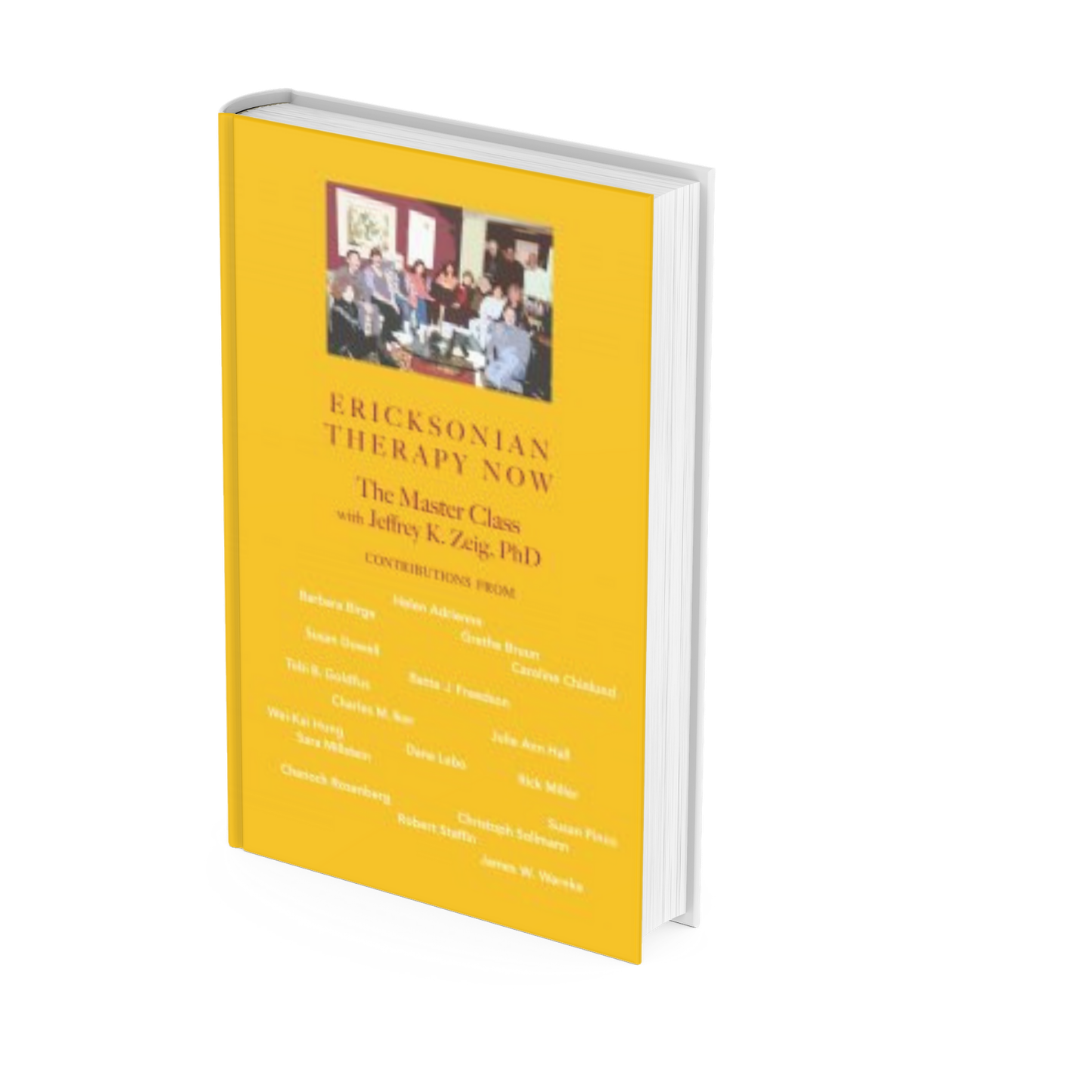
The Master Class with Jeffrey K. Zeig, PhD
by Jeffrey K. Zeig
Type: Hardcover
Milton Erickson was my mentor intermittently for more than six years; he was also an inspiration in creating the Master Class. At his essence, Erickson was experiential. He was the most radically experiential therapist to ever practice. Creating transformative experiences is a component in many schools of therapy, including rational emotive behavior therapy and cognitive behavior therapy, but for Erickson being experiential was not merely a component; it was most of his therapeutic work. Hypnosis is essentially an experiential technique. The subtext of hypnosis is this: “By living this experience, you can be different.” Hypnosis is not a means of providing information.
This book is an opportunity to study single-session therapies that are based in experiential methods. The learning from these methods is primarily stimulated by the client living the change, not by intellectual understanding of how to change. The participants declare what they are going to do differently and the sessions are designed to create experiences that foster the accomplishment of stated goals. Participants have solved complex problems and have made significant life changes. They have overcome writer’s block and then completed a book; they are happier in their jobs and relationships; they rebalance work and life; and they surmount childhood trauma.
The transcripts contained here offer opportunities to sit in on live interactions between therapist and client. An extraordinary adjunct to the transcripts are the participants’ — all stellar professionals themselves — notes on the sessions. They are able to articulate their understandings and impressions in such powerful ways that upon reading their perspectives I also took away something new.
Jeffrey K Zeig

by James F. Masterson
Type: Softcover
The culmination of 40 years of research into the personality disorders, this book documents the breakthrough integration that has brought Dr. Masterson’s theory into its fullest possible dimension. Initially descriptive, it evolved into a developmental theory, then into a developmental object relations theory, and, finally, into a developmental self and object relations theory. Now, with the recent emergence of attachment theory and the theory of the neurobiologic development of the self, the picture is complete and a clear and comprehensive statement to depict the origin and development of the personality disorders has taken shape.
Dr. Masterson and his fine team of coauthors have assembled a rich and comprehensive volume that features discussions of transference and countertransference, consciousness, mother-infant attachment, the psychotherapy of trauma, and therapeutic neutrality under challenge, among many other important topics. The members of the team are Margot T. Beattie, Barbara L. Short, Donald D. Roberts, Ken Seider, Steven K. Reed, Joseph Farley, Jerry S. Katz, and Judith Pearson.