

September Book of the Month
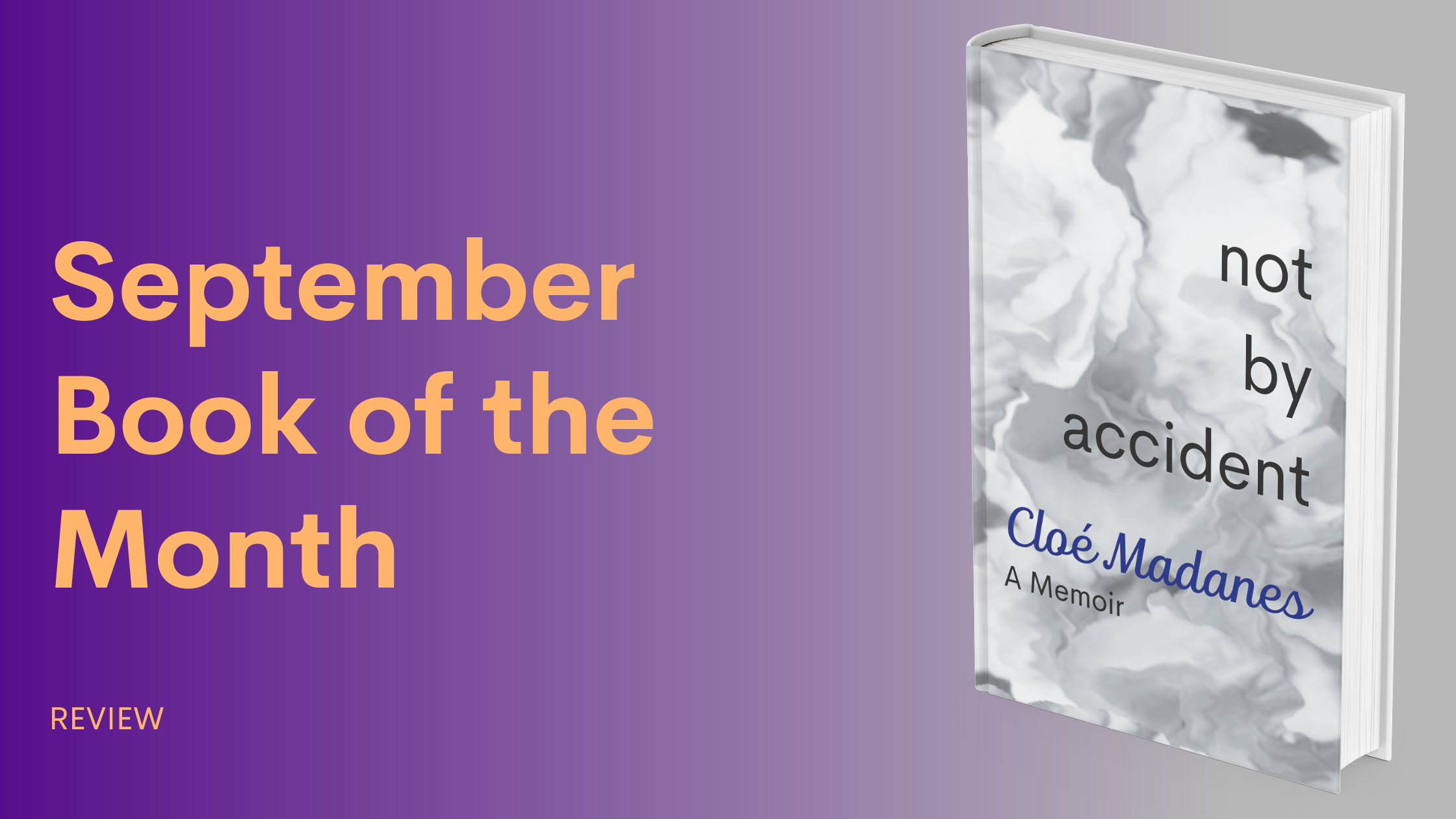
Not By Accident By: Cloé Madanes
Book Review by: Taylor Watson
From the very beginning of Not by Accident, Cloé Madanes reminds us that life is rarely simple. Instead, it is filled with incongruities, contradictions, and paradoxes that require flexibility, tolerance, and curiosity if we are to truly understand ourselves and one another. Love and violence can coexist. Joy can emerge alongside grief. Fear can eventually become courage. These seemingly opposing forces are not exceptions to the human condition– they are the human condition.
Perhaps that is one of the reasons this memoir feels so incredibly applicable to the times we are living in. We are constantly surrounded by news headlines, social media, political division, and an endless stream of information that often leaves us focused on darkness. Yet Madanes demonstrates another possibility. She shows us how darkness can be alchemized into light, how suffering can become wisdom, and how experiences that appear tragic at one point in life can later become the very foundation of purpose, creativity, and healing. She writes, “by telling my story I want to show how experiences that could be viewed as negative have inspired my most creative work.” Later she continues, “I wanted this memoir to create a bridge between my social context and my personal life, as these influenced my thinking about therapy, what I chose to focus on, and the way I look at human dilemmas.” These two statements beautifully capture the heart of the book. Madanes does not separate her personal life from her professional one; instead, she illustrates how each continually influenced the other. Her experiences living through the political unrest and war changed not only her family and worldview, but ultimately shaped the therapist, teacher, and humanitarian she would become.
From chapter one, Madanes demonstrates her own hypnotic storytelling abilities; she has an incredible way of taking readers directly to the “scene of the crime,” so to speak. Rather than simply describing events, she makes you feel as though you are standing beside her, experiencing them yourself. Like the finest Ericksonian communication, her storytelling is experiential rather than instructional. The reader is invited into the experience rather than simply observing it. At times this memoir almost reads like an exciting work of fiction– until you remember it is not fiction at all. It is someone's reality. As therapists, we often witness something similar with our clients. Some of their deepest traumas eventually become their greatest strengths. Their stories, much like works of fiction, follow a familiar narrative arc. There is an exposition where life seems ordinary, a rising action filled with conflict, a climax where everything appears to fall apart, and eventually a falling action and resolution where meaning begins to emerge. Healing rarely happens because painful chapters are erased. Healing happens because new meaning is created from them. What a beautiful reminder that, while we cannot always choose what happens to us, we continually construct the meaning we assign to those experiences. Madanes took the reality of growing up amid war, political instability, and uncertainty and transformed it into something profoundly beautiful. That, perhaps, is a lesson all of us can learn as we navigate today's world. Rather than allowing fear to dictate our lives, we can continuously cultivate love, trust, compassion, and hopeful curiosity.
Readers familiar with Madanes’ professional work will recognize many of the themes that have shaped her distinguished career. Long before this memoir, she became internationally known through Strategic Family Therapy, a text that continues to influence generations of clinicians. Yet reading Not by Accident provides an entirely different appreciation of her work because we begin to understand where those ideas originated. We meet not only the therapist, but the woman behind her theories. A particularly touching detail throughout this memoir is the role poetry played during the difficult periods of her life while the world around her was at war, poems of the heart sustained her inner world. They became a place where beauty, creativity, and hope could continue to exist regardless of external circumstances. Madanes discusses this as “creating good memories,” such a beautiful Ericksonian concept. While therapy often focuses on understanding painful memories, Madanes reminds us that healing also involves intentionally creating new experiences worth remembering. We are not simply processing the past– we are actively constructing the future.
This memoir is also a remarkable story of a woman's resilience especially through the lens of what women have historically endured in order to be respected and viewed as equals. Throughout her career, Madanes never lost sight of what mattered most. As she reflects, “what was most important to her was her work, especially her teaching.” That commitment is evident throughout every page. One of the most meaningful sections of the memoir describes Madanes meeting Dr. Milton H. Erickson during one of the most painful periods of her life following both her divorce and the death of her father. Reading these stories one cannot help but feel that this memoir serves as a beautiful thank you letter to Erickson himself– not simply for his brilliance as a therapist, but for his extraordinary ability to know exactly what another human being needed and gently empower them to discover it within themselves.
Years ago, Roxanna Erickson Klein described Cloé Madanes by writing that “[she] exudes a sophisticated, charismatic style,” and that “she knows how to take ideas and expand them, exploring the limits of professional understandings.” Those words remain just as true today. Her contributions to strategic family therapy, children's rights, violence prevention, International education, and humanitarian work have only continued to grow. Yet perhaps what strikes me most is her ability to embody what Roxana later described as “the centrality of love and the human experience.” Even while discussing difficult topics, Madanes consistently returns to hope, humor, compassion, and human potential.
The memoir concludes with a favorite reflection: "It's as if I had two lives: one was about what was happening around me, what others did to me; and the other was my inner life, what truly mattered to me–the life that is unique and personal.” This beautifully captures one of the central lessons of both Ericksonian Psychotherapy and this memoir. We each live simultaneously in an outer world and an inner world– in the conscious and the unconscious. While we cannot always control what happens to us, we have remarkable influence over how we choose to experience it, remember it, and ultimately integrate it into the story of our lives
Not by Accident is itself an extraordinary example of that process; it reminds us that our memories are not simply records of the past. They are living narratives continually shaped by perspective, meaning, and hope. Cloé Madanes took the hardships of her life and transformed them into wisdom, teaching, and service to others. In doing so, she offers readers far more than a memoir. She offers a model for how each of us might transform our own lives– not by accident, but through intention, curiosity, and love.
Whether you are a clinician, a student of ericsonian psychotherapy, or simply someone interested in the resilience of the human spirit, Not by Accident is a memoir worth spending time with. Its lessons unfold slowly, inviting reflection long after the final page. Like the finest therapeutic conversations, it leaves you not with all the answers, but with better questions– and perhaps a renewed appreciation for the remarkable ways human beings can transform adversity into meaning.
This book can be purchased through the Milton H. Erickson Foundation website at the link below.
You may also like …

A Memoir
by Cloé Madanes
Type: eBook
Format: .epub
Honest, clear, brilliant … Cloé Madanes tells her own story, and, in the process, explains how a psychotherapist is born, develops and contributes. She weaves a tapestry of her personal history, her social context and the politics of the time. The book is a gift to all who hope to understand the role of the past in who we become.
Not By Accident reflects Madanes’ conviction that free will and a system that follows its own rules exist simultaneously, and that the human spirit has the capacity to triumph in the face of all kinds of adversity. This conviction is central to Madanes’ account of her own life journey. In Not By Accident, she shows us how her therapy strategies evolved from her unshakeable belief in the power of people to drive each other sane and the power of words to change the world.
The book is a no-nonsense exploration of the hard truth about how Madanes went about constructing her own life. She captures contradiction, paradox and the complexity of the human experience in ways that will resonate with her readers’ own experiences and life stories.

A Memoir
by Cloé Madanes
Type: Softcover
Honest, clear, brilliant … Cloé Madanes tells her own story, and, in the process, explains how a psychotherapist is born, develops and contributes. She weaves a tapestry of her personal history, her social context and the politics of the time. The book is a gift to all who hope to understand the role of the past in who we become.
Not By Accident reflects Madanes’ conviction that free will and a system that follows its own rules exist simultaneously, and that the human spirit has the capacity to triumph in the face of all kinds of adversity. This conviction is central to Madanes’ account of her own life journey. In Not By Accident, she shows us how her therapy strategies evolved from her unshakeable belief in the power of people to drive each other sane and the power of words to change the world.
The book is a no-nonsense exploration of the hard truth about how Madanes went about constructing her own life. She captures contradiction, paradox and the complexity of the human experience in ways that will resonate with her readers’ own experiences and life stories.

Cloé Madanes (2009) Strategic Therapy with a Couple demonstrates with a young couple who is conflicted about holiday celebrations and vacations. The husband has wounds from his past that resonate with family holidays. He also wants to be more a part of his wife “inner circle” with her son from a previous marriage and vacations challenge him in this area. Madanes uses humor, insight and emotional connection to guide the couple to an accepting compromise.
Educational Objectives:
To name two strategies for therapy.
To list three important questions to ask in therapy.

by Cloé Madanes
Type: Softcover
After more than three decades, Behind the One-Way Mirror is as an essential resource now as ever. Why a revised edition? Because Cloé Madanes is a singular voice in strategic therapy, whose clarity and intellect can light the way for everyone working on the front lines of human relations — therapists and life coaches.
Ms Madanes has updated this important contribution to reflect an evolution in her own thinking: “I realized that now we possess a body of knowledge that can help millions of people and that we need to share this knowledge so that everyone can benefit from it, instead of limiting it to a small group of people who belong to the therapy professions. We are all related and we are here to help each other.” And it is with some urgency that she proffers a democratization of therapeutic advocacy: “ … we need to break up the illusion of separate identities that is the cause of so much intolerance.”
Ms Madanes’ clear observations, precise strategies, and nuanced understandings are brought to life in vivid case excerpts that allow therapists and coaches to identify the key steps in moving from idea to action with their own clients.
