

Diagnosis From Design
Elizabeth Erickson on Milton’s Eye for the Human Psyche
In 1986, Dr. Jeffrey K. Zeig received a handwritten Christmas letter from Elizabeth Erickson, along with one of her husband’s most treasured books — Hans Prinzhorn’s Bildnerei der Geisteskranken (1922), or Artistry of the Mentally Ill.
Prinzhorn’s book was among the first to treat the artwork of psychiatric patients as creative expressions worthy of aesthetic and psychological respect. His research challenged the boundaries between madness and genius, influencing artists from the Surrealists to Jean Dubuffet, who later coined the term art brut (raw art created outside of formal training).
Milton H. Erickson, whose curiosity about the human experience was limitless, found deep meaning in these ideas about art. He believed that drawings, paintings, and even casual doodles could reveal how people experience the world through their perceptions, distortions, and emotional truths. To him, art was another language of the unconscious.
Mrs. Erickson’s handwritten note to Dr. Zeig captures this side of her husband’s work. What follows is her account, exactly as she wrote it.
“Milton was always deeply interested in the manner in which neurotic and psychotic symptomatology, and ways of experiencing and interpreting the world, were manifested in the artistic productions of the artist.
For example, I recall at Eloise Hospital, a borderline psychotic patient – paranoid schizophrenic, I believe was his diagnosis – decorated the patient’s recreational room. He painted the walls and then trimmed them with an ornamental border near the ceiling. It looked like a simple design, but Milton showed me how he had concealed eyes along the design.
One of Milton’s more cherished books was a very rare copy in the German language of Hans Prinzhorn’s monumental and profound study of the art of psychiatric patients: Bildnerei der Geisteskranken (Springer, 1922).
Some years ago — probably in the 1950s — Life magazine, then a very popular picture weekly, had a special section on paintings done by mental patients, beautifully printed in color, with a brief description and diagnosis of each artist. I carefully covered all of the captions with opaque paper strips, and then challenged Milton to diagnose each one.
He did not make a single error. In a few, his diagnosis was more general than the actual caption–for example, a post-traumatic head injury patient was diagnosed by him as ‘some sort of organic brain damage.’ But not a single one was in error.
Some years later, I came across a very interesting article about the poet and artist, William Blake. Milton and I both were fond of his poetry. We both knew that he was considered to be a mystic and a visionary, but [we] had not read any biography of him.
I ran across (somewhere) a story about William Blake, describing him as sometimes manifesting psychotic symptoms. As an example, it was described that he had told a friend that he saw before him the ghost of a flea and that he then sketched the ‘hallucination.’ A reproduction of this sketch–a truly weird portrayal–was included.
Fascinated, I blocked off all the open pages except the sketch, showed it to Milton, and without revealing any identification whatsoever asked him to diagnose the artist.
His answer given with no hesitation, whatsoever, was, ‘That picture was done as a hoax–a joke- trying to convince someone else that he was ‘seeing things.’
I said, ‘Milton are you SURE? I have other information that leads me to believe this artist may have been mentally disturbed.’
Milton said, ‘I’m not saying this sketch was done by a well-adjusted person without mental problems. I’m saying that these particular sketches are a hoax…that in doing it, he was putting somebody on.’
All this happened many years ago-definitely before 1970, as I recall being in the Cypress Street house.
On July 9, 1985, I was on a visit to London, England with Janet Hensley and Shirley Bliss. Among places on that day, we visited the Tate Gallery — primarily to see a special exhibit of Turner paintings.
It just so happened that there was an exhibit of sketches, paintings, and manuscripts by William Blake.
Included was the ‘Ghost of a Flea’ — and an account beside it, stating that it had been done as a sketch of a hallucination, for a friend named VARLEY. It also stated that this may have been done as a hoax because Blake knew that Varley was very gullible and could have very well been leading him on.
This was the first time I had ever been aware that anyone except Milton had realized the nature of this sketch.”
Elizabeth Erickson’s letter shows how naturally Milton moved between art and psychology. A drawing was not just a picture to him. It was a map of thought and feeling, a record of how someone experienced the world. He inferred diagnosis from design, using form and pattern as evidence of underlying mental processes.
Psychotic Art #1 — displayed at the Erickson Historic Residence
You may like…
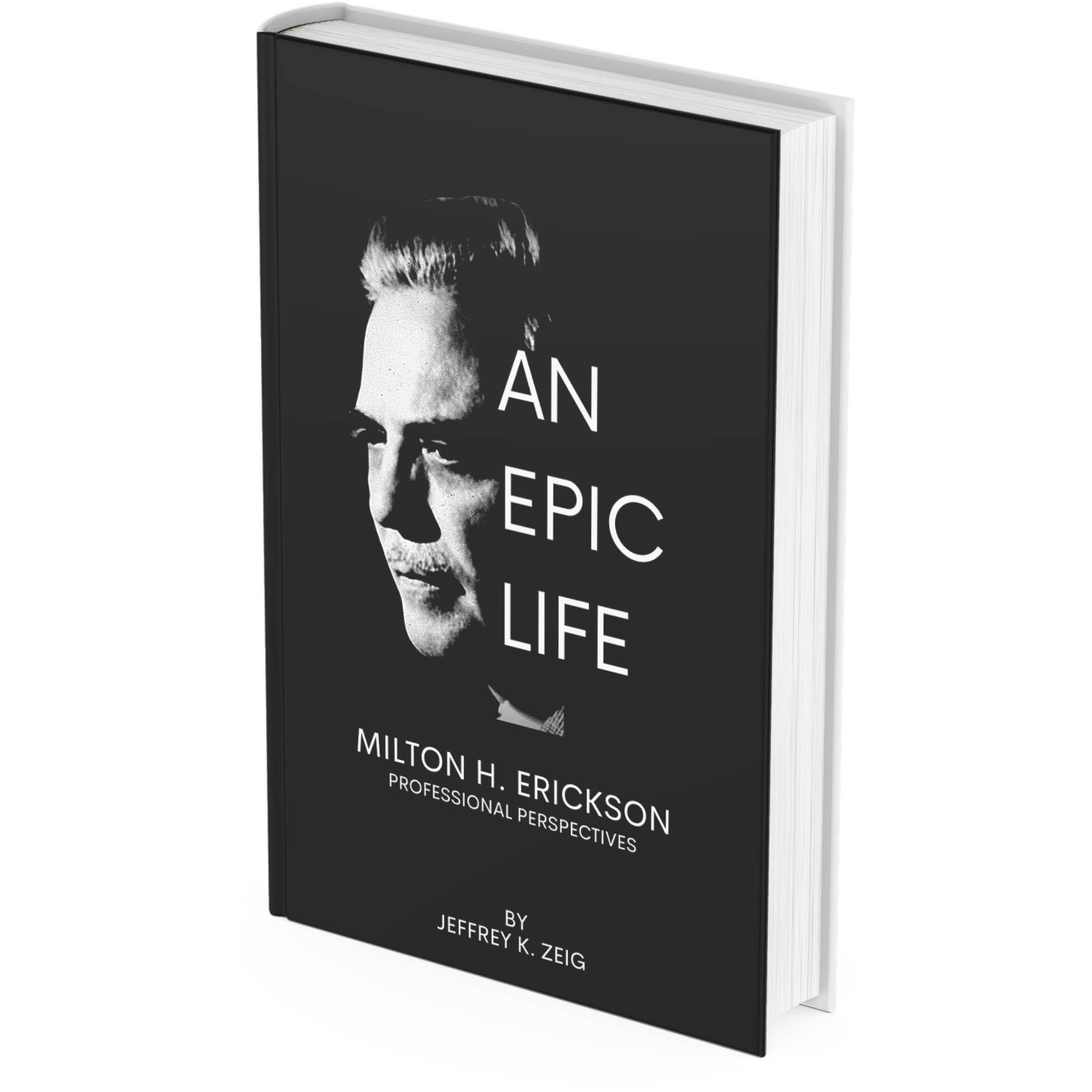
Professional Perspectives
by Jeffrey Zeig, PhD
An Epic Life is a biography written by many authors. Throughout his professional life, Milton H Erickson attracted a diversity of critics and supporters, and this book gives all a voice. Erickson was known to work with patients to elicit in them the innate ability to “connect the dots” to discover their adaptive potentials. Readers will delight in being able to connect the dots too, piecing together a portrait of an extraordinary and complex figure, as they look through the eyes of the men and women who met him at important junctures.
An Epic Life draws upon four decades of interviews with professionals who knew Erickson. The incisive perspectives are interlaced with commentary from Jeffrey Zeig to clarify and contextualize. The images of Erickson that emerge are congruent, divergent, myriad. In the end, readers gain unusual access to the man, his commitment, and his work. There is nothing simple in what is conveyed, and yet the impression it makes is coherent — and lasting.
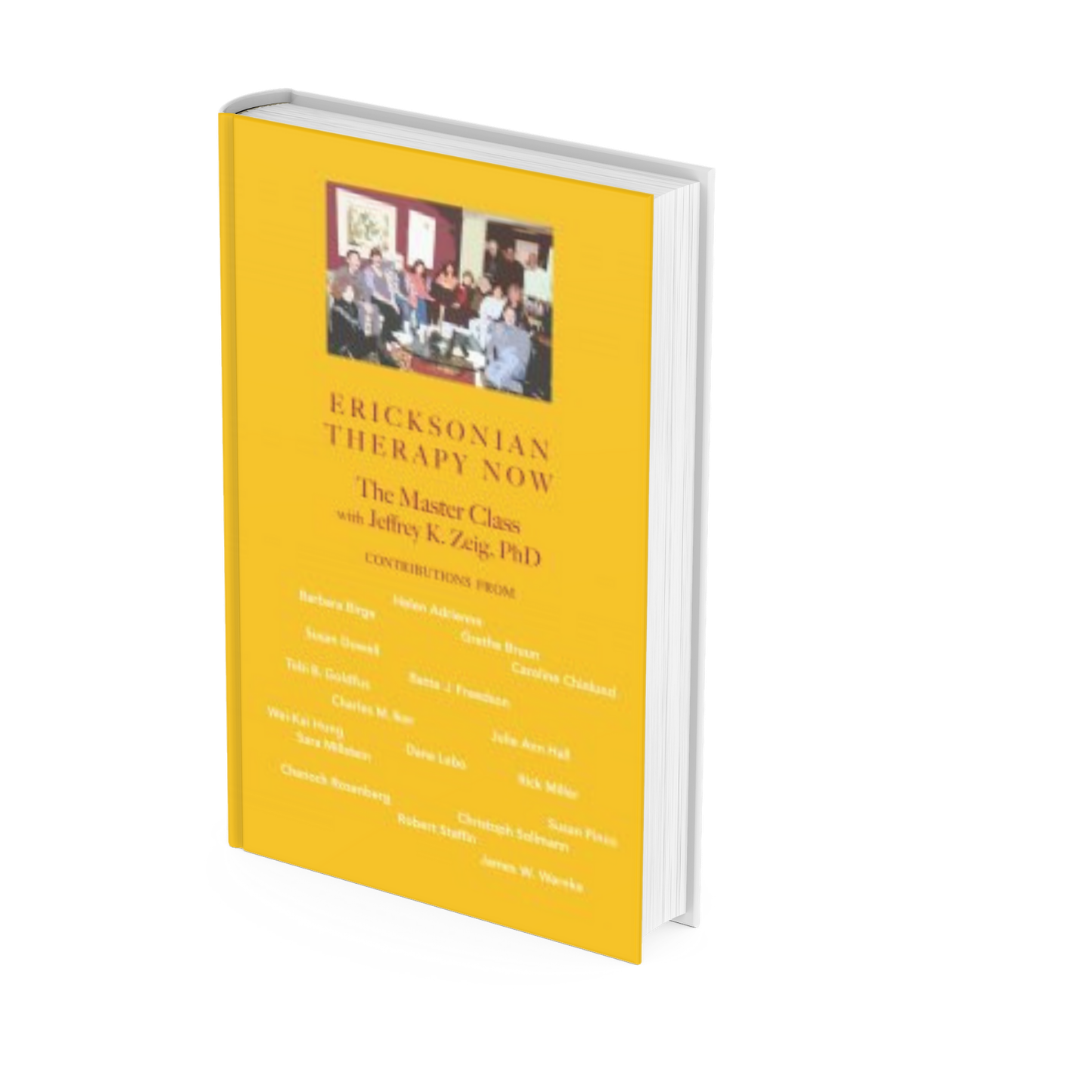
The Master Class with Jeffrey K. Zeig, PhD
by Jeffrey K. Zeig
Type: Hardcover
Milton Erickson was my mentor intermittently for more than six years; he was also an inspiration in creating the Master Class. At his essence, Erickson was experiential. He was the most radically experiential therapist to ever practice. Creating transformative experiences is a component in many schools of therapy, including rational emotive behavior therapy and cognitive behavior therapy, but for Erickson being experiential was not merely a component; it was most of his therapeutic work. Hypnosis is essentially an experiential technique. The subtext of hypnosis is this: “By living this experience, you can be different.” Hypnosis is not a means of providing information.
This book is an opportunity to study single-session therapies that are based in experiential methods. The learning from these methods is primarily stimulated by the client living the change, not by intellectual understanding of how to change. The participants declare what they are going to do differently and the sessions are designed to create experiences that foster the accomplishment of stated goals. Participants have solved complex problems and have made significant life changes. They have overcome writer’s block and then completed a book; they are happier in their jobs and relationships; they rebalance work and life; and they surmount childhood trauma.
The transcripts contained here offer opportunities to sit in on live interactions between therapist and client. An extraordinary adjunct to the transcripts are the participants’ — all stellar professionals themselves — notes on the sessions. They are able to articulate their understandings and impressions in such powerful ways that upon reading their perspectives I also took away something new.
Jeffrey K Zeig

by Stephen R. Lankton
Type: Hardcover
A compilation of essential contributions that span a period of 17 years, this volume highlights the extraordinary breadth of Stephen Lankton’s unique therapeutic approach, its techniques, protocols, and frameworks. The sections include Ericksonian Hypnosis and Therapy, Brief Therapy, Metaphor, Anxiety and Trauma. Within each section readers will discover an array practical and potent material that is certain to enhance the power of therapy, whether or not the therapist is working within an Ericksonian paradigm.
Praise for Assembling Ericksonian Therapy: Collected Papers of Stephen Lankton
“Stephen Lankton’s lucid and readable prose puts the principles and applications of Ericksonian Therapy easily within the grasp of his readers.”
Alexander A. Levitan, M.D., M.P.H.
“This collection reveals why [Lankton] has been at the forefront of the fields of hypnosis and brief, goal-directed psychotherapies for more than two decades. These papers provide readers with an opportunity to share his wisdom.” —
Michael D. Yapko, Ph.D.
“The ideas [are] both practical and imaginative, dealing with hypnotic technique as well as such areas as family violence. This is an expansive presentation of papers ranging from the ideology of Erickson to using therapeutic metaphor in social work.” —
Jay Haley.

Personal Perspectives
by Jeffrey Zeig
An Epic Life Vol. II is the second biography on Milton H. Erickson written by Jeffrey Zeig. The first volume features professional perspectives on Erickson and this book offers a personal lens, as seen through Erickson’s family, friends, neighbors, students, secretaries, and patients. The reader gains access into the dynamic personal world of Milton Erickson, who was a one-of-a-kind communicator of unparalleled brilliance.
Erickson was known to work with patients to elicit in them the innate ability to “connect the dots” to discover their adaptive potentials. Readers will delight in also being able to connect the dots, piecing together the professional aspects of Erickson in the first volume with the personal ones in this volume. For Erickson, the line between his professional life and personal life was blurred. He was doctor, teacher, friend, and neighbor all at the same time. Readers will see how his therapy methods carried over into his personal life. Or was it perhaps the other way around?
An Epic Life II draws upon decades of interviews with those who knew Erickson on a more personal level. The incisive perspectives are interlaced with commentary from Zeig to clarify and contextualize. The images of Erickson that emerge are congruent, divergent, and myriad. In the end, readers will have a more complete picture of the man, his commitment, and his work. There is nothing simple in what is conveyed, and yet the impression it makes is coherent – and lasting.
Zeig prepares us for this stimulating journey by providing a comprehensive history of Erickson’s lineage, and background on the many contexts mentioned in the book.
Erickson was one of the greatest psychotherapists of the 20th century and the father of modern hypnosis and brief therapy. His professional contributions continue to influence the field and its practitioners and his personal life is inspirational.
As we strive to evolve personally and professionally, we should do as Erickson did: Leave the world a better place.