

March Book of the Month

“The Imprinters: Surviving the Unlived Life of Our Parents”
by Eileen Walkenstein, MD
In “The Imprinters: Surviving the Unlived Life of Our Parents,” psychiatrist Eileen Walkenstein presents a detailed account of a nine-month psychotherapy group she led in Florence, Italy, during the 1970s. Through narrative, session transcripts, reflective commentary, and later correspondence with participants, she traces deeply rooted emotional patterns formed within early family relationships and explores how they influence identity and behavior.
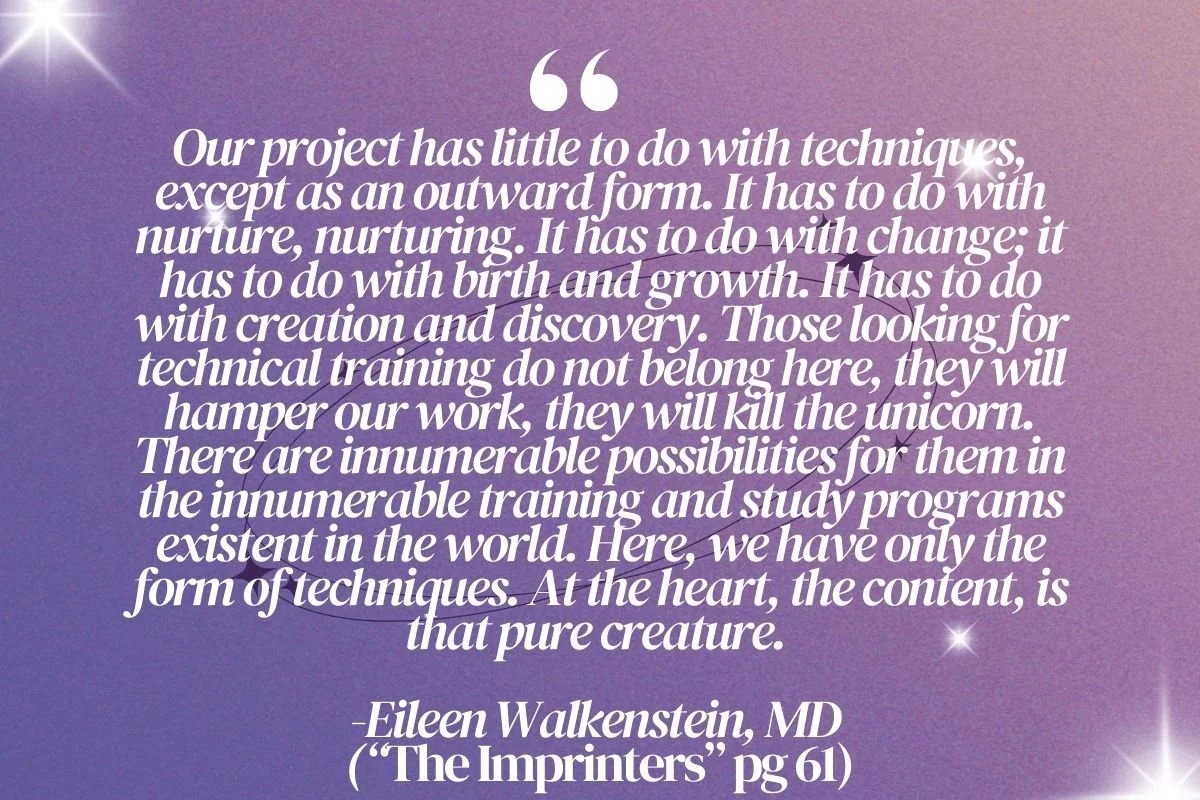
Walkenstein’s book reflects the atmosphere of the human potential movement during that era. It was a period of intense experimentation, when therapists were exploring new experiential ways of addressing psychological and emotional pain. Session exercises often included intense forms of physical and symbolic regression work. The goal was to grasp an elusive element Walkenstein referred to as “the unicorn”:
🧱 Structure and Content
Walkenstein includes extended dialogue from the sessions, allowing one to follow the process as it unfolds. The reader can observe:
The use of structured role dialogues and direct exchanges.
Participants’ internalized parental figures.
The evolution of key insights across multiple sessions.
Moments of resistance, emotional intensity, humor, and integration.

Interspersed throughout the session material are “End Notes,” in which Walkenstein reflects on what occurred, clarifies conceptual points, or comments on clinical dilemmas that arose in the moment. The book also includes later updates from participants, providing a longitudinal view of how the work influenced their lives in the years that followed.
🎯 Central Themes
The book places strong emphasis on:
The relational field rather than the isolated individual.
The ongoing presence of parental influence in adult life.
Experiential methods as means of accessing and transforming entrenched patterns.
⚙️ Method and Clinical Style
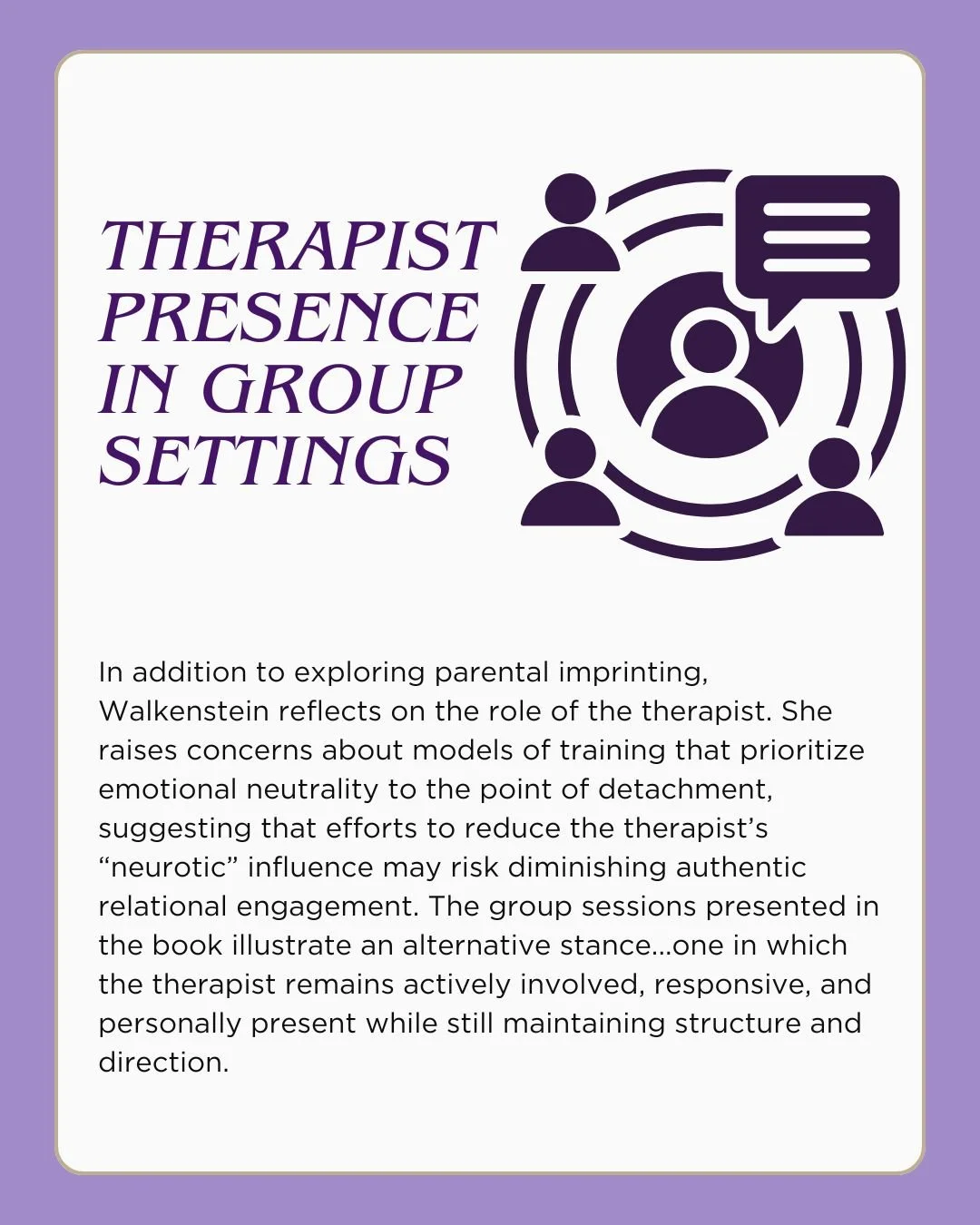
Walkenstein’s approach is highly experiential. Techniques frequently involve:
· Role exchanges between participants and imagined parental figures.
· Direct repetition of emotionally charged statements.
· Structured confrontation of internalized voices.
· Behavioral and verbal experiments conducted within the safety of the group.
The sessions often move between intense engagement and periods of distancing or reflection. Walkenstein documents these shifts openly, providing insight into group process as well as individual work.
🔗 Relevance for Ericksonian Readers
Although Walkenstein does not frame her work within Ericksonian psychotherapy, several aspects may be of interest to readers familiar with Milton Erickson’s legacy:
Experiential Emphasis: Change is pursued through lived experience in the session rather than through interpretation alone.
Utilization of Process: The therapist works with what emerges in the room…circumstance, emotions, resistance, humor, and shifts in attention…rather than following a rigid protocol.
Focus on Relational Context: The individual is consistently identified within a broader relational system.
Attention to Behavioral Expression: Insight is linked to observable shifts in speech and interaction.
Readers interested in generational transmission, group psychotherapy, and action-oriented methods may find the detailed session material particularly valuable.
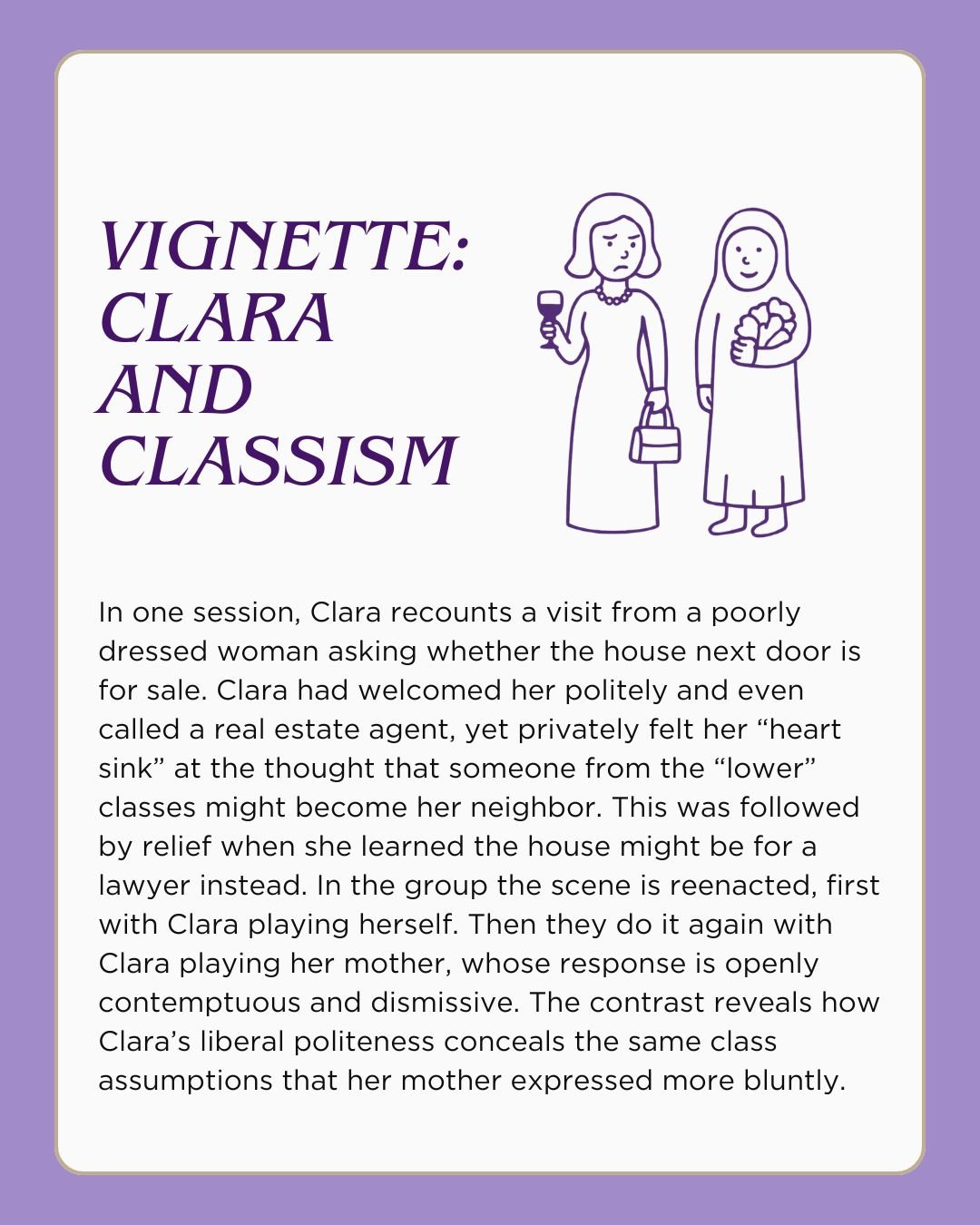
💡 “The Unicorn” Revealed
The following is an excerpt from page 345, written towards the conclusion of the sessions:
“…it is fitting somehow that our search for the unicorn should end the nine months’ voyage by bringing our dreams home to our own shores. And I know that each in her own way has caught a glimpse of the elusive pure creature…and that each will continue her unique pursuit for its presence.”
“The unicorn” evolved from a vague concept at the beginning of the book into being a symbol for the authentic self that was hidden beneath inherited family patterns.
💡 Conclusion
Walkenstein’s book documents an experimental form of group psychotherapy in the midst of its development, allowing readers to see how her ideas emerged directly from the group experience.
“The Imprinters: Surviving the Unlived Life of Our Parents” is available in softcover through the Milton H. Erickson Foundation Bookstore.

✍️About the Author: Eileen Walkenstein was a psychiatrist and psychotherapist whose work explored experiential approaches to psychotherapy and personal development. She is the author of several books examining the influence of early family relationships and emotional development.
You may also like …

by Jerome A. Price and Judith Margerum
Type: Softcover
Jerome Price and Judith Margerum have joined forces to bring together an essential model for helping parents to help themselves as parents. Therapists will find here a host of practical, easy-to-implement strategies for working with parents to reclaim their lives when their children’s behavior is out of control.
Each Right to Be the Grown-Up package comes with a “Facilitator’s Guide” and 6 copies of the “Parent Handbook.” The package is designed to be used in groups or when working alongside parents in a private therapy setting. (The authors also provide a series of parenting affirmations — or lifelines — on wallet-sized cards so that therapists can give them out to their clients.)
The Facilitator’s Guide is laid out into 5 sessions: Getting Started; Reactivity; Information; Coalitions/Teamwork; and Making It Work. Step-by-step guidance is provided on how to lead parents gently but determinedly through a series of learning modules, each of which will clarify parenting goals, instill hope, provide tools, and “unfuzzy” the boundaries that have faded over time. Practical exercises and support materials are offered throughout.
The Parent Handbook follows the sequence of the guide and offers a slew of helpful homework assignments, definitions, and mottos designed to reinforce the information presented there and to bolster parent confidence even at the toughest of times. Additional Parent Handbooks and packets of “lifelines” may be ordered separately.
Developed by the Michigan Family Institute, this skills program has already met with great success through workshops and trainings based on it. Price and Margerum show what it looks like to move from theory to action when it comes to improving the lives of parents and their adolescent children.

Surviving the Unlived Life of Our Parents
by Eileen Walkenstein
Type: Softcover
The Imprinters is the story of a very personal journey. The book evolved out of an intensive year’s work near Florence, Italy with a group of dedicated persons willing to follow Dr. Walkenstein into whatever dark and even dangerous passageways beckoned. That work was at the same time taking place in her monthly workshops in Paris.
The work in Italy was deepened and enhanced by the participation of several people from her Paris Workshop who came to Florence. Out of the intensity was born “the Nucleus,” the most amazing, even explosive, discovery in all of Walkenstein’s years of working in the field in which she has been so passionately involved. The book is daring. It explodes old myths about the family, and shows the way to get freed from the shackles and tyranny of the past.
“The sins of our fathers and mothers are visited upon us,” Walkenstein explains. “It is what we do with the consequences that determines the degree of our integration and wholeness. Therapy heals us only when it heals our parents within us. So the best therapy is that which treats the grand crimes of our parents against us. That is our job, and what we were born in order to accomplish.”
At the “professional heart” of this book, Walkenstein reveals that The Nucleus is not a technique, not a new tool for therapeutic manipulation of people, not a new psychoanalysis “to push people down on their backs and run roughshod over them with a new jargon.” Instead, The Nucleus is “a concept, a suggestion of an entity, a dream. It must be approached not in the spirit of capturing it….but in the spirit of following it into whatever dark corners it may lead us.”

Volume 6
Four family constellations show the harmful identifications that children sometimes have with parents and grandparents. Hellinger works with participants to acknowledge hidden dynamics and to discover healthy ways to recover compassion and love.

by Bert Hellinger and Gabriele ten Hovel
Type: Softcover
Considered one of the most innovative psychotherapists in the world today, Bert Hellinger has garnered the attention of the international therapy community, as well as the segment of the lay community interested in recovering sources of healing and wholeness. In Acknowledging What Is, Hellinger sheds light on his unique use of family constellations to reveal hidden – often destructive – family dynamics and to activate healing resources. Hellinger also speaks freely and frankly about his observations of the forces at work in family systems and the controversy that surrounds some of those observations.
In this probing interview, Gabriele ten Hovel brings to her conversations with Bert Hellinger a journalist’s skepticism. In her voice is the sense of wonderment that many may have who do not understand how such an approach can work or who have only heard about statements attributed to Hellinger. And there are times when we hold our breath, poised to be outraged by his answers and explanations. Instead, the tough questions are met by equally tough answers – and in the spaces between question and answer the formidable power of the family constellation begins to unfold.
This book provides an opportunity for Bert Hellinger to lay to rest some misunderstandings, to clarify his thinking on entanglement and resolution, to describe what he means by the “movements of the soul.”
In the end, though, the book also provides an opportunity for readers to open their hearts and minds to the power of the family constellation. Born out of the most humble therapeutic stance, that of respectful observation, this approach makes contact with the deepest levels of family engagement and disengagement.
Sit in as the logical minded journalist and the “caretaker of the soul” consider the human condition together. You may take away little gems or find that your perspective goes through a major shift – either way, these “conversations with Bert Hellinger” will energize your thinking.
Described as the ultimate empiricist, Bert Hellinger acknowledges several important influences on his life and work: his parents, whose faith immunized him against accepting Hitler’s National Socialism; his 25 years as a priest, particularly as a missionary to the Zulu; and his participation in interracial, ecumenical training in group dynamics. However, it was in Hellinger’s later training in family therapy that he first encountered the family constellations that have become the hallmark of his therapeutic work.
