

December Video of the Month

Timeless Presentations from Erickson Foundation Events
This is a series exploring keynotes, workshops, and dialogues from past Erickson Foundation conferences—featuring the field’s most influential voices.
These recordings from The Milton H. Erickson Foundation archives offer historical interest and hold lasting clinical value. Each session distills complex therapeutic ideas through lived examples, practical experience, and the subtle choices of the presenters and participants. These sessions continue to invite reflection, offer perspective, and reconnect us with core principles that remain relevant across time and context.
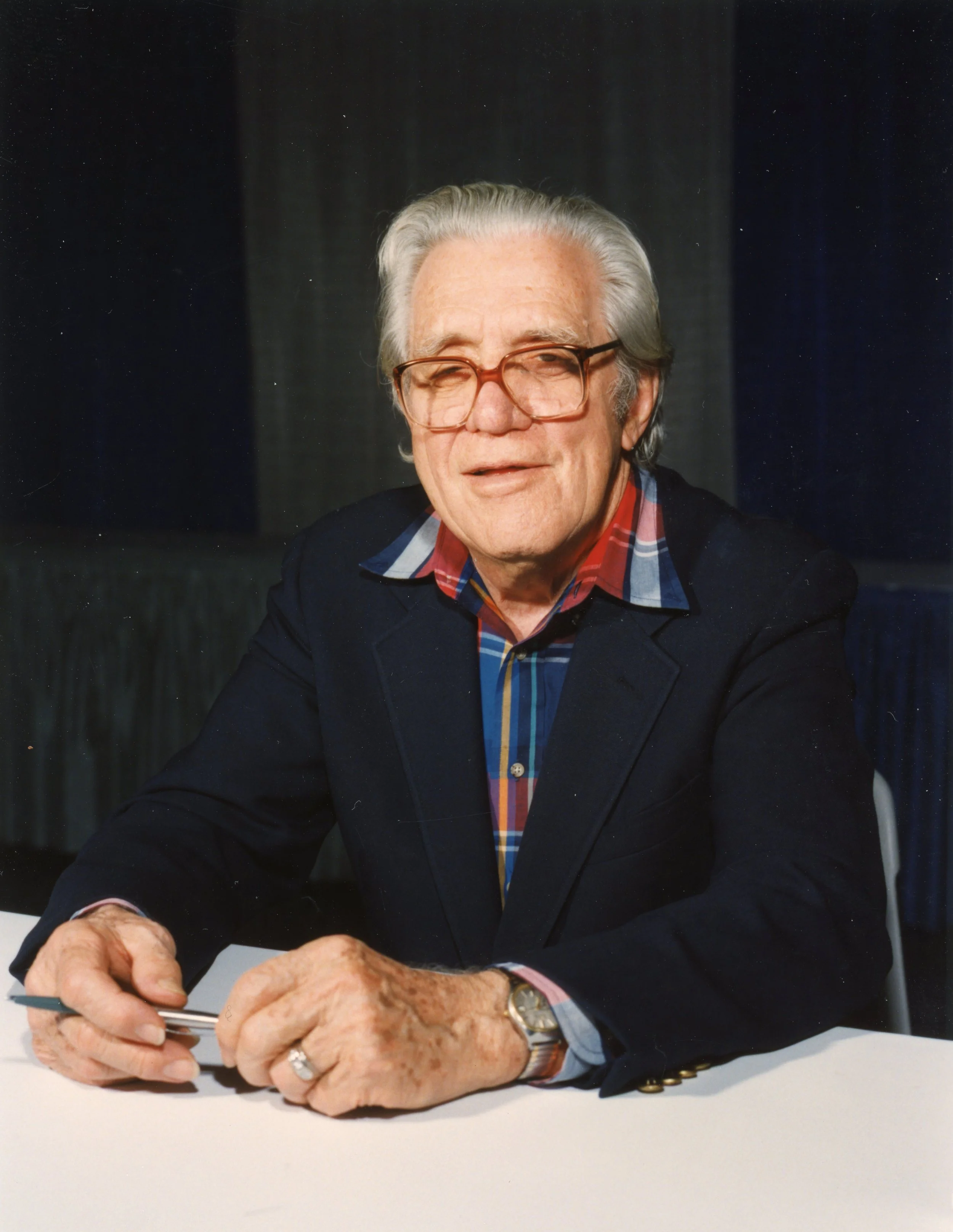
Carl Whitaker at Author’s Hour, 1990 Evolution of Psychotherapy Conference.
This month’s selection is…
Therapeutic Three-Generation Family Reunion – Carl Whitaker, MD
Evolution of Psychotherapy Conference 1990 | Anaheim, CA
About the Speaker
Carl Whitaker, MD (1912–1995) was a pioneering figure in experiential family therapy and one of the field’s most unconventional and highly improvisational voices. Trained as a psychiatrist, Whitaker served as Chair of the Department of Psychiatry at the University of Wisconsin Medical School, where he helped shape innovative approaches to psychiatric training and family-oriented clinical work.
He later helped establish a Family Therapy Training Program in Wisconsin, known for its emphasis on emotional process, therapist self-awareness, and experiential learning. Whitaker’s approach was characterized by spontaneity, humor, and a belief in the healing potential of authentic engagement.
He is the co-author, with Augustus Napier, of the influential book ‘The Family Crucible’, which remains a cornerstone text in many family therapy programs. His style reflected the norms and clinical culture of his era at times, but Whitaker’s ideas continue to inform systemic and experiential models of therapy, offering insights into how families grow, loosen rigid patterns, and find new ways of relating.
Unwrapping Family Roles: Whitaker’s Approach to Multigenerational Connection
The holiday season invites a special kind of gathering. Kitchens fill, living rooms spill over, and generations converge…sometimes joyfully, sometimes tensely. This time of year has a way of placing families face-to-face with ancestral dynamics: the traditions we inherit, the wounds we carry, and the roles we step into almost automatically.
In Carl Whitaker’s 1990 clinical presentation, Therapeutic Three-Generation Family Reunion, we witness a family navigating these types of dynamics. A grandmother, a mother, a father, and two young children are intertwined across three generations and two households. The nine-year-old girl has been struggling with anxiety and heart palpitations. Whitaker, with his hallmark blend of irreverence and playfulness, steps into the system along with their regular family therapist to consult and help the family gain a deeper understanding of themselves.
This family comes together while struggling with blurred generational roles and disrupted routines. Economic changes have led to their fragmented living situation. Cultural expectations shape how each generation sees its duties. Grief, loyalty, and unspoken fears quietly shape the bonds between them. In a sense, this session is a portrait of a holiday reunion many of us would recognize.
The Vulnerability of the Generations
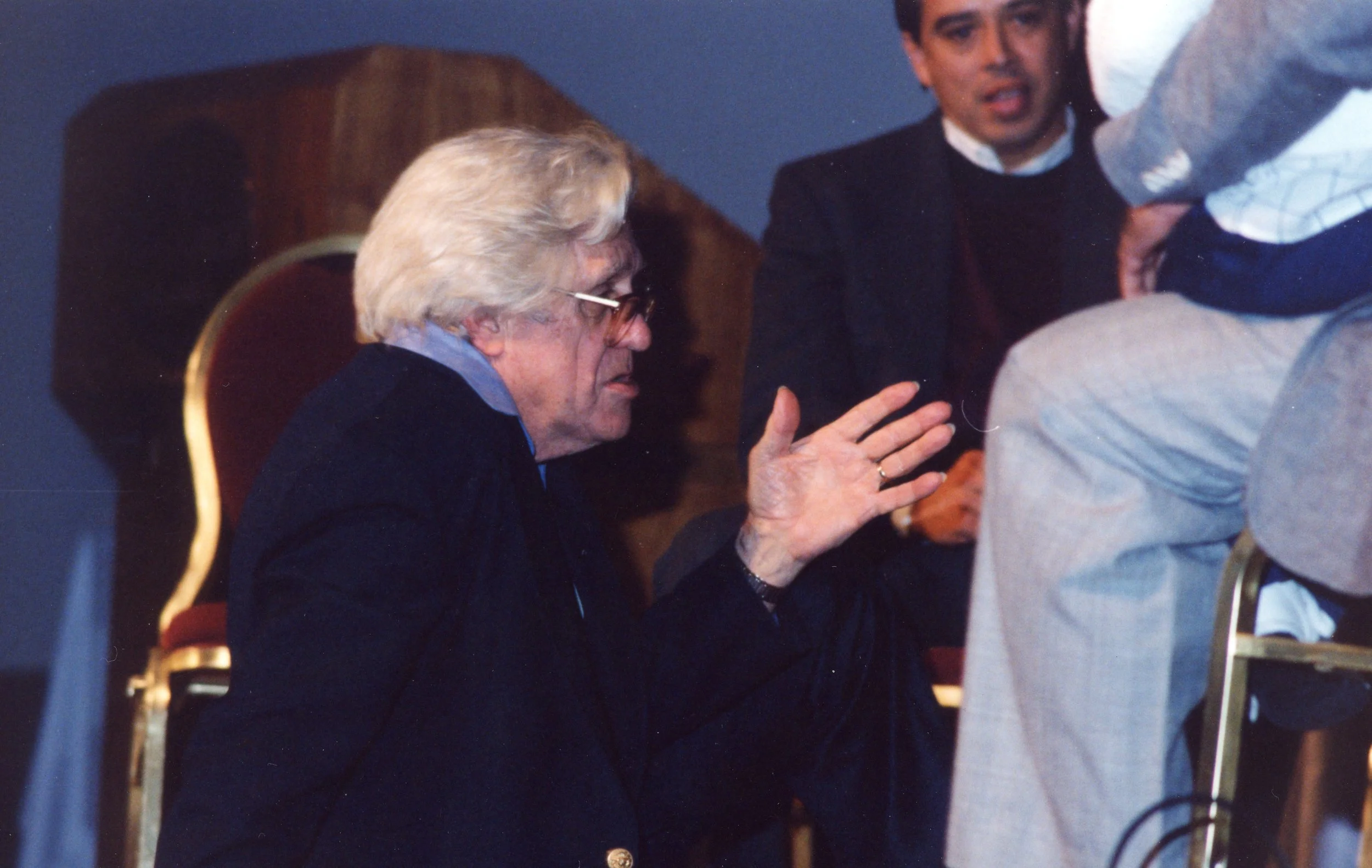
Whitaker gets on the floor, likely attempting to connect with the children in the family.
Whitaker begins by inviting the family to reflect on where tension sits in the system. The grandmother admits “we don’t understand each other,” expressing her frustration at feeling unheard. The mother, raised in a strict household, struggles to imagine being anything other than responsible and composed. The father reveals deep attachment to his own mother, hinting at cross-generational loyalties that complicate his role in the current household.
Holidays often amplify these types of dynamics. Old patterns re-emerge, unspoken resentments resurface, and the child that is sensitive, intuitive, and watchful, becomes the emotional barometer of the home. Whitaker recognizes this immediately. The anxious little girl, he observes later, has been placed in the impossible position of carrying the family’s emotional weight.
From here, Whitaker begins guiding the family toward a new balance, one where the child no longer bears the system’s anxiety.
Role Reversal Brings Renewal
Instead of “fixing” the family, Whitaker gently disrupts their expectations. What if the grandmother became a teenager again? What if the mother became the daughter? What if the granddaughter became the mother to her own mother? These unconventional interventions create space for the family to breathe.
Holiday rituals often reinforce familiar family roles: the mother who bakes cookies shaped like stars, the father who pulls out festive sweaters, the grandmother who insists on a traditional recipe, the children who take their places as eager helpers. These roles can be comforting, but they can also become too rigid over time, turning into expectations rather than choices.
Whitaker works directly with that kind of rigidity. In the session, when the grandmother shyly considers his suggestion of going dancing with her son-in-law, he isn’t trying to create a new ritual…he’s temporarily lifting her out of the familiar role she always occupies, much like imagining the mother who always bakes cookies during the holidays doing something entirely different for once. By inviting just one family member to step outside of their usual place, he gives the entire system a chance to move. Practices like this can open space for new ways of seeing and relating to one another.
Healing That Moves Generationally
One of Whitaker’s most profound contributions to family therapy is his belief that change happens at the level of the whole system. A child’s symptoms often reflect adult tensions. Anxiety in one generation may be a response to unresolved grief or immobilized roles in another. As Whitaker reflects after the session, the little girl’s anxiety may stem from “being put in the position of being the maternal person” in a fragmented family, carrying an emotional responsibility far too heavy for her age.
By reshuffling the generational order, even imaginatively, he gives everyone permission to release their grip on the roles that keep them stuck. The grandmother is allowed to stop being the stoic matriarch. The mother is allowed to stop being perfect. The father is allowed to step closer. And the little girl is allowed, finally, to be a child.
In his closing reflections, Whitaker names this loosening of roles as central to easing anxiety within the family system:
A Seasonal Invitation to Reconnect
As we enter the holiday season, Whitaker’s session offers a reminder:
families cannot heal by tightening old roles, but loosening them may provide the freedom necessary to find a new way forward.
When we gather for the holidays, we might ask ourselves:
Which responsibilities am I holding that are no longer mine? Which responsibilities do I no longer want?
Where might a little playfulness free us from old patterns?
What would happen if I allowed myself or someone I love to shift, even slightly, towards a different role?
Whitaker shows us that multigenerational connection can be built upon by being flexible and warm, and having the courage to imagine one another anew.
And perhaps that is the most universal holiday tradition of all: the chance, year after year, to reconnect, rediscover, and strengthen ties within the family.
You may like …

by David Keith
Type: Softcover
Carl Whitaker was one of the most influential family therapists of the 20th century. He had his loyal following, including David Keith. He also had critics, such as one therapist who shortly after Whitaker’s death in 1995 called him a Crazyman. Not far from the truth Keith would say, though he defines Crazyman this way: a full-fledged human being: thoughtful, imaginative, down-to-earth, curious, spiritual, smart, playful, inconsistent, tough, tender, ironic, supportive, rebellious, self deprecating, loving, and generous.
Whitaker was a longtime friend, teacher, mentor, co-therapist and collaborator. Their connection lasted 33 years. Whitaker embodied therapeusis, that elusive complex, energetic, and abstract core of psychotherapy. And with this book, Keith calls for a higher order — the reinvigorating of clinical minds in accord with therapeusis. He proposes that therapists listening be more nuanced, and that they playfully and energetically use language in all its forms irony, syntax, metaphor, etc. rather than relying solely on evidence-based methods. Irony, especially, commands Keith s full attention because overregulation he suggests leads to squelched spirits, impaired by irony deficiency.
Keith champions semiotics, offering an analogy of a forest: alive, recycling, blossoming, growing, consuming. If not for the heartless Empire of Overregulation with its lifeless language of business-eze, bureaucracy, and bottom-lines, therapists could more freely pursue their passion for truly helping others. Carl Whitaker took giant steps in this direction, and David Keith continues making the case. Like a marathon runner, Keith has taken up the torch of therapeutic freedom, adding essential perspectives to the real meaning of caring for patients. This is an endlessly rich and creative process in which patients may actually be guided to greater well-being and therapists may avoid the pitfalls of burnout and resignation.

Hypnotically Generating Theraputic Possibilities tape cover Hypnosis, to quote Michael Yapko, is about focusing–about helping clients build a frame of mind to accomplish their goals. What attracted Yapko to hypnosis–and has kept him attracted to it all these years? His answer, quite simply: “I don’t know a better way of empowering people.”
In this compelling 60-minute teaching demonstration of a formal induction, viewers watch as Dr. Yapko, a master listener and storyteller, empowers Bob, a fellow clinician struggling with issues of professional competence.
Emphasizing the inherent ambiguities of the clinical situation, and the multiple ways of doing good therapy, Dr. Yapko frees Bob to begin to trust himself more and to worry less about validation from others. Upon coming out of hypnosis, Bob observes how liberating the session was for him. “There was a world of choices,” he says, “where before there was only one–and the one I had wasn’t any good.”
The tape includes captioned commentaries in which Dr. Yapko explains his goals for the session and the significance of moment-by-moment interventions. A brief, concluding Q&A section adds another dimension to the learning. Michael Yapko is among today’s clearest teaching therapists. And for all those interested in how metaphor, humor, confusion, and storytelling can be combined with permissive suggestions to open up new possibilities for clients, Hypnotically Generating Therapeutic Possibilities is without peer.

Volume 4
In this powerful video, four different family systems move toward resolution in the wake of the loss of a child.

Volume 6
Four family constellations show the harmful identifications that children sometimes have with parents and grandparents. Hellinger works with participants to acknowledge hidden dynamics and to discover healthy ways to recover compassion and love.
