

8 Ways to Manage Relationship Stress During COVID-19

Estimated Reading Time: 4 minutes, 16 seconds
This past year, everyone has gotten used to the pandemic life, and with that has come relationship stress. Whether you live with your partner or not, this is a big stressor many people are feeling. Those that live with their partner are together more often than usual with their partner as we all have been quarantining, on lockdown, or trying to stay safe. You’re also seeing couples working remotely, juggling multiple jobs, handling child and elder care, and struggling to find that disconnect between work and home. Those couples that don’t live together are struggling from similar situations, but also not being together as often, relying on virtual time together, and possibly having a long-distance relationship.
Most relationships are feeling tremendous stress. It is important to identify your feelings and concerns and find ways to manage any stress that you might have. Here are 8 ways to manage relationship stress during these times.
1. Acknowledge what is happening. Recognize that there is a pandemic, and this is going to be a time of uncertainty, fear, and a lack of control. You may feel negative emotions and stress, or your everyday tasks may feel like a burden. People miss the normalcy we once had and the spontaneity of it all. Acknowledge that you and your partner are coping together, and you are both experiencing similar feelings. Identifying this will help lessen the possibility of an emotional reaction that leads to heightened disagreements and resentments.
2. Check anger levels. Make sure to communicate your feelings to your partner but try to stay away from angry confrontations. If it does happen, check your emotional state and your tone of voice that comes with it. If you find yourself getting angry, try to bring yourself down from that anger. Try walking into a different room, take a drink of water, take a few deep breaths, or use a distraction.
Next time talk calmly to identify each other’s underlying concerns. Look for what you each could do differently in response to your partner’s concerns and aim for a plan of action that addresses both of your concerns. At any sign of increasing anger, both partners should take a calming time-out.
3. Forgive freely. The occasional disagreement or relational jab is inevitable for most couples living under stressful conditions. However, under pandemic conditions the likelihood of fighting increases. To recover from the fights and make sure they don’t become volatile, forgive quickly and easily. As long as you and your partner are not engaging in emotional or physical violence, be quick to forgive and move forward.
4. Take time for yourself. Humans thrive with positive human connection and positive relationships. However, in order to maintain healthy relationships and a sense of personal identity, making sure you take time for yourself is vital, especially now when we’re spending so much time with our household members and/or partners.
5. Be compassionate towards yourself and your partner. Be kind towards yourself as you navigate how to cope with all that is happening. Remember that your partner is also most likely experiencing stress, fear, and anxiety during this pandemic. Be sensitive and empathize with them towards these worries and hardships.
6. Remember the love. Conflicts are easier to resolve when a couple has a foundation of loving interactions to take from. Richard Slatcher, Ph.D., a social and personality psychologist lead an online study called Love in the Time of COVID to track people’s experiences in isolation and lockdown. Data found shows that people who were in happy relationships at the beginning of stay-at-home orders are doing well, while those who were struggling in their relationships have found their problems magnified.
7. Create playfulness. If you are spending so much time together and you see that tensions are rising in your household, try adding playfulness and fun into the daily routine. Sharing new experiences and playfulness brings couples closer together and reduces stress in relationships. Playfulness can be as simple as a morning routine that includes a silly greeting or as elaborate as learning a new skill together.
8. Get fresh air daily. Staying home and staying inside all the time can make you go stir crazy, so get outside, sit on the porch, go for a walk, open the window or listen to the birds. This can help reduce your stress, so connect to the outdoors in any way that works for you. This could be hearing and seeing animals, feeling the sun, gazing at the stars, smelling flowers, feeling a breeze, taking a hike, or walking around your neighborhood.
The pressures of the pandemic can affect even the strongest relationships. Important aspects of our lives – work, finances, family connections, health, romantic relationships, and many more have all been jeopardized by the pandemic. Humans have proven to remain strong and overcome the hardships that brought them closer together. Eventually, the pandemic will pass, our stressors will ease, and our relationships will still remain.
Resources:
Pappas, Stephanie. “Four Ways to Strengthen Couples’ Relationships Now.” American Psychological Association, American Psychological Association, 12 June 2020, www.apa.org/topics/covid-19/strengthen-couples-relationships.
Forti, Allison. “9 Tips for Navigating Relationship Stress During COVID.” Psychology Today, Sussex Publishers, 8 Oct. 2020, www.psychologytoday.com/us/blog/in-the-mile/202010/9-tips-navigating-relationship-stress-during-covid.
You may like…

by Jeffrey K. Zeig
Type: Softcover
Need some good advice? Have questions about your marriage, dating, children, money, sex, even cheating, or divorce? It’s all covered here.
Seventy psychologists, therapists and counselors who regularly help couples with their relationship issues were asked to create ten basic rules that every couple needs.
Each set of “commandments” deals with something essential, from general areas such as making your relationship last or maintaining connection to more specific challenges like rekindling passion, dealing with infertility, or financial issues. The “commandments” have been collected from a remarkable panel of exemplary experts who work extensively in relationship counseling and relationship improvement. In addition, each contributor had no knowledge of what the others had written. What distinguishes this book from others is that the inspirations are presented as easy to reflect upon “sound bites.” Once digested, they can be internalized as “commandments,” commandments that will enrich your primary relationships.
Contributors include: John Gottman & Julie Gottman, Harville Hendrix, & Helen LaKelly-Hunt, Harriet Lerner, Pat Love, Terry Real, Marty Klein, Cloé Madanes, Judith Beck, Helen Fisher, Lisa Firestone, Sue Johnson, Bill O’Hanlon, Michele Weiner-Davis, Claudia Black, Jon Carlson, Scott Miller, Reid Wilson, Daniel Amen, Janet Abrams Spring, Phillip Zimbardo —And more, covering all topics with over 80 sets of commandments.
Highly readable, practical and profound, this book invites you to sit down with the finest minds in couples therapy. And when it comes to the most important aspect of life — the intimate relationship at its center — who doesn’t need some good advice now and then?
About the Editors:
JEFFREY K. ZEIG, PHD is the founder and Director of the Milton H. Erickson Foundation, having studied intermittently with Dr. Erickson for more than six years, He has edited, co-edited, authored, or coauthored more than 20 books now available in twelve foreign languages. His current area of interest is extracting implicit codes of influence from various arts, including movies, music, painting, poetry, and fiction that can be used to empower professional practice, and everyday communication. Dr. Zeig is the architect of The Evolution of Psycho-therapy Conferences, and organizes the Brief Therapy Conferences, the Couples Conferences, and the International Congresses on Ericksonian Approaches to Hypnosis and Psychotherapy. Dr. Zeig is on the Editorial Board of numerous journals; is a Fellow of the American Psychological Association (Division 29, Psychotherapy); and Fellow of the American Society of Clinical Hypnosis. He is a Distinguished Practitioner in the National Academy of Practice in Psychology of the National Academies of Practice. A psychologist and marriage and family therapist in private practice in Phoenix, Arizona, Dr. Zeig conducts workshops internationally (more than 40 countries). Specialty topics include experiential psychotherapy, hypnosis, and brief therapy with various clinical problems. Dr. Zeig has spoken at major universities and teaching hospitals including The Mayo Clinic, Men-bingers and MD Anderson. He is president of both Zeig, Tucker & Theisen Publishers in the behavioral sciences, and the Erickson Foundation Press.
TAMI KULBATSKI, PSY.D., C.PSYCH. is a psychologist registered with the College of Psychologists of Ontario. She holds a Doctorate degree in clinical psychology and has over 15 years of clinical experience. Dr. Kulbatski runs a private practice in Toronto, Canada where she provides psychotherapy and counsel-ing to adults, couples, and adolescents. She is the founder and director of the Toronto Centre for Positive Psychology. Dr. Kulbatski has held a position as core faculty member at a graduate school for psychology, and has taught extensively in the field of psychology. She has been quoted in numerous national magazine and newspaper articles. Dr. Kulbatski provides lectures, seminars and work-shops on various topics, including Positive Psychology, Happiness, Dating, Relationships, Marriage, Communication, Self-Esteem, Coping with Stress, and Striving for Psychological Well-Being. She is a dynamic speaker who enjoys inspiring and motivating her listeners to maximize their potential and to achieve happiness and fulfillment in their lives.
10 Commandments For Every Aspect of your Relationship Journey

Here’s the premise: A relationship is an ongoing process of co-creation, for better or for worse. This important videotape takes this essential concept and shows couples how to put it into action – for better.
Working with real couples, Dr. Stuart demonstrates a series of exercises he has developed to help them clarify areas of discord and to acknowledge common ground. By delineating pockets of responsibility and forging a greater understanding of oneself and one’s partner, the process – and the promise – of co-creating begins to unfold.
Words such as “acceptance,” “caring,” and others that we associate with positive relationships are often just wish-words, that is, they don’t have meaning in our day-to-day lives. But the activities presented here will help couples to take these words and make them ways.
Co-Creating a Positive Relationship unlocks new opportunities for working as partners to build a more flexible, responsive and stimulating life together.
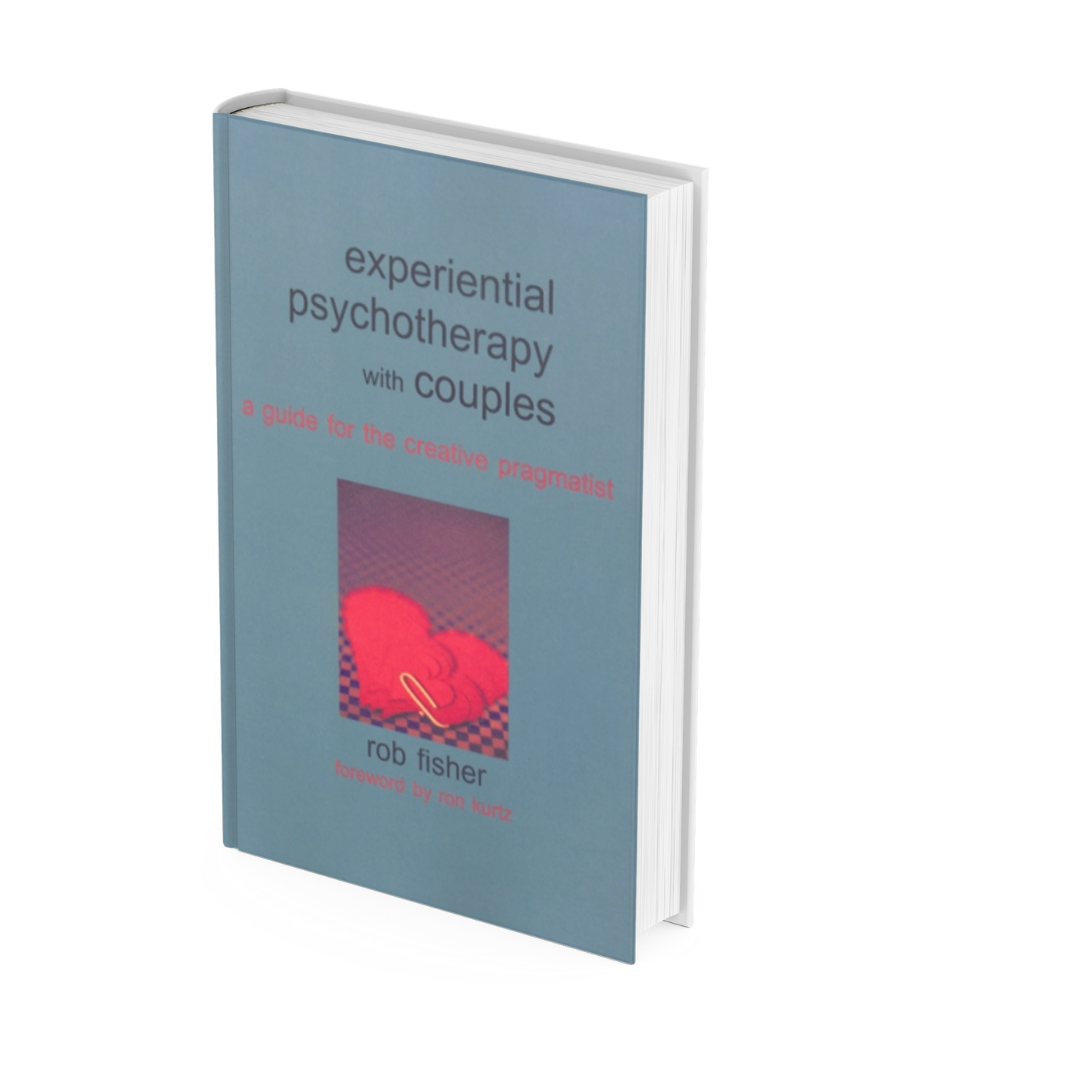
A Guide for the Creative Pragmatist
by Rob Fisher
Type: Softcover
Ever read a book or attended a workshop and thought that the ideas were great, but then were lost when you tried to apply them yourself? This phenomenon seems to be particularly common in the field of psychotherapy. The charisma effect: when the words sound convincing and the teacher teaches well, but the concepts disintegrate in practice.
Well, now Rob Fisher steps forward with a new book entitled Experiential Psychotherapy with Couples: A Guide for the Creative Pragmatist, in which he not only describes the approach, he explains step by step how to put it into action. Depth and brevity are the two guideposts of the writing, and ample case material and innovative exercises clarify the experiential techniques presented as well as their underlying principles. Fisher’s approach helps to move clients (and therapists) from insight to impact as it uncovers opportunities to access and then shift the couple’s negative interactive impulses – by engaging them thoughtfully rather than denying their purpose — toward creating a more satisfying and balanced relationship.
For therapists of any discipline, this book offers practical ways both to understand and to intervene with couples across several dimensions simultaneously. Since issues exist on many levels, so too should therapy if it is to be truly effective and enduring. Rob Fisher’s goal? For readers not only to find the book “interesting,” but for them to be able to customize and employ what they learn within their own clinical practice.
Rob Fisher has performed the delicate task of integrating classical theories & techniques of couples psychotherapy with such important innovations as non-violence, mindfulness, and bodymind holism. His advocacy of freeing ourselves from character strategies that cripple our capacity for relatedness rings true. Using lots of clear clinical examples, he guides the reader through experiential methods of assessing couples problems, and shares experiential means to unravel them. Accessible and imminently usable, this book can be used by therapist and couple alike to plumb the depths of relational intimacy. I plan on assigning it to both my students and clients. Christine Caldwell, Ph.D., LPC Director, Somatic Psychology Department Naropa University Boulder, Colorado author of Getting in Touch: The Guide to New Body-Centered Therapies.

Deciphering the Social Matrix in Psychotherapy
by Dan Short
Type: Softcover
Transformational Relationships is a vital resource for therapists who want state-of-the-art information on what works in psychotherapy. To navigate successfully the complex demands of individualized treatment, a therapist needs to recognize the social matrix against which the course of treatment is plotted. To this end, Dr. Short shares the most essential aspects of the therapist-patient relationship and how this powerful bond produces lasting transformation.
Readers will discover a unique and compelling narrative of science and clinical wisdom. The first section deciphers key dynamics of social complementarity, including dominance and submission, reciprocity, affective attunement, verification, and attachment. In the second section the reader will learn how relational beacons facilitate complex interpersonal maneuvering. The process of transformation begins long before the treatment ends.