

Writing Wright

Years in Coming: When Do I Get the Book Review?
Erickson’s Efforts to Secure a Book Review
by Joyce Bavlinka, M. Ed., LISAC'
Several weeks ago, while researching an article on T.E.A. von Dedenroth, I came across a folder containing 85+ pieces of correspondence between Milton Erickson, M. D. and Eric M. Wright, Ph.D., M.D. of the University of Kansas covering the period from 1964 to 1966. In 1965, Wright was the president of the American Society of Clinical Hypnosis and Erickson was editor of the American Journal of Clinical Hypnosis. The file was donated to the Erickson Foundation in 2015 by David Wark, Ph. D. of Minneapolis, MN.
The file correspondence covers the Society’s activities, Erickson’s trials as editor of the Journal and Erickson’s attempts to get Wright to complete a review of the second edition of Lewis Wolberg’s Hypnoanalysis. Erickson has some quirky prods to get Wright, the reviewer, to fulfill his responsibility, including sending poems and stories about his parents and potentially applying arm-twisting.
The first edition of “Hypnoanalysis” was published in 1945 and the second edition was published in 1964. The second edition copy we have had been the property of T.E.A. von Dedenroth. Von Dedenroth’s books on hypnotherapy and hypnotism were donated to the Foundation.
On July 27, 1964, Erickson writes to Wright:
“Now that I mention it, there does seem to be some vague possibility of an incompleted correspondence about something such as a possible book review: Perhaps if you pause briefly in your frantic cerebrations it may come to you.
But this is not the purpose of this letter. Stating it very simply, the purpose is to ask you if you would be interested in reviewing the revised and enlarged “Hypnoanalysis” by Lewis R. Wolberg, M.D.
If you find yourself hesitating, let me now at once and I will try to fasten an arm-twister to you.”
Wright responds on August 17, that he “would be interested in reviewing the revised and enlarged Hypnoanalysis by Lewis Wolberg “because I would read the book in the first place and I might as well read it with this purpose in mind.”
On October 28, 1965, Erickson writes to Wright:
“Myself when young did go to school, the months to learn. I discovered that wet April is followed by merry May, then comes happy June followed by sultry July, succeeded by doggy August and schoolday’s September. Then comes glorious Indian Summer October, Thankful November and Merry Christmas December. Then it’s the end of the year. But nowhere, just nowhere, in that list of months do I find The Wished-For-Month containing the Book Review of Wolberg’s “Hypnoanalysis” you promised (What base innuendo lies within that word?) “after April.” (This year, too! Ach, Weh ist mir!)
I can only wonder with the poet, “Of what Base-Metal Hopeful Substance are Editors made?
P.S. I’m definitely not mentioning the other book review.”
Attached to that letter is a copy of THE PLAINT OF THE CAMEL EDITOR. The poem is a take-on “The Plaint of the Camel,” by Charles Edward Carryl. Erickson replaces the refrain of the poem to the plight of the editor and how the camel/editor is viewed and how poorly he is treated. In the first stanza, the camel laments that other animals have fine food diets “but there’s never a question about MY digestion, ANYTHING……ANY DATE does for me!” Later, the camel laments that he does not have the unique housing afforded other animals and that he is a beast of burden. The camel’s lamemnt in the last verse is the following: “Camel all lumpy and bumpy and humpy, ANY SHAPE, ANY DATE does it for me.”
Erickson’s typewritten version of “The Plaint of the CAMEL EDITOR” appears at the end of this blogpost.
On December 15, 1965, Wright writes:
“When you have failed to fulfill an obligation in spite of your intentions to do so, it seems to me the only thing that one can do is ask for pardon and express regret. I honestly would like to review the Wolberg book, but I know that there are needs that your editorial job makes insistent. If you are willing to extend your period of grace until the first of March 1966, I shall make a sincere effort to fulfill this obligation. However, if you feel that this report is long, long overdue, please let me know and I will forward the book back to your office with great relief. You are perfectly right to childe me, and I have only the wish that I were somewhat more patient and more fluently productive so the I did not fall behind in my obligations. It is hard for me to judge the long -term quality of things which I have tried to write and have written, but I do know that they have been gone over and reworked several times before being submitted, and if they are not of good caliber, it is not for lack of trying.
There are times when you do create very real ambivalences. For example, if the book review on Wolberg had been written with promptness, the five-sonneted poem “The Plaint of the Camel Editor” would never have been written. Now it is better to have placated the editor so that his job moved smoothly along bur he remains uncreative? Even Hamlet, when he held the skull of poor Yorick in his hands, was no less perplexed. To so or not to do, that is the question. Now there are other cryptic comments and notes which escape my grasp. You make me wish I had the featness of mind of von Dedenroth who seems to be always perfectly tuned in on even the surplus of allusions which you make.”
On December 19, 1965, Erickson writes to Wright:
“Unfortunately for you, I am delighted to extend the period of grace to the first of March 1966. I do so much want to have you review that book.
Now really Erik, I just plagiarized that poem - - it was such an appropriate plaint. Useful too!
“I’ll try to be less obscure in my allusions. Too bad you are getting a barrage of letters from me—one mailed yesterday.
With Season’s Greeting from all of us to all of you =- us includes the mice, the guinea pig, the skunk, the tortoises, the ducks, the hen, the dog, the fish, and various other re-incarnations.”
On January 21, 1966, Erickson writes Wright:
“The passing seconds become minutes, the passing minutes become hours, the passing hour become days, the passing weeks become month, the passing months become years - - - do I hear a pitiful sobbing in the wilderness of the desert? Ah, yes, it is the crying of the tears into his beers by the editor pertinaciously thinking about a book review of Wolberg’s Hypnoanalysis. But what boots it to repeat how fleeting are these little woes of common humanity?”
Erickson attached a “complaint form” to the letter, asking the reader to state the nature of complaints in a box 1/8” by 1/8” with a ‘write legibly’ instruction.
On February 28, 1966, Erickson write to Wright:
“My mother waited most patiently for her 93 rd birthday and my father likewise waited most patiently for his 96 th birthday. Both of those days were momentous occasions and here I am, do shamefully impatient about a little book review. It’s really hard to live up to the achievements of our betters.”
On March 3, 1966, Wright writes:
“As promised, enclosed is the review of the Wolberg’s “Hypnoanalysis.” I wish that it were of the dimensions of a 93 rd or 96 th birthday. It is not the birthdate which is so impressive, it is the keen interest your father shows in the world around him. To live until the 10 th decade is unusual for man, but to remain alive is even more wonderful.”
What exactly was Erickson doing? Erickson discloses to Wright that he was testing out his confusion technique on him. T.E.A. von Dedenroth, who presented at the first Erickson Congress, had a great description of Erickson’s confusion technique:
“…. he would have them [the patient] follow exactly what he said, and then, wind up saying something totally unexpected by the patient so they would not follow what they thought they were following… because they couldn’t follow what they thought he said….Confusing??? ….. not at all.”
Wright’s book review was published in The American Journal of Clinical Hypnosis, Volume IX, Number 1, July 1966, pages 80-81. He notes new material in the first three chapters: Uses and Abuses of Hypnoanalysis, Induction of Hypnosis, and A Hypnoanalytic Session.
These letters date back to the days before word processors, spellcheck, and autocorrect. Many of the letters go on for three pages, single-spaced without a typing error!!!
Watch for Part II: “Hau Trees and Roasted/Baked Camel Stew: Erickson Shares the Challenges of Being President of the American Society of Clinical Hypnosis” and you will read one of Erickson’s early descriptions of his confusion technique. This description is a first from the archives of the Erickson Foundation. WARNING: You very well might get confused, very confused!!!
Please send your comments on this article to joyce@erickson-foundation.org
Note about T. E. A. von Dedenroth
In doing research in the archives and going through the historic book collection, the name T. E. A. von Dedenroth kept coming up. Von Dedenroth knew Erickson as a dedicated teacher, as a colleague, as a friend, and as Erickson’s personal physician. He was involved with the American Society of Clinical Hypnosis, presented at the First Congress and developed a program to stop smoking. As a result of his studies with Erickson, he switched from being an internist to a forensic psychologist. Von Dedenroth’s books were donated to the Erickson Foundation. More to come on von Dedenroth in a future blog post.
Erickson’s typewritten version of “The Plaint of the CAMEL EDITOR”
You may like…

Professional Perspectives
by Jeffrey Zeig, PhD
An Epic Life is a biography written by many authors. Throughout his professional life, Milton H Erickson attracted a diversity of critics and supporters, and this book gives all a voice. Erickson was known to work with patients to elicit in them the innate ability to “connect the dots” to discover their adaptive potentials. Readers will delight in being able to connect the dots too, piecing together a portrait of an extraordinary and complex figure, as they look through the eyes of the men and women who met him at important junctures.
An Epic Life draws upon four decades of interviews with professionals who knew Erickson. The incisive perspectives are interlaced with commentary from Jeffrey Zeig to clarify and contextualize. The images of Erickson that emerge are congruent, divergent, myriad. In the end, readers gain unusual access to the man, his commitment, and his work. There is nothing simple in what is conveyed, and yet the impression it makes is coherent — and lasting.

Personal Perspectives
by Jeffrey Zeig
An Epic Life Vol. II is the second biography on Milton H. Erickson written by Jeffrey Zeig. The first volume features professional perspectives on Erickson and this book offers a personal lens, as seen through Erickson’s family, friends, neighbors, students, secretaries, and patients. The reader gains access into the dynamic personal world of Milton Erickson, who was a one-of-a-kind communicator of unparalleled brilliance.
Erickson was known to work with patients to elicit in them the innate ability to “connect the dots” to discover their adaptive potentials. Readers will delight in also being able to connect the dots, piecing together the professional aspects of Erickson in the first volume with the personal ones in this volume. For Erickson, the line between his professional life and personal life was blurred. He was doctor, teacher, friend, and neighbor all at the same time. Readers will see how his therapy methods carried over into his personal life. Or was it perhaps the other way around?
An Epic Life II draws upon decades of interviews with those who knew Erickson on a more personal level. The incisive perspectives are interlaced with commentary from Zeig to clarify and contextualize. The images of Erickson that emerge are congruent, divergent, and myriad. In the end, readers will have a more complete picture of the man, his commitment, and his work. There is nothing simple in what is conveyed, and yet the impression it makes is coherent – and lasting.
Zeig prepares us for this stimulating journey by providing a comprehensive history of Erickson’s lineage, and background on the many contexts mentioned in the book.
Erickson was one of the greatest psychotherapists of the 20th century and the father of modern hypnosis and brief therapy. His professional contributions continue to influence the field and its practitioners and his personal life is inspirational.
As we strive to evolve personally and professionally, we should do as Erickson did: Leave the world a better place.
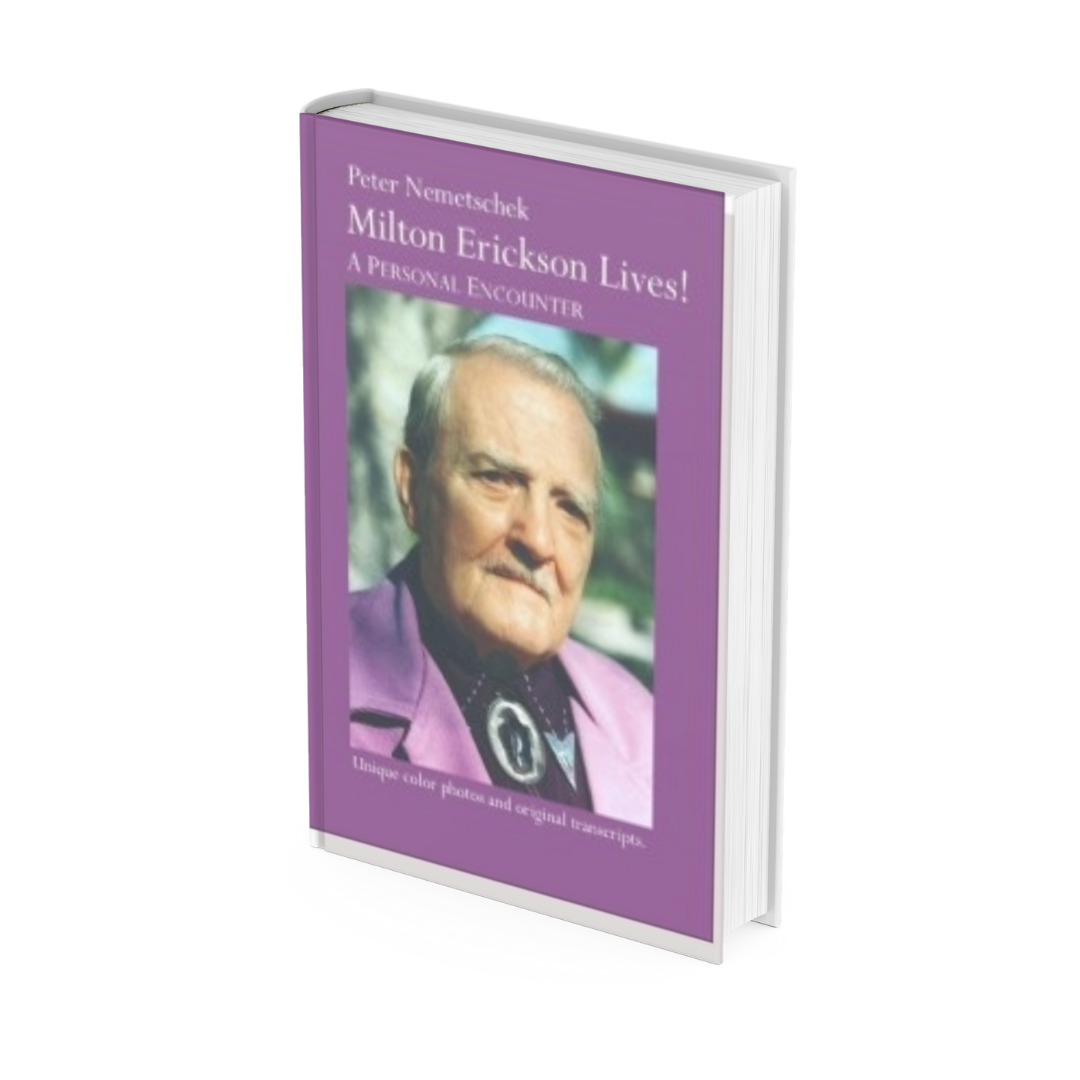
A Personal Encounter
by Peter Nemetschek
Type: Softcover
Milton H. Erickson Lives has the feel of an impressionist painting. In its details and broad strokes, the book focuses on an unusual man - from the perspective of an unusual ma. Original transcripts, rare photographs, and the special tone and palette on memory draw the reader into the vid experience of what is being described. It was an exciting moment for Milton H. Erickson and those who surrounded him, a moment of great clarity, intellectual explosion, a paradigm-shifting investigation-a moment that continues to reverberate powerfully beyond the parameters of that specific period.

No. 1 Presentation to the San Diego Society of Clinical Hypnosis
by Milton H. Erickson, MD
Type: Softcover
The Milton H. Erickson Foundation is pleased to announce the release of The Seminars of Milton H. Erickson. Culled from the Foundation’s private archives, these volumes offer access to never-before published transcripts.
Each edition is designed to highlight new dimensions of Erickson’s thinking and practice, laying the groundwork for a scholarly understanding of modern hypnosis, hypnotherapy, and strategic approaches.
The Presentation to the San Diego Society of Clinical Hypnosis, April 29, 1962 , is the first offering in the series. This seminar describes essential differences between traditional hypnosis and the more versatile practice of modern hypnosis. Information is presented on specific clinical problems, including sexual dysfunction, pain management, psychosomatic problems, and parent-child issues. The contents of this lecture are divided into five chapters:
That Which Occurs Within
The Inward Orientation
Frigidity and Impotence
The Individual Approach
Common Sense Suggestion
