

Unreasonably Rationality

By Richard Landis, Ph.D.
Estimated Reading Time: 3 minutes, 28 seconds
Sue was a 27-year-old, single woman who was intelligent and valued self-awareness. She came to therapy after her roommate told her that she needed therapy because she was “far too rational to be real.” She was able to see everyone’s perspective and rarely got angry. Sue had recently broken up with Clay, a boyfriend of three years after she had walked in on him having intimate relations with his secretary in his office. Sue admitted being hurt and feeling betrayed. However, she quickly was able to rationalize his infidelity by citing his difficult childhood and that the secretary was pretty. She genuinely felt sad for him because she thought he would never be able to have a monogamous relationship. I was beginning to understand why her roommate was concerned.
Physically, Sue was suffering from several different but related gastrointestinal disorders and severe tension headaches that seemed to “come out of nowhere.” When I asked if she were happy, Sue replied, “I am satisfied, but I couldn’t actually say ‘happy’.”
Sue’s history helped make sense of her “coping mentality.” Sue left home at the age of 18 to escape her father who raged and broke things during his rages. He was easily set off and seemed to be looking for excuses to rage out of control. When he raged, Sue’s mother would scream and cry, but remain intimidated and helpless. Everyone would hide. At a young age, Sue promised that she would “never rage like Dad.”
During our first session, I said, “Sue, your roommate sent you here, but I do not know if you are motivated enough to do what you need to do to be safely happy and to enjoy life and get rid of unnecessary tensions.” I then spent the next ten minutes getting her to agree to do what I told her to do without actually telling her what I wanted her to do. When she finally agreed to this unconditional agreement, I instructed her to go to any store where they sold cheap, thick clay plates. She was to buy a cheap thick clay plate that was of a pleasing color on the outside. She was then to take the plate, a fist-sized rock, and some eye-protection goggles and to find a nice clear area of cement in the driveway. In great detail, I told her to put the rock on the ground and, with both hands bring the plate down gently but strongly on the rock so the plate broke in half. She was then to look and notice how far the pleasant color actually went into the clay. She was then, on the rock, to comfortably break the plate into several small pieces. She was then to take the rock and grind the pieces into sand and dust. She was then to scoop the sand and dust into a plastic food storage bag and bring it to the next session.
Sue returned the next week exhilarated with her ground sand and dust. The day after she had reduced the plate to rubble, she had phoned her old boyfriend and told him off. The assignment contributed to her being able to reconcile her inner battle of attributing the expression of anger with being her father. Once she recognized that the issue was not anger per se but uncontrolled anger, she was able to express her feeling more congruently. By having her destroy something in a highly controlled fashion, she felt safer in expressing her anger at appropriate times.
My intention also was to use the fact that it was a clay plate to be associated with Clay, her boyfriend. Also I had hoped that the obviously shallow layer of the color glaze might trigger an appreciation of his depth, or lack of depth. Regardless, after a few more sessions, the tension headaches disappeared and the gastrointestinal ailments started to respond to medical treatment.
I spoke with Sue three years after we ended therapy. She still has the sand and dust from the plate in a glass urn in her living room. When asked why she kept it, she replied laughing, “I don’t know. It just feels good.”
This excerpt has been extracted from Volume 24, Issue No. 2 of The Milton H. Erickson Foundation Newsletter.
You may like…
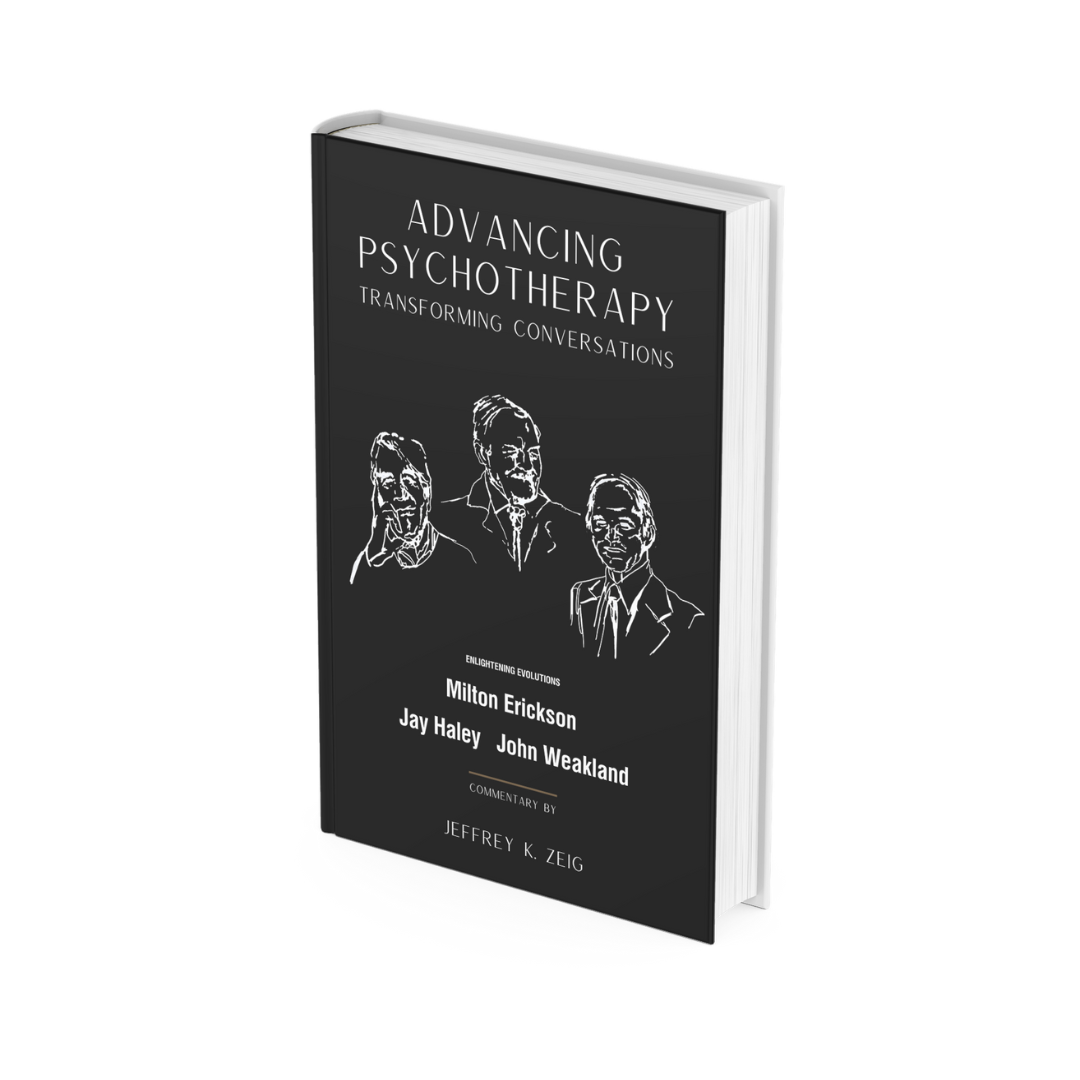
Transforming Conversations
by Jeffrey Zeig
Type: Softcover
When great minds meet, we are privileged to learn from their explorations…
As part of a communications project conducted in the mid-1950s and spearheaded by anthropologist Gregory Bateson, Jay Haley, and John Weakland went to Phoenix, Arizona to learn from and collaborate with Milton Erickson.
The meetings of these three great minds were recorded. Their explorations together both advanced the Bateson Project’s Double Bind Theory and helped to develop more effective approaches in psychotherapy.
Advancing Psychotherapy is a glimpse into an important time in the history of the field and a rare opportunity to learn from those who shaped the future of psychotherapy. Its content will improve your practice of psychotherapy.

The Fundamentals of an Existential-Humanistic Approach
by James F.T. Bugental
Type: Softcover
“This book takes you on a wonderful adventure through the process of psychotherapy, both from the side of the client and the therapist. Although it has brief moments of academic flavor, it is mostly engaging and interesting no matter from where you approach it. Bugental shares his own experience as a therapist and discusses a view on human potential that is beautiful, moving, and inspiring. I highly recommend this book for an enjoyable read (nonfiction) and for insight on what psychotherapy can be.”
Contents include:
Deficiency Levels of Therapeutic Goals
Matching Therapy to Client Needs
Other Contrasts among Therapies
What the Client Brings to the Enterprise
Desirable Qualities in a Therapist
The Fundamental Importance of Concern
An Existential-humanistic Ideal for the Client-therapist Relationship
Phases in the Psychotherapeutic Process
A Client’s Account of Working in Therapy
What the Therapist Does
Changes in Life Experience
Enlarged Sense of Identity
JAMES F. T. BUGENTAL was a leading psychotherapist and a founding father, with Abraham Maslow and others, of humanistic psychology or “the third force” (in contrast to psychoanalysis and behaviorism). He was also the creator, along with Rollo May, of existential-humanistic psychotherapy. Bugental earned his doctorate from the Ohio State University in 1948 where he was influenced by Victor Raimy and George Kelly. After a brief time on the University of California, Los Angeles faculty in psychology, Bugental resigned in 1953 to found the first group practice of psychotherapy, Psychological Service Associates, with Alvin Lasko. The group added Tom Greening in 1958, and subsequently Gerard Haigh, Bill Zielonka, Harris Monosoff, and others. A men’s encounter group evolved from this core, which included Jim Clark, Bob Tannenbaum, and Art Shedlin from UCLA, and this group continued meeting for decades until 2006.
With Abraham Maslow and others, Bugental was a cofounder of the Journal of Humanistic Psychology and the Association for Humanistic Psychology in 1961. He was elected a fellow of the American Psychological Association (APA) in 1955, and was the first recipient of the APA’s Division of Humanistic Psychology Rollo May Award. Bugental also was president of the California State Psychological Association, the Los Angeles Society of Clinical Psychology, and the Association for Humanistic Psychology (serving as its first president in 1962). Among Bugental’s many valuable contributions to psychology and psychotherapy are his other books, Challenges of Humanistic Psychology (1967) (and its updated, co-authored version The Handbook of Humanistic Psychology, 2001), The Search for Existential Identity (1976), Psychotherapy and Process (1978), The Art of the Psychotherapist (1987), and Psychotherapy Isn’t What You Think (1999).

by Roxanna Erickson Klein, RN, PhD, Ernest Rossi, PhD and Kathryn Rossi, PhD
The collected papers of the first section all demonstrate Erickson's utilization approach to a variety of psychological problems. Utilization theory emphasizes that every individual's abilities and inner resources must be accessed in order to determine how they may be evoked and utilized for therapeutic purposes. The next part illustrates a variety of Erickson's indirect approaches to symptom resolution. This is followed by papers on sexually related problems illustrative of the extremely wide range of approaches the hypnotherapist has available. The last section illustrates the facilitation and utilization of the patient’s own inner resources for solving personal problems. In a number of these illustrations, Erickson did not even know the nature of the problem that the patients solved within the privacy of their own trance experience.