

The Lesser Of Two Evils

Richard Landis, Ph.D.
Ericksonian Integrative Medical Institute of Orange County
Judith was a 46-year-old woman who, for the first time in thirty years, was without a job. In the past, when she left a job, it was because someone contacted her with a better offer. Now, for the first time, she had to find a job for herself. She had been sending out resumes by the bushel but received no replies. Judith had been referred to me by someone who said I was practical and knew the ins-and-outs of the business world. The referral source told me that Judith did not want therapy. He identified her as feeling worthless unless she had a job, and that no one would care about her until she was in a position to help others. To match her expectations, I presented myself to Judith more as a coach than as a therapist. However, it was readily apparent that Judith was painfully shy and felt that she had no personal worth.
Her job hunting strategies were limited to using the want-ads in the newspapers and on the Internet. When I asked if she asked any friends or acquaintances if they knew of job openings, Judith said that she could not do that. It would be too embarrassing and why would they want to help her? There was nothing in it for them. This presented the opportunity to both open possible job offers and to challenge her underlying assumptions about her personal worth and rights as a person.
During the next session, I said that there were two avenues I would like her to explore in the coming week that would increase her likelihood of getting a job. The first one was to ask a friend or colleague from the old job if he or she knew of something that was available. Judith turned white and I continued. I said that I would like her to do it as a gift to the other person since Judith knew how good it felt when she could do a favor for someone else. I thought she was being selfish withholding this opportunity for her friends or colleagues to feel good. I spent less than five minutes talking about this alternative.
The second avenue was to make cold calls on companies. She was to research which type of company would most likely be able to afford the salary that she had before and might have a position that she could enjoy. I went into agonizing detail over how to dress and who to ask for when she walked into the office. We rehearsed what she was to say and what her presented attitude should be. I really micro-managed it ad nauseam for 35 minutes. She left knowing what to do but was a bit shaken.
When she returned the next week, she reported that she had done the research for the cold calls, but did not visit any sites. Instead, she decided to ask an old colleague. Judith was pleasantly surprised that her colleague was delighted to be of help and asked everyone else in the office if they knew of any possibilities. From that interaction, Judith got three referrals. Heartened by that outcome, she asked a parent that she met at a PTA meeting during the week. She had never met the parent before, and it just came out in conversation. The parent was a supervisor in a medical office and they were looking for a back-office person.
Judith left therapy at that time since she was no longer feeling depressed and helpless. She was a bit apologetic about not doing the cold- call homework. I reassured her that I was pleased how she knew which of the assignments fit her best. She did not recognize that by my emphasizing the alternative that generated the greatest anxiety, it made the other alternative more accessible and less scary by comparison. She had a strong need to do something, and the less anxiety-producing of the two choices now seemed possible to her. At the same time, she discovered that she was worthy enough that people were willing to be helpful. Her husband later contacted me for some help for himself. At that time, he disclosed that Judith acting on the assignment turned out to have been sufficient for her to become more assertive at work and at home. Once breaking her old assumptions by doing something that challenged them, she continued to assert herself as well as continuing to give to others.
You may also like…

by Eric Greenleaf
Type: Hardcover
"For individuals, evil may exist in the form of enacted imagery, as with sexual sadists; of the misuse of trance, as seen in the negative voices that remind, direct, and afflict us; and of the betrayal of relationship and trust. This book is organized around cases dealing with the resolution of the consequences of evil.
–From the Introduction
Directed toward therapists of all persuasions who deal with the most difficult issues in therapy, The Problem of Evil provides a practice-expanding vision of healing. When common notions of compassion and empathy fail in the face of dilemmas that seemingly defy solution, the use of trance and story brings therapy to the next level. Greenleaf’s synthesis of the narrative, trance, and relationship perspectives –and the integration of his own innovative practice of “passing the trance” –make this book a uniquely compelling addition to the literature.
Most of the disturbances alluded to in The Problem of Evil are the consequence of pain, humiliation, and confusion suffered at the hands of more powerful persons. Greenleaf skillfully demonstrates how the means once used to hold clients captive in perilous patterns of victimization can become the means to free these same clients. Images can help diffuse nightmares; trance can move individuals toward advocating for themselves; and the therapeutic relationship can become a source of new information and positive influence.
Within these pages are intensely moving stories, both harrowing and hopeful in the telling. Within these pages readers will discover creative and effective ways to open doors to healing that were once impenetrable.

by Miriam M. Gottlieb
Type: Softcover
"In a time when high-quality anger management and violence prevention programs are in hot demand, Miriam Gottlieb delivers with a superb and clearly written workbook that can greatly benefit therapists in the trenches and the clients they treat. Her book is filled with practical tools that can successfully empower clients to gain better control of their anger. There have been many books written about anger management, but by far The Angry Self tops them all!
— Matthew D. Selekman, MSW author of Pathways to Change: Brief Therapy Solutions with Difficult Adolescents
The Angry Self is a resource for any counselor dealing with a client who has an anger problem, or whose anger is getting in the way of resolving some other problem. It consists of nine chapters, each with a specific therapeutic goal. The chapters are divided into units. A typical unit contains a small amount of explanatory text, a story or two to illustrate the point being made, and an exercise for the client to do.
Although the units within a chapter build towards that chapter’s goal, a great deal of flexibility has been built in to allow the counselor to modify, rearrange, add or delete material without damaging the integrity of the process. In this way, The Angry Self meets its dual objectives of providing a complete anger management program, while at the same time giving the counselor the freedom necessary to tailor therapy to the needs of the individual client.
The Angry Self can be used by the counselor alone, but in some cases it may be effective to give the Book to the client. The client can read a unit and do its exercise as “homework”, and discuss it with the counselor during the next session. Still another approach is to read the material with the client during a session, doing the exercises together.
The major elements used in The Angry Self are:
Explanatory text, used mainly to introduce new concepts.
Stories, used to illustrate the concepts.
Exercises, used to reinforce the concepts and to aid in skill development.

Skills for the Art of Bringing Forth Change
by Hillary Keeney and Bradford Keeney
Type: Softcover
Performance. This is where it starts. The Keeney’s heretical perspective holds that professionals can fill up on theory — indeed, on many theories — at the expense of developing the performance skills that are the foundation of effective therapy. They argue that creative performance technique, rather than theory, is primary. Thus this new book is appropriate for any practitioner no matter what school of therapy they belong to.
The authors begin by envisioning every session as a three-act structure with a beginning, middle and end. This helps therapists maintain a focus on movement and change, like a compass that allows practitioners to keep track of the plot line and direction of every session. Exercises help readers make these ideas their own.
In Chapter Two, “Short-Circuiting Vicious Circles,” the focus is on creative ways to interrupt the pathological discourse that maintains impoverished experience in clients’ lives, while “Feeding Virtuous Circles” considers the creation of more generative, resource-rich experiences. This section ends with “Designing Prescriptive Action for Change,” thus rounding out the discussion of the basic tools necessary to implement a well-formed therapeutic performance.
The midsection of the book presents opportunities to initiate and maintain consistent presence inside creative, transformative interactions in every session. “Always Utilize and Improvise” leads the way by describing, and inviting the reader to practice, ways to create openings for new movement. “Absurdity Lubricates the Wheels of Change” introduces exercises to help awaken difference and inspiration. “The Changing Therapist” encourages the therapist to include and expand his or her role as an instrument of change.
In the case studies in Chapters Eight, Nine, and Ten, the authors demonstrate ways in which they have helped practitioners to uncover their own unique resources and to develop mastery of creative and effective expression. The final chapter, “Bringing Life to Clinical Training,” gathers together thoughts on the importance of performance-based skills and one’s own wisdom-based learning as the linchpins of an alive therapeutic environment.
Hillary Keeney and Brad Keeney bring to their work a rare combination of intellectual depth and jump-off-the-page enthusiasm. Creative Therapeutic Technique is a practical guide that knocks the familiar staid therapeutic stance on its ear, suggesting instead an approach that allows therapists to always be ready and able to meet clients where they are — and then uncover fresh and vital ways to get them where they long to be.
————————————–
“A book you can’t put down! I don’t know how to adequately convey that the Keeneys are true to the work of Milton H. Erickson. This is improvisation and utilization at its best, delivering solidly based effective therapeutic work. With exercises and all sorts of informative teaching, they show us how to do it. Best of all, the book fulfills a remarkable paradox: you will hate to finish this well-written, entertaining, and practice-changing book, but will hardly wait to finish so that you can use what’s been learned.”
—Betty Alice Erickson, M.S., LMFT
Private Practice, Dallas, TX
“If you are looking for new inspiration to enliven your clinical practice, this is the book to read. The Keeneys are masters of invention. Turning conventional thinking and practices on their head, they encourage therapists to leap over the bonds of the rational and enter the realm of the theatrical and metaphorical. They create a new therapeutic context with first, second and third acts. Guidelines are included that lay out specific ways for therapists to give free rein to their own imagination and develop their unique creativity. The book is filled with many clinical surprises. There are startling examples of transformative experiences in which silver linings are found within the darkest situations, seeds of hope are implanted in barren landscapes and nightmares are turned into dreams. It was a pleasure to read and I highly recommend it.”
—Peggy Papp, LCSW
internationally renowned therapist;
senior faculty member, founder and director of the
Project for Adolescents and Their Families,
Ackerman Institute for the Family, New York City
“If you try to get nothing from this book, happily, you will fail: It is a page-packed monument to unscripted change! You won’t put it down once you begin as it teaches how to amplify experiential resources rather than focus on either problems or solutions. The book’s creative voice alone will inspire therapists to pull the weeds out of any garden-variety approach and let flowers of change blossom and grow for both them and their clients. Enjoy.”
—Stephen Lankton, MSW, LCSW, DAHB
Editor-in-Chief, American Journal of Clinical Hypnosis;
Faculty Associate, Arizona State University, School of Social Work;
Member, Arizona Board of Behavioral Health Examiners;
Secretary, Arizona Social Work Credentialing Committee
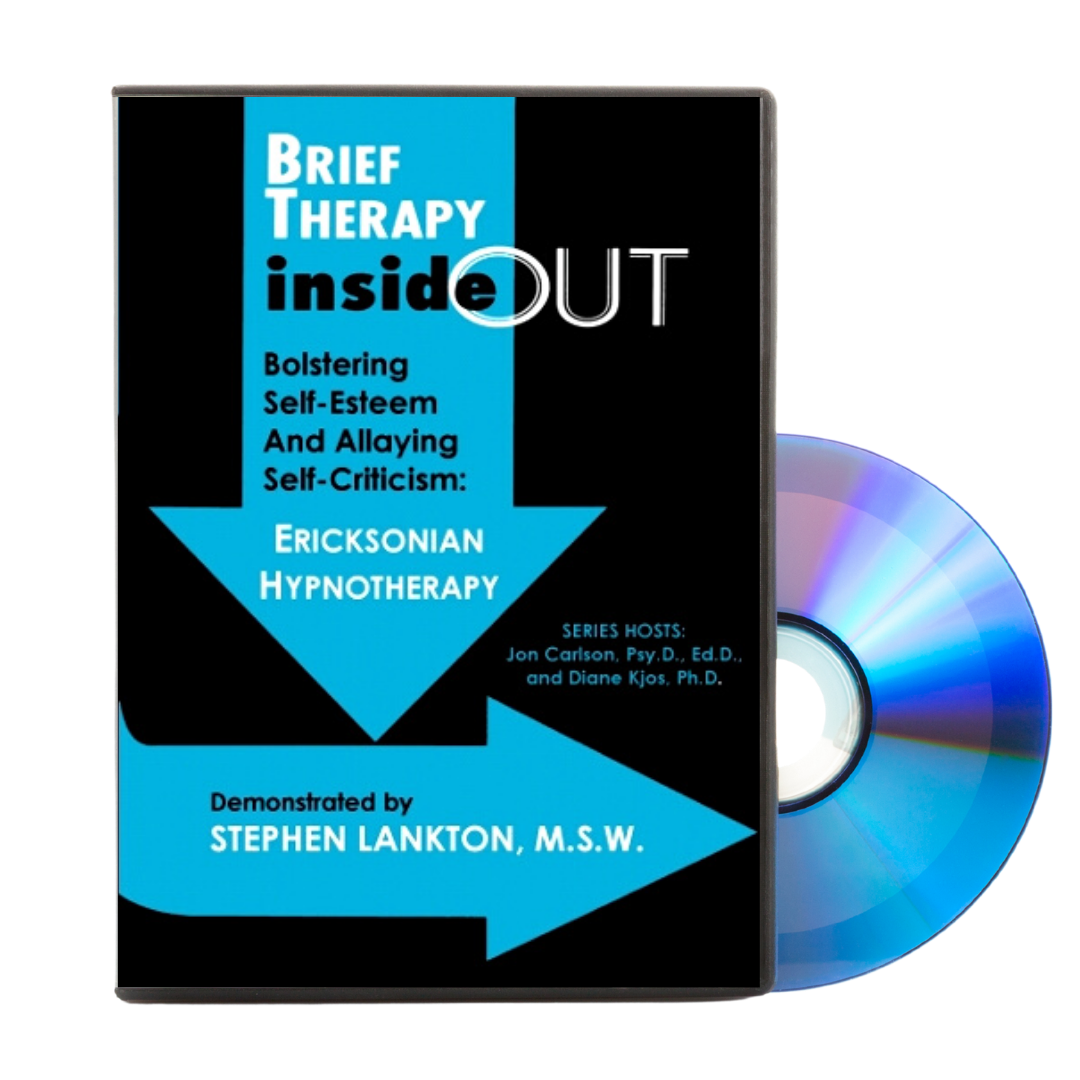
Ericksonian Hypnotherapy
Stephen R. Lankton, M.S.W., is a clinician, corporate consultant, clinical trainer, and widely published author. He recently received the Lifetime Achievement Award for Outstanding Contributions to the Field of Psychotherapy from the Milton H. Erickson Foundation, Inc.
Therapy, for Lankton, is about opening up possibilities for the client. In this videotape, he demonstrates how hypnosis, storytelling, confusion, and other techniques can be used to help a client struggling with low self-esteem to tap underutilized inner resources and quiet self-doubt.