

The Boxer

By Dan Short, Ph.D. Dallas, TX
Estimated reading time: 4 minutes, 30 seconds.
The 21-year-old client did not want to be in therapy. Charged with assault on his girlfriend, he had been ordered to counseling as a condition of probation. The intake, conducted by another therapist, noted, “Client is reluctant to focus on violence-related issues.”
The client, muscular and sullen, entered the first session in silence and sat slouched in his chair with a cap concealing most of his face. He had described himself as “a boxer” and had explained that counseling should not interfere with his “career,” which consisted solely of daily sparring at a local gym.
After preliminaries, I began giving the client an explanation of the negative effects of emotional stress. I told him how “industrial psychologists are paid high wages to ensure workers have their lives in order at home.” The role of sports psychologists was also described in detail with some impressive statistics about successful results. The client was then offered psychological training in order to benefit his boxing career. He responded with increased enthusiasm toward treatment.
First, the client was trained in hypnotic time distortion and rapid relaxation. This allowed him to experience, subjectively, 15 to 20 minutes of rest in a three-minute period. This was important because it allowed him to “gather strength more quickly between boxing rounds.” He also was given training for increased tolerance of frustration “to ensure clearness of thought while in the boxing ring.” The client was told to practice these skills at home with his girlfriend.
During the first few sessions, the client came with specific requests aimed at helping him with his boxing. For example, he said his coach told him he didn’t do as well while sparring with people he liked and that he needed to stop being “so nice.” We explored the concept of respect. Respect for a friend demonstrated by sitting at lunch and asking “how things are going” was differentiated from sparring in the ring “where one wants to show respect by doing one’s very best.”
In the following sessions, our topics changed from specific boxing tactics to more general principles. These included moral strength, responsibility for self and self-respect. The client was given both direct and indirect suggestions about transferring the abilities for the self-discipline required in boxing to the self-discipline required for healthy relationships.
After a few weeks, the client no longer mentioned his boxing career. Instead he began to ask for advice about his relationship with his female partner. He also talked extensively about his current relations with his extended family and his desire to be a son of whom his deceased mother “would be proud.” Toward the end of his counseling, the client was discussing plans to retire early from boxing and become an accountant. After the mandated ten visits, the client was given a letter of completion. Three months later, he returned for a social visit. A six-month follow-up revealed he had enrolled at a local junior college and has had no further reported acts of violence.
Commentary: The Boxer
by Tina Foster Jansen, M.S.
Court-ordered clients are typically unmotivated. Faced with this type of client, Short used an opening strategy that would encourage the client to be involved in counseling to the “benefit of his boxing career.” As Cormier and Cormier state, “A productive assumption in converting involuntariness into a commitment to be counseled is that the client’s chief interest is himself.” (p.575) Short’s adroit therapeutic intervention began the changes that eventually alleviated further violence, and also had positive influences in other areas of the client’s life.
The treatment in this case is a study in reframing and utilization. Short used the strengths, weaknesses, and temperament of the client to reframe inherent abilities so destructive behaviors could be changed. Haley (Nichols, 1984) maintains reframing is a necessary step in altering problem-maintaining sequences. Proper reframing changes a viewpoint to the meanings of interactions that are changed while the facts of that interaction remain the same. Short reframed respect for the client. This new definition allowed the client to change behaviors while keeping and building on the client’s wish for personal respect. Haley (1971) concludes that, on a general level, the goal of the therapist is to change the maladaptive behavior of the individual. An additional and subsidiary goal is to extend the client’s personal range of experience. By getting this client to change his violent behavior, Short was able to open the door for further change by the client. The man’s personal range of experience could be extended. He could consider ways of obtaining respect other than through violence – he could consider becoming the son his mother “could be proud of.” He then could begin to extend his idea of a career and investigate choices.
Utilization is a cornerstone of Ericksonian psychotherapy. Short demonstrated a superb ability to enter his client’s world and regard that world as having the material for productive change. He took the problem behavior, violence, and gave the client ways in which to reframe that behavior so his needs to be respected and strong were productively met. Short should be congratulated for his insightfulness and creativity in using negative behaviors as material for productive change.
References:
Cormier, W. H. & Cormier, L. S. 1985. Interviewer Strategies for Helpers. Brooks/Cole, Publishing Company. Monterey, CA.
Haley, Jay. 1973. Uncommon Therapy: The Psychiatric Techniques of Milton H. Erickson, M.D. W.W. Norton. NY.
Nichols, M. T. 1984. Family Therapy Concepts and Methods. Gardner Press, Inc. NY.
You may also like…

Deciphering the Social Matrix in Psychotherapy
by Dan Short
Type: Softcover
Transformational Relationships is a vital resource for therapists who want state-of-the-art information on what works in psychotherapy. To navigate successfully the complex demands of individualized treatment, a therapist needs to recognize the social matrix against which the course of treatment is plotted. To this end, Dr. Short shares the most essential aspects of the therapist-patient relationship and how this powerful bond produces lasting transformation.
Readers will discover a unique and compelling narrative of science and clinical wisdom. The first section deciphers key dynamics of social complementarity, including dominance and submission, reciprocity, affective attunement, verification, and attachment. In the second section the reader will learn how relational beacons facilitate complex interpersonal maneuvering. The process of transformation begins long before the treatment ends.

A Neuro-Linguistic Programming Approach
Steve Andreas, M.A., has been learning and teaching NLP for over 20 years, and has edited or written several books, including Virginia Satir: The Patterns of Her Magic. He has also coauthored several books with Connirae Andreas, including Heart of the Mind and Change Your Mind–And Keep the Change.
The goal of Neuro-Linguistic Programming is to help clients change their patterns of experience. Emphasizing forgiveness, in this videotape Andreas, one of today’s leading practitioners of NLP, shows how by focusing on the visual, kinesthetic, and auditory components of their experiences, clients can be helped to quickly change entrenched responses, including patterns of inappropriate anger.
by Miriam M. Gottlieb
Type: Softcover
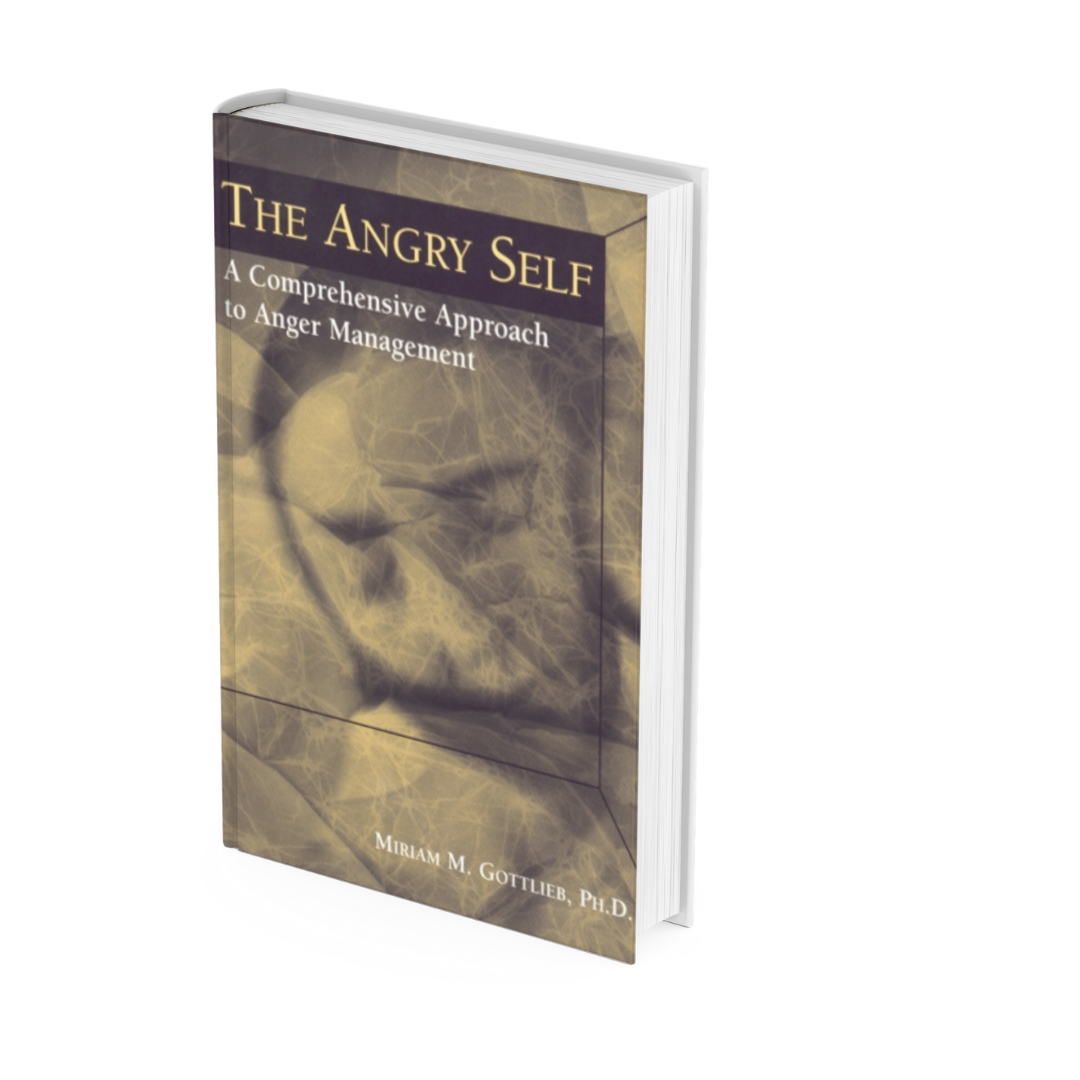
"In a time when high-quality anger management and violence prevention programs are in hot demand, Miriam Gottlieb delivers with a superb and clearly written workbook that can greatly benefit therapists in the trenches and the clients they treat. Her book is filled with practical tools that can successfully empower clients to gain better control of their anger. There have been many books written about anger management, but by far The Angry Self tops them all!
— Matthew D. Selekman, MSW author of Pathways to Change: Brief Therapy Solutions with Difficult Adolescents
The Angry Self is a resource for any counselor dealing with a client who has an anger problem, or whose anger is getting in the way of resolving some other problem. It consists of nine chapters, each with a specific therapeutic goal. The chapters are divided into units. A typical unit contains a small amount of explanatory text, a story or two to illustrate the point being made, and an exercise for the client to do.
Although the units within a chapter build towards that chapter’s goal, a great deal of flexibility has been built in to allow the counselor to modify, rearrange, add or delete material without damaging the integrity of the process. In this way, The Angry Self meets its dual objectives of providing a complete anger management program, while at the same time giving the counselor the freedom necessary to tailor therapy to the needs of the individual client.
The Angry Self can be used by the counselor alone, but in some cases it may be effective to give the Book to the client. The client can read a unit and do its exercise as “homework”, and discuss it with the counselor during the next session. Still another approach is to read the material with the client during a session, doing the exercises together.
The major elements used in The Angry Self are:
Explanatory text, used mainly to introduce new concepts.
Stories, used to illustrate the concepts.
Exercises, used to reinforce the concepts and to aid in skill development.

by Robert W. Firestone
Type: Softcover
The Enemy Within: Separation Theory and Voice Therapy is a compendium of the life work of theorist and clinical psychologist, Robert Firestone. An in-depth exploration of the author’s latest findings, the books brings to light his holistic approach to understanding human behavior, relationships, and crucial socio-political issues. It also provides fresh insights into the critical inner voice and fantasy bond: the key concepts in the Firestone’s theoretical approach. Separation Theory is derived from Firestone’s primary focus in psychotherapy on helping individuals separate from critical inner voices and destructive emotional ties or fantasy bonds. Various applications of Voice Therapy — a powerful technique that enables clients to challenge their destructive thoughts — are also described.
“A commanding articulation of Separation Theory and Voice Therapy in the service of fostering ‘life-affirming death awareness’ by one of the most influential theorists and clinicians of our times.”
Sheldon Solomon, PhD
Professor of Psychology
Skidmore College
“Rich with examples, the work highlights his crucial concepts of the ‘inner voice’ and ‘fantasy bond,’ which have enlightened our understanding of dynamic processes of human development, with new implications for understanding current socio-political issues.”
Donald K. Freedheim, PhD
Professor Emeritus of Psychology
Case Western Reserve University
“Filled with case examples it illuminates the role of the voice and fantasy bond in such powerful issues as violence and suicide: A must-read for clinicians and students who want to learn how to work in depth with the self-destructive voice and the fantasy bond.”
Leslie S. Greenberg, PhD
Distinguished Research Professor
Dept. of Psychology, York University
“Thank you Robert Firestone for this comprehensive, practical and precious work identifying The Enemy Within and providing clear strategies for addressing resistance in psychotherapy, but more important, our own resistance to a better life.”
Pat Love, EdD
Author of Hot Monogamy,
The Truth About Love, and
How to Improve Your Marriage Without Talking About It
“… the culmination of a lifetime of insight into the human heart beginning with children’s relationships to parents and by implication the wondrous yet trepidating existence around them. Combining both extensive data from his own practice, as well as experience at the forefront of the intentional community movement, Firestone has produced a milestone of incisive, illuminating and practical guidance to the core of therapeutic healing–as well as cultural healing in my view.”
Kirk Schneider, PhD
Author of The Spirituality of Awe
and Existential-Humanistic Therapy
“Once again demonstrating the wisdom of integrating psychoanalytic and existential themes, Firestone brings to bear his long and deep experience in understanding and healing the human condition. He introduces important concepts that constitute a kind of psychological matter and anti-matter to unlock some crucial challenges we must face as individual people and as a collective humanity.”
James Garbarino, PhD
Maude C. Clarke Chair in Humanistic Psychology
Loyola University Chicago
Author of The Lost Boys and Listening to Killers