

Sapphire Water on Fiery Red Flames

By Carrie Rehak, Ph.D.
Estimated reading time: 3 minutes, 24 seconds.
I did not know what time it was when I came downstairs to finish our winter display — images and symbols communicating the holiday season, as observed and celebrated by various sacred traditions in anticipation of the coming of the light. All I knew was that it was cold and dark outside, and I was ready to head home.
Just as I was hanging one of the last ornaments, I caught a glimpse of her in the corner of my eye — a student of mine, who I knew had an extremely long commute. And, I also knew she had cancer, as she asked our community to remember her in our prayers at a service she could not attend last year.
“It’s beautiful,” she said, referring to our twinkling display.
“It really is,” I agreed. “A student worker put it up. I just came down to hang these last few pieces.”
I asked how she was doing.
She pointed to an area under her left arm, saying, “I am in a lot of pain — scar tissue. It’s unbearable.” She said the pain was so distracting she was uncertain if she would be able to finish her program.
I asked what time she had to be in class. She had an hour. I asked if she would like to take 15 minutes for a meditation that might help with the pain. She agreed, even though she just finished a nearly two-hour drive.
We found an empty classroom. I adjusted the lighting so that it was neither too dark nor too bright.
I invited her to get comfortable in her chair and then listened as she described her pain.
“Does it have a color?” I asked.
“Yes,” she said, “it’s red, fiery red. Like flames.”
I asked if she had a place of health or strength — physical, mental, or emotional.
She said she was emotionally strong.
I asked what that place of strength looked like. She said it was blue.
“Light blue or dark blue?” “It is sapphire, she replied.
“Sapphire blue….Does it have a shape?” “No,” she said, “it’s like water,” I asked if she could bring it to her place of pain.
Then I queried, “Is the water cool?”
“It’s getting warm,” she answered. “It’s putting the pain out.” “How is it feeling now?” I asked, after a long pause.
“The pain is gone. It feels tender.” “Does it want anything?” I inquired. “It wants ointment,” she said.
“OK. Can we apply some ointment, so it’s just right?” “Yes,” she said, “I am applying it now and it feels good.”
“Take as much time as you need,” I said. “I am covering it with gauze now,” she said.
“That’s right,” I said. “It will protect it, while allowing it to breathe and the tissue can stretch.”
“It feels good,” she said, dreamily, after another long pause. Then, opening her eyes widely, she said, “It’s cool!”
“It’s cool?”
“Yes!” she said, “the area — it’s cool! And what we just did — it’s cool!” “Yeah, it is cool,” I agreed.
When I got home, I called my mom who is in severe pain after a terrible fall that resulted in a broken hand and fractured knee. By the time we got off the phone, she said she could no longer feel the pain — pain that had made it nearly impossible for her to sleep.
But, that’s a story for another time.
Commentary By Eric Greenleaf, PhD
Student work is often more impactful and immediate than other work. It carries authority because it is relational, not technical. And it is also fresh, taking the essence of teaching to heart. Carrie Rehak, a student of mine who is studying Ericksonian approaches, has years of experience in spiritual direction and pastoral care. This example of her work with imagery was spontaneous and effective, and utilized the spirit of a class exercise we had done, called “A Pain Map.” This consists of drawing one’s physical and emotional pains on the outline of a body; drawing one’s strengths and resources on a second map; and, in trance, placing a particular strength on pain and then taking note of what happens. In, Carrie’s example, the exercise is focused, empathic, and succinct.
You may like…

by Stephen R. Lankton
Type: Hardcover
A compilation of essential contributions that span a period of 17 years, this volume highlights the extraordinary breadth of Stephen Lankton’s unique therapeutic approach, its techniques, protocols, and frameworks. The sections include Ericksonian Hypnosis and Therapy, Brief Therapy, Metaphor, Anxiety and Trauma. Within each section readers will discover an array practical and potent material that is certain to enhance the power of therapy, whether or not the therapist is working within an Ericksonian paradigm.
Praise for Assembling Ericksonian Therapy: Collected Papers of Stephen Lankton
“Stephen Lankton’s lucid and readable prose puts the principles and applications of Ericksonian Therapy easily within the grasp of his readers.”
Alexander A. Levitan, M.D., M.P.H.
“This collection reveals why [Lankton] has been at the forefront of the fields of hypnosis and brief, goal-directed psychotherapies for more than two decades. These papers provide readers with an opportunity to share his wisdom.” —
Michael D. Yapko, Ph.D.
“The ideas [are] both practical and imaginative, dealing with hypnotic technique as well as such areas as family violence. This is an expansive presentation of papers ranging from the ideology of Erickson to using therapeutic metaphor in social work.” —
Jay Haley.
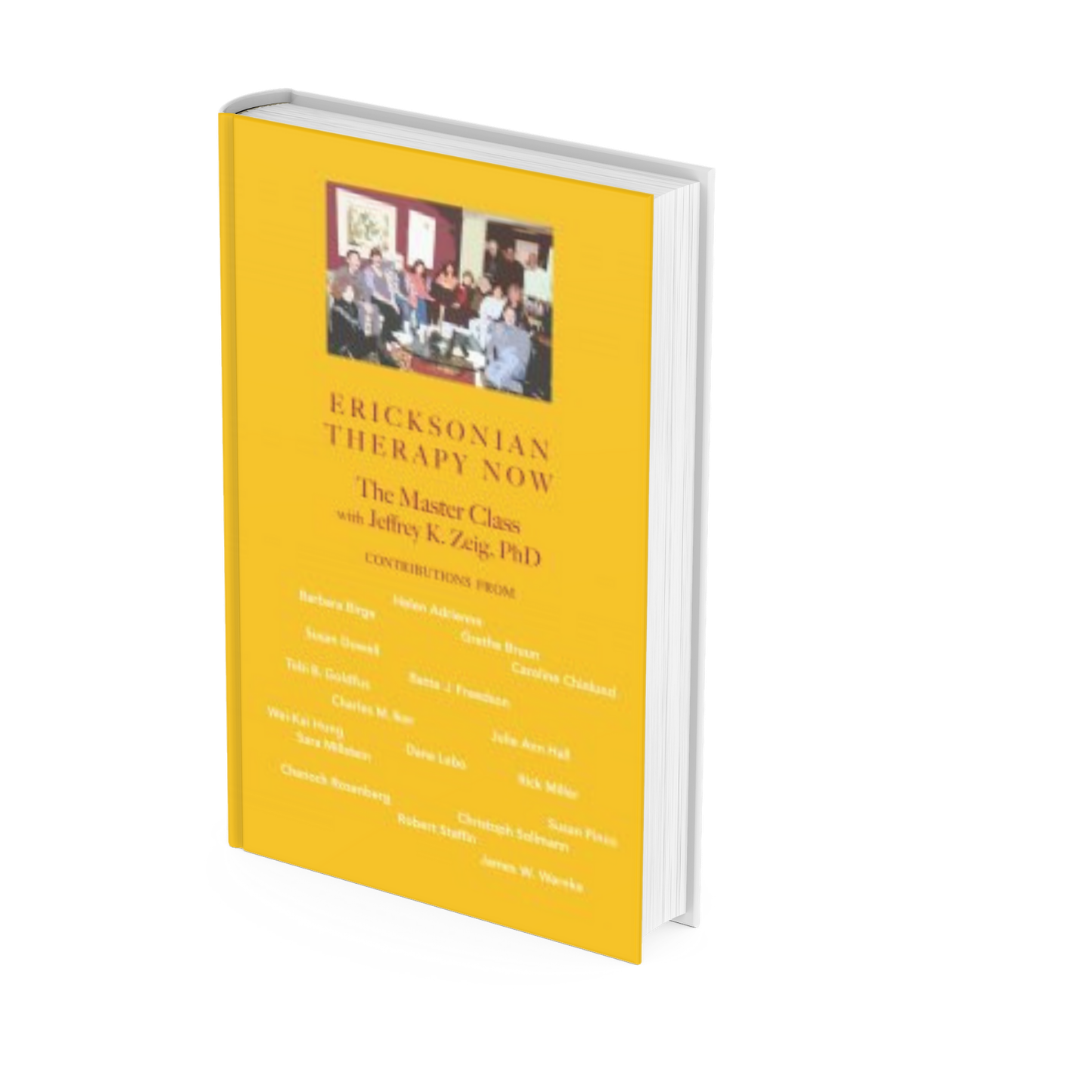
The Master Class with Jeffrey K. Zeig, PhD
by Jeffrey K. Zeig
Type: Hardcover
Milton Erickson was my mentor intermittently for more than six years; he was also an inspiration in creating the Master Class. At his essence, Erickson was experiential. He was the most radically experiential therapist to ever practice. Creating transformative experiences is a component in many schools of therapy, including rational emotive behavior therapy and cognitive behavior therapy, but for Erickson being experiential was not merely a component; it was most of his therapeutic work. Hypnosis is essentially an experiential technique. The subtext of hypnosis is this: “By living this experience, you can be different.” Hypnosis is not a means of providing information.
This book is an opportunity to study single-session therapies that are based in experiential methods. The learning from these methods is primarily stimulated by the client living the change, not by intellectual understanding of how to change. The participants declare what they are going to do differently and the sessions are designed to create experiences that foster the accomplishment of stated goals. Participants have solved complex problems and have made significant life changes. They have overcome writer’s block and then completed a book; they are happier in their jobs and relationships; they rebalance work and life; and they surmount childhood trauma.
The transcripts contained here offer opportunities to sit in on live interactions between therapist and client. An extraordinary adjunct to the transcripts are the participants’ — all stellar professionals themselves — notes on the sessions. They are able to articulate their understandings and impressions in such powerful ways that upon reading their perspectives I also took away something new.
Jeffrey K Zeig