

Instant Change

By Betty Alice Erickson, M.S., L.P.C.
Estimated Reading Time: 3 minutes, 33 seconds
To be in Milton Erickson’s presence was to invite him to teach. And teach he did! Almost everyone who spent time with him can remember precisely the words he said that changed life forevermore. Even people who read his words often comment that “his voice goes with them.”
I am fortunate that when I think of my father, I vividly remember many times when just a few words changed me instantly. In this case, Dad and a family friend, Margaret Mead, worked in tandem. Although the event and words are crystal clear, I don’t remember who said what-they complimented each other beautifully.
In the mid-1970s, my family and I had just returned from a four-year stay in Addis Ababa, Ethiopia. I had taught at a private high school there; our student body was a mixture of races and cultures. One third were military or State Department dependents, a third Ethiopian nationals, and the remainder were children of the international community, including a small number of Americans whose parents were employed by the United Nations.
On my first visit home after our return to the States, I was telling Dad and Margaret Mead about something that had truly troubled me. My last year there, one of my 16-year-old American students, Tom, had great difficulties and I didn’t know how to help him. I had watched him change over the school year, I said, turning from an unhappy youngster who merely had difficulties making friends to a depressed and bitter boy who withdrew from all social contact. In one long discussion with me, Tom had confided he was being severely emotionally abused and mistreated by another teacher.
The teacher had befriended Tom who did not want to give up his only friend. It’s important to know that there was no television, no radio, no movies, shopping malls, or other standard entertainment in Addis. Social interactions and school sports were virtually the only entertainment.
My father and Dr. Mead both listened carefully as I talked about my dismay over the boy’s pain. They responded as a team. “Why didn’t you report the teacher’s behavior to the boy’s parents?” “I did. The parents didn’t care,” I answered. They thought the friendship was good for their lonely son-and Tom vehemently defended the comradeship he felt.
“What did the principal of the school say?” “He didn’t care either,” I replied. His orientation was to smooth things over. Tom was now involved, had a social life, and did not appear to be troubled. I argued that the relationship was inappropriate and harmful to Tom. The principal insisted that Tom’s relationship with the teacher was not a problem and that Tom and the family were happy with the situation.
Dad and Dr. Mead began to understand my difficulties but pushed further. “Were there no authorities you could go to with your concerns?”-No. The Ethiopians were in the midst of political turmoil through out their country and didn’t care about possible problems in the foreign community. Tom was not a military dependent so that avenue was also closed.
They asked me if the boy realized he was being mistreated. “Vaguely, but he didn’t care,” I said. I continued that he was so desperate for acceptance, for a friend, any friend, for anybody to pay attention to him that there was no room for any other thought in his mind. My children were too young to fill that gap. The times I had invited him to dinner was not enough, and I could scarcely go out and talk the other teenagers into being his friend. I had also talked to other teachers about my concerns but without success.
Finally, they asked, “Did you go to the teacher himself and say, ‘Stop! I know what you’re doing. Stop!”‘
I hadn’t. “But he wouldn’t have stopped,” I said.
There was a long pause while they both looked at me. “Well, we’ll never know, will we!” Our conversation was over.
At that moment, I made a vow. I would never ever be in a position again where I did not explore every option. I never wanted to hear myself–or anyone, ever again, say, “Well, we’ll never know, will we.”
This excerpt has been extracted from Volume 24, Issue No. 3 of The Milton H. Erickson Foundation Newsletter.
You may like…

by Brent B. Geary and Jeffrey K. Zeig
Type: Softcover
"The fascinating thing about Milton Erickson’s work is that his originality is not contained in any attempt to differ from others, but simply is a matter of his own pursuit of the new, within his own work.
— Margaret Mead
In these letters there are aspects of Erickson’s life that have never before been revealed publicly. Herein, we are privy to Erickson, the man, in a way that provides new insights into his awesome power as a clinician, a researcher, a theorist, and an individual.
As a reader, you will meet the luminaries with whom Erickson interacted, both in the field of psychiatry and in related disciplines. Sit in on Erickson as he consults on cases with renowned psychoanalysts, exchanges views with Gregory Bateson and Margaret Mead, and discusses research issues with Stanley Milgram. Read firsthand Erickson’s advice to patients, colleagues, and students.
But these letters offer more than a fascinating slice of history, more than an intriguing bit of biography, more than a glimpse of a giant’s legacy. Through these letters we have a portal to the future.
Erickson’s contributions to psychology have been described as encompassing five main streams – strategic psychotherapy, the Mental Research Institute, solution-focused therapy, the psychobiological approach of Ernest Rossi, and the Neo-Ericksonians, including Michael Yapko, Stephen Gilligan, and Carol and Stephen Lankton. The fields of individual, couples, and family psychotherapy continue to reverberate as a result of Erickson’s influence.
Current heirs continue to refine, experiment, and extend the heritage. And the upcoming generation will reach beyond present thinking. In Volume I of The Erickson Letters we gain access to the man and his work through his own words, unfiltered and unencumbered. The rich and vast intellect of a creative genius emerges – not to show us up, but to show us out of the prison of mediocrity.
In a man’s letters, his soul lies naked.
— Samuel Johnson

Una Introductión Al Hombre Y Su Trabajo
por Jeffrey K. Zeig
Tipo: Tapa blanda
“Este libro vale la pena ya que es una descripción muy adecuada de la persona del Dr. Erickson y su muy personal manera de entender los problemas psicológicos y sus soluciones. Describe al hombre más como humano y menos como extraterrestre. Transcribe diálogos que tuvo con Erickson, la forma en que le explicaba al Dr. Zeig cómo podía ayudar a sus pacientes usando historias y referencias que se pueden aceptar sin que las preconcepciones previas interfieran con la nueva perspectiva.”
—Ricardo Figueroa Quiroga. MSc.
Director Instituto Milton H. Erickson de Guadalajara.
México.
“El volumen presente, principalmente un recuento personal de las experiencias personales que el autor tuvo con Erickson, es una contribución importante hacia la comprensión de muchas de las actitudes y métodos utilizados por Erickson con sus pacientes. Al¬gunas de sus intervenciones fueron un resultado de las técnicas de afrontamiento que él empleaba para moderar el dolor y las incapa¬cidades resultantes de la poliomielitis de su infancia. La lucha con¬tra sus deficiencias hicieron una mezcla única de inventiva, flexi¬bilidad, ingenio, astucia e improvisación las cuales mezcladas con un estilo poco ortodoxo y una propensión a manejar una situación hasta más allá del límite, han creado un modelo de psicoterapia que emociona al leer, pero es difícil de duplicar para el terapeuta promedio educado en el diseño de tratamiento tradicional. Sin em¬bargo, hay lecciones que aprender no solamente de las formas há¬biles con las que Erickson se relacionaba consigo mismo y con sus pacientes, pero también de las dramáticas experiencias diseñadas por este talentoso innovador.”
—Lewis R. Wolberg, M. D.
Fundador y Decano Emérito
Postgraduado en el Centro para Salud Mental
Ciudad de Nueva York
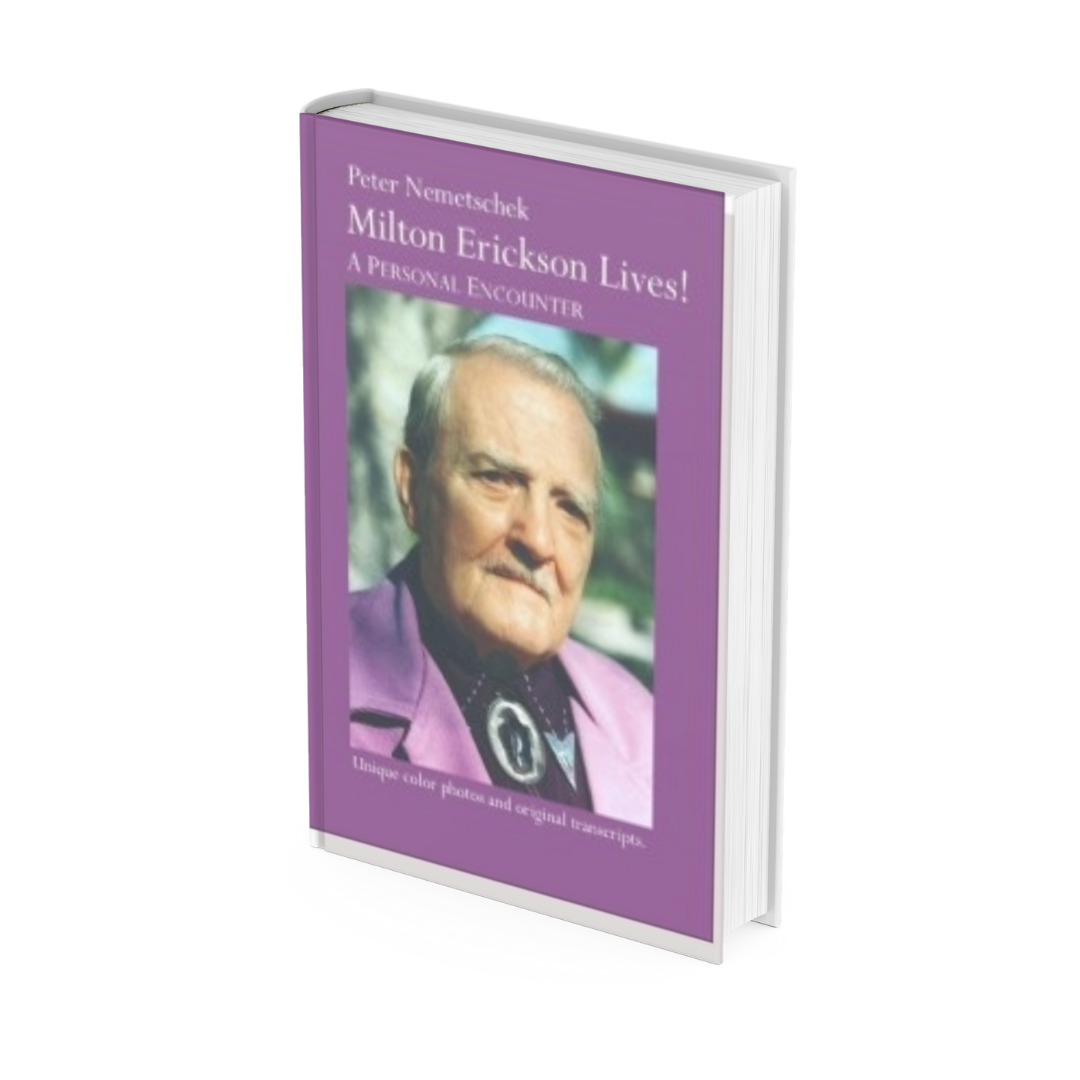
A Personal Encounter
by Peter Nemetschek
Type: Softcover
Milton H. Erickson Lives has the feel of an impressionist painting. In its details and broad strokes, the book focuses on an unusual man - from the perspective of an unusual ma. Original transcripts, rare photographs, and the special tone and palette on memory draw the reader into the vid experience of what is being described. It was an exciting moment for Milton H. Erickson and those who surrounded him, a moment of great clarity, intellectual explosion, a paradigm-shifting investigation-a moment that continues to reverberate powerfully beyond the parameters of that specific period.
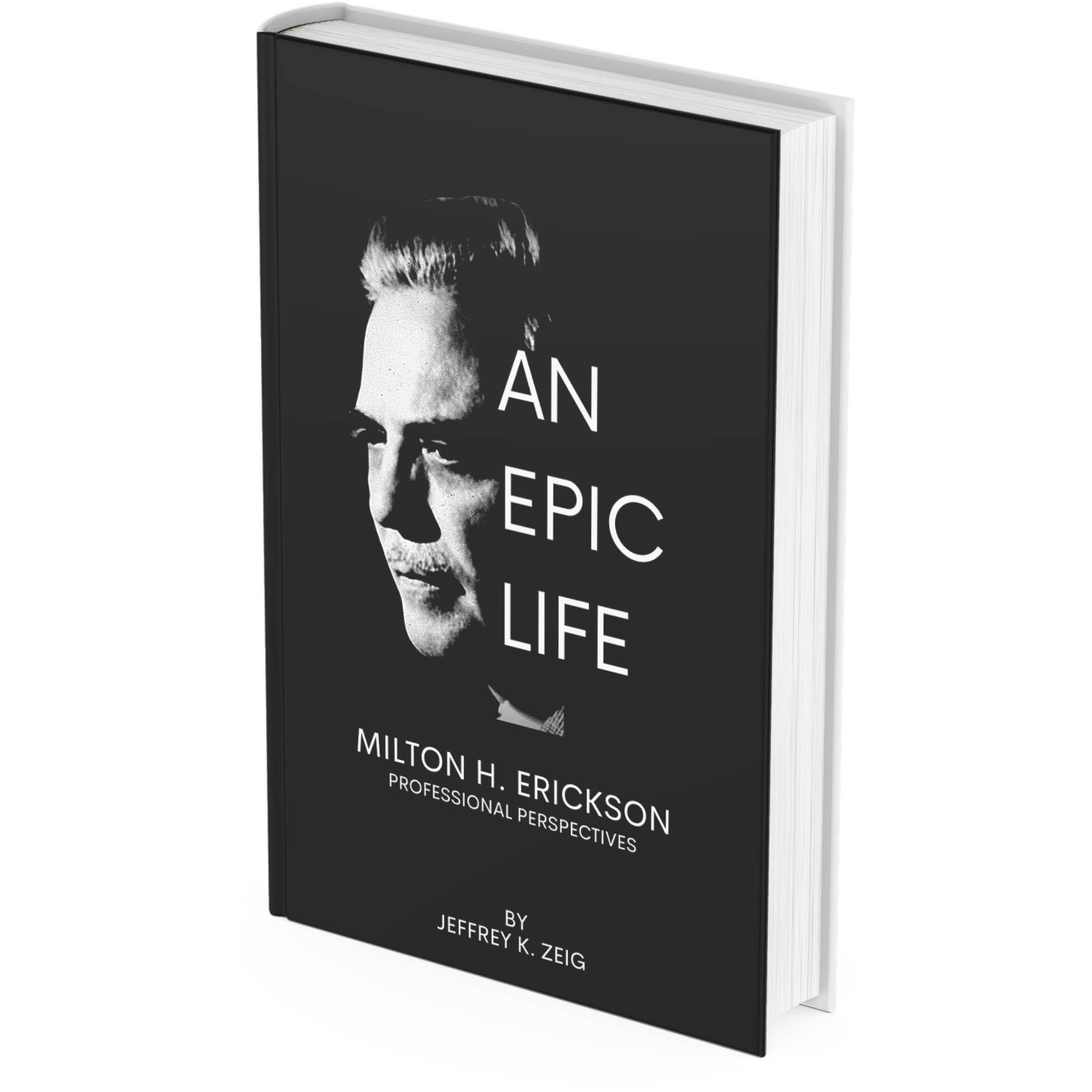
Professional Perspectives
by Jeffrey Zeig, PhD
An Epic Life is a biography written by many authors. Throughout his professional life, Milton H Erickson attracted a diversity of critics and supporters, and this book gives all a voice. Erickson was known to work with patients to elicit in them the innate ability to “connect the dots” to discover their adaptive potentials. Readers will delight in being able to connect the dots too, piecing together a portrait of an extraordinary and complex figure, as they look through the eyes of the men and women who met him at important junctures.
An Epic Life draws upon four decades of interviews with professionals who knew Erickson. The incisive perspectives are interlaced with commentary from Jeffrey Zeig to clarify and contextualize. The images of Erickson that emerge are congruent, divergent, myriad. In the end, readers gain unusual access to the man, his commitment, and his work. There is nothing simple in what is conveyed, and yet the impression it makes is coherent — and lasting.