

In Memory of Aaron T. Beck

The Father of Cognitive Behavioral Therapy
By Christine Padesky, PhD
On November 1, 2021, Aaron Temkin (Tim) Beck died peacefully in his sleep at the age of 100. He was a giant on whose shoulders other giants will stand throughout this century.
A few highlights of his professional contributions to psychotherapy are captured in this tribute, and yet this does not begin to encapsulate what made Tim Beck such a great man. For this we need stories. Tim Beck was my dear friend for more than 40 years. I am grateful for this opportunity to intermingle parts of his biography with personal memories that highlight some of the many facets of his extraordinary presence and the ways he made this world a better and more humane place. Some of the experiences I recount here took place at the Evolution of Psychotherapy conferences and readers of this newsletter undoubtedly have their own stories of interactions with him at these special conferences. Remarkably, many people have told me they met Tim for just a few minutes and yet those few minutes changed their lives forever.
Who was Aaron T. Beck?
Aaron T. Beck was a scientist at his core. He believed that research could help us find better and better ways to help people. In the course of his well-lived life, he transformed and disrupted the field of psychotherapy by illustrating that psychotherapy could be empirically evaluated and that patients had a right to know whether the therapy they were receiving had evidence of being effective. This work began quietly in the 1950s. After completing his psychoanalytic training, Tim set out to find empirical evidence to support psychoanalysis by investigating Freud’s theory of depression as anger turned inward. When his clinical data provided evidence that contradicted Freud’s theory, he followed the evidence instead of his psychoanalytic training and ended up creating a whole new model for understanding human emotion that was rooted in its links to cognition.
Aaron T. Beck was a clinician at his core. He cared so much about every person he interviewed. I once sat with him in a private interview room as he spoke with a woman in a California hospital who going to be discharged later in the week. He asked her in detail about the circumstances surrounding her attempts to kill herself which led to her hospitalization and about the conditions at home to which she was returning. During the interview, he jotted something down on a slip of paper. At the end, he handed it to her and said, “This is my home phone number. Call me after you have been home a few days and let me know how it is going.” When I later asked why he did this, he replied simply, “She lives alone. Leaving a hospital can be harder than people think. I don’t want her to be all alone.” Often when we were traveling and teaching together, Tim would receive huge packets of mail forwarded from his office. He would open them and quietly hand write replies to every suicidal and depressed person who wrote to him. His home phone number was always listed so that people in distress could contact him. Tim’s international expertise in suicide intervention was a lived experience for him. In all my professional years, his level of compassion and commitment to helping others was unparalleled.
Aaron T. Beck was a theoretical and psychotherapy innovator at his core. In the 1960s, he published Depression: Causes and Treatment, in which he articulated a new cognitive theory of depression. Throughout the 1970s, he conducted empirical research to test his theory, and when his theory proved robust, he and his team at the University of Pennsylvania developed Cognitive Therapy (now called Cognitive Behavior Therapy or CBT)— an entirely new form of therapy based on his research. The early randomized and controlled outcomes studies of his approach showed for the first time that a form of psychotherapy could attain the same treatment outcomes as psychopharmacological treatments for depression, which were considered the gold standard at that time. This was significant because trumpets were sounding in the late 1970s, predicting that drugs would one day solve all ills and that psychotherapy would cease to exist because it could not possibly help as much or as quickly as drugs.
Once his treatment for depression was established as one of the first empirically-based therapies, Tim turned his attention to anxiety disorders. But he did not assume that the same treatment methods that helped depression would be helpful for anxiety. Instead, he developed a new cognitive model for understanding anxiety disorders. Research teams working with him at the University of Pennsylvania and in a number of countries around the world began empirically testing his theory and creating therapy approaches specifically designed to address key maintaining factors in each of the anxiety disorders. This was one of the first times a branch of psychotherapy was committed to developing nuanced protocols specifically designed for particular diagnostic issues. Over the next few decades, evidence-based protocols emerged and were empirically evaluated for almost every diagnosis in the psychiatric lexicon.
It was during this period of rapid development in cognitive therapy that Tim Beck was invited to participate in the first Evolution of Psychotherapy conference in Phoenix, Arizona, held in December of 1985. He was the youngest on the faculty at that conference and his therapy was the most contemporary. Nonetheless, over 1,500 people attended his workshop “Cognitive Therapy for Anxiety,” which I had the honor of co-presenting with him.
Over the years, Tim and I taught many workshops together in the U.S. and abroad. And I had a front-row seat, observing his quiet humility in the face of audience skepticism. When therapists stood up at workshops and attacked him for his ideas, saying that they were simplistic or that his therapy was superficial, he would quietly summarize the evidence that supported his work, if it existed. Or, he would humbly say, “You might be right. We need more data on that. I hope you do some research and send me your findings.”
At the second Evolution of Psychotherapy conference in Anaheim in 1990, Tim and I were shadowed throughout the conference by Marjorie Weishaar who was interviewing him for the biography she was writing about him, entitled, Aaron T. Beck (1993). One afternoon, between sessions, as we were walking, she asked, “Dr. Beck, where do you hope Cognitive Therapy will be in 10 years?” Without skipping a beat, he looked at her and said, “I hope Cognitive Therapy does not exist in 10 years.” We must have looked shocked. He went on to say, “In the same way that few therapists say today that they do Rogerian therapy and yet all therapists recognize that the elements of therapy Rogers taught us are important foundations of all psychotherapy, I hope in 10 years there won’t be a need for Cognitive Therapy. My hope is that all psychotherapists will work with patients collaboratively and be patient-centered and encourage patients to actively test out ideas. And my hope is for therapists to follow the best evidence supported therapy methods that exist.” His answer to her speaks volumes. He never saw himself as a guru who needed to be honored as the top psychotherapist in the world. Instead, he was dedicated to making psychotherapy the best it could be for the benefit of patients worldwide.
By the end of the 20th century, CBT had rapidly become one of the most dominant forms of therapy throughout the world. Its exponential growth had been spurred on by its empirically supported efficacy and the relatively brief length of time required for the effective and enduring treatment of depression, anxiety disorders, and many other problems for which people seek help.
In early years of the 21st century, Tim Beck was in his 80s and enthusiastic to take on new challenges. In the remaining 20 years of his life, he worked tirelessly to address serious, chronic mental illness. I have never seen him as happy. Whenever he would talk to me about his research and ideas, he would bubble over with excitement. He and his team worked in tandem with psychosis researchers and therapists in many other countries and they created a specialized therapy called Recovery-Oriented Cognitive Therapy (CT-R) for people experiencing psychosis and similar mental health challenges. CT-R is a collaborative, strengths-based, person-centered approach that focuses on identifying a person’s values and motivations in order to build greater empowerment, engagement, hope, and sense of belonging. His team developed their approach working with people who had been chronically institutionalized, often for decades in state hospitals.
Like Cognitive Therapy, Recovery-Oriented Cognitive Therapy has been empirically tested and found to be highly effective with long-lasting positive outcomes for the majority of people. After participating in CT-R, many patients have been able to leave institutions and return to community life. When Tim spoke virtually about CT-R to a packed convention center at the 2017 Evolution of Psychotherapy conference in Anaheim, California, he received a standing ovation for his heartfelt presentation that demonstrated his deep humanistic understanding and respect for patients. At one point, in response to a question about improving adherence to the use of anti-psychotic medication, Tim simply asked, “Why would we want to force a person into a treatment they don’t want?” The audience burst into applause. He went on to show how CT-R is a valid alternative treatment that patients often prefer.
In fully listing Tim Beck’s achievements, I would need to go into detail about his award-winning contributions to our understanding of suicide, psychological assessment, case conceptualization, innovative therapy approaches, and so much more. The dozens of awards and honorary degrees he received include the Lasker DeBakey Clinical Medicine Research Award (considered the U.S. Nobel Prize), the Grawemeyer Award for Psychology, the Sigmund Freud Award, the Heinz Award for the Human Condition, Lifetime Achievement Awards from multiple state and national organizations, and the Kennedy Community Mental Health Award. He was also short-listed for the Nobel Prize in Medicine.
In 2005, at an international Congress of CBT in Gothenburg, Sweden, Tim Beck enjoyed a lively on-stage dialogue with the 14th Dalai Lama, winner of the Nobel Prize for Peace. At one point in the wide-ranging discussion of cognitive and Buddhist understandings of anger and mind, the Dalai Lama burst out in a wide smile and exclaimed to Tim, “You should win the Nobel Prize for Peace.” After their exchange in Sweden, the Dalai Lama carried on a personal friendship with Tim for the remaining years of his life. In 2014, the Dalai Lama traveled to the United States on a speaking tour and asked Tim to meet him in one of the cities. Tim was in a wheelchair at that time and could not easily travel. So, the Dalai Lama adjusted his schedule and traveled to Philadelphia to meet with him in his home. After a morning of having his home swept by U.S. Secret Service agents, Tim, his family, the Dalai Lama, and his translator enjoyed lunch and conversation and a warm exchange of gifts.
So, what was it about this soft-spoken, yet prolific scientist, compassionate clinician, and innovative thinker that attracted thousands of therapists and researchers around the world to devote their careers to his work? And what was it that led eminent people like the Dalai Lama to want to be his friend? And how was Tim Beck able to radically transform the field of psychotherapy in just a few decades?
Aaron T. Beck was one of a kind. He had the gift of being sincerely interested in every person with whom he spoke. Students were stunned that he genuinely wanted to hear about their ideas. That is how my relationship with him began. I was a 24-year-old graduate student at UCLA and one of the first therapists outside of Philadelphia to learn about his new therapy. I began using it with both adults and children. He asked me to send him email updates about what I was doing with my clients. I did so, and he wrote back and sometimes phoned me so that we could discuss my thinking behind the interventions I was piloting. He came to California for a month each winter and we would meet and discuss his latest ideas and the books he was writing. He always treated me like a colleague and friend, rather than a student or young professional, even before we began teaching together. Our relationship flourished and deepened over the remaining 43 years of his life.
Colleagues were amazed to hear their names mentioned in his workshops and lectures. He was always quick to share credit for ideas and cite others whose ideas informed his own. Clients knew he genuinely cared about what was on their mind.
Tim Beck’s genuine curiosity and interest in others opened the door to many relationships. The depths of his compassion, breadth of his intellectual rigor, and his creative brilliance that he was willing to use as a spotlight to shine on young professionals, transformed those relationships into deep love for and loyalty to him. It is a rare person who gains recognition in their lifetime as a top scientist, top clinician, top theorist, or top psychotherapy innovator. Tim Beck was all of these things, simultaneously, with equal excellence. He lived his life with passionate engagement, working until the final weeks of his life. He dedicated his life to science, clinical service, theoretical innovation, and the singular goal of improving other people’s lives. Over the course of his lifetime, he radically shifted the field of psychotherapy, developed innovative psychotherapy approaches, and empirically examined their power to alleviate distress and suffering. In doing so, he has empowered millions of people around the world to lead more fulfilled and resilient lives.
None of us need to be giants to be proud to stand on Tim Beck’s shoulders.
Rest in peace, Tim.
Christine A. Padesky, PhD, is a clinical psychologist, co-founder of Strengths-Based CBT, an award-winning CBT lecturer, and author of six books including Mind Over Mood. In 2007, Aaron T. Beck presented her with the Aaron T. Beck Award from the Academy of Cognitive Therapy.
You may like…

The Fundamentals of an Existential-Humanistic Approach
by James F.T. Bugental
Type: Softcover
“This book takes you on a wonderful adventure through the process of psychotherapy, both from the side of the client and the therapist. Although it has brief moments of academic flavor, it is mostly engaging and interesting no matter from where you approach it. Bugental shares his own experience as a therapist and discusses a view on human potential that is beautiful, moving, and inspiring. I highly recommend this book for an enjoyable read (nonfiction) and for insight on what psychotherapy can be.”
Contents include:
Deficiency Levels of Therapeutic Goals
Matching Therapy to Client Needs
Other Contrasts among Therapies
What the Client Brings to the Enterprise
Desirable Qualities in a Therapist
The Fundamental Importance of Concern
An Existential-humanistic Ideal for the Client-therapist Relationship
Phases in the Psychotherapeutic Process
A Client’s Account of Working in Therapy
What the Therapist Does
Changes in Life Experience
Enlarged Sense of Identity
JAMES F. T. BUGENTAL was a leading psychotherapist and a founding father, with Abraham Maslow and others, of humanistic psychology or “the third force” (in contrast to psychoanalysis and behaviorism). He was also the creator, along with Rollo May, of existential-humanistic psychotherapy. Bugental earned his doctorate from the Ohio State University in 1948 where he was influenced by Victor Raimy and George Kelly. After a brief time on the University of California, Los Angeles faculty in psychology, Bugental resigned in 1953 to found the first group practice of psychotherapy, Psychological Service Associates, with Alvin Lasko. The group added Tom Greening in 1958, and subsequently Gerard Haigh, Bill Zielonka, Harris Monosoff, and others. A men’s encounter group evolved from this core, which included Jim Clark, Bob Tannenbaum, and Art Shedlin from UCLA, and this group continued meeting for decades until 2006.
With Abraham Maslow and others, Bugental was a cofounder of the Journal of Humanistic Psychology and the Association for Humanistic Psychology in 1961. He was elected a fellow of the American Psychological Association (APA) in 1955, and was the first recipient of the APA’s Division of Humanistic Psychology Rollo May Award. Bugental also was president of the California State Psychological Association, the Los Angeles Society of Clinical Psychology, and the Association for Humanistic Psychology (serving as its first president in 1962). Among Bugental’s many valuable contributions to psychology and psychotherapy are his other books, Challenges of Humanistic Psychology (1967) (and its updated, co-authored version The Handbook of Humanistic Psychology, 2001), The Search for Existential Identity (1976), Psychotherapy and Process (1978), The Art of the Psychotherapist (1987), and Psychotherapy Isn’t What You Think (1999).
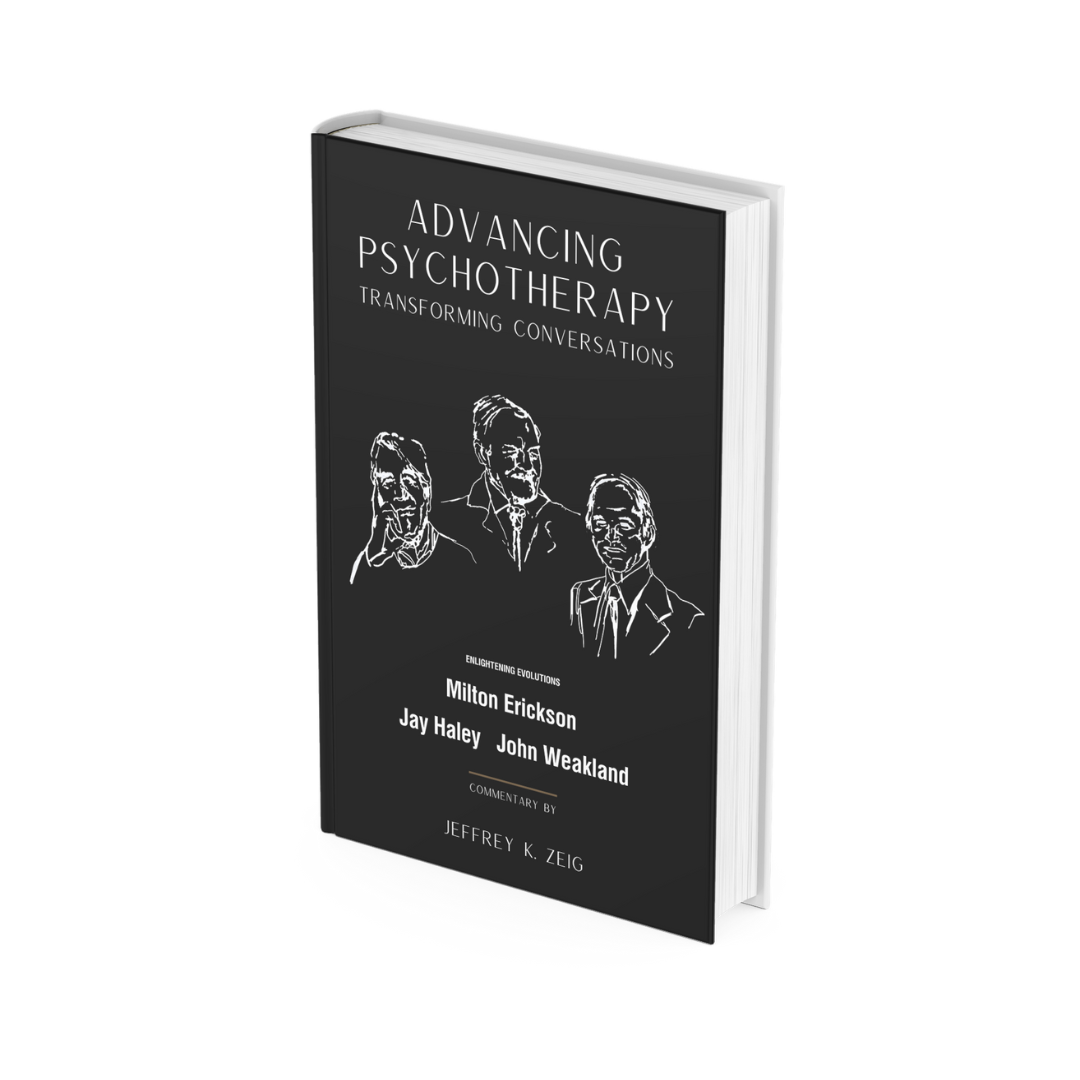
Transforming Conversations
by Jeffrey Zeig
Type: Softcover
When great minds meet, we are privileged to learn from their explorations…
As part of a communications project conducted in the mid-1950s and spearheaded by anthropologist Gregory Bateson, Jay Haley, and John Weakland went to Phoenix, Arizona to learn from and collaborate with Milton Erickson.
The meetings of these three great minds were recorded. Their explorations together both advanced the Bateson Project’s Double Bind Theory and helped to develop more effective approaches in psychotherapy.
Advancing Psychotherapy is a glimpse into an important time in the history of the field and a rare opportunity to learn from those who shaped the future of psychotherapy. Its content will improve your practice of psychotherapy.

by James F.T. Bugental
Type: Hardcover
"The time has come for a major shift in how we think about and how we do psychotherapy," proposes James Bugental. And in a major new contribution-Psychotherapy Isn’t What You Think-he explains why it is necessary that psychotherapists redirect their attention from gathering information about the client to attending to the client’s actual experiencing in the living moment.
This change in the focus of therapist concern, he asserts, enriches the work, as therapeutic partners discover what is most truly alive in their immediate engagement. In bringing this aspect to the fore, they can begin to identify ways in which it is part and parcel of the client’s way of conducting life. The phenomenon of transference is a familiar one, but in this context, it gains greater power to bring about significant life changes.
Dr. Bugental’s conception is basically simple; its application is more challenging. The author provides many clear examples of the idea in action and a vast array of practical tips for accessing the newfound productivity that this conception makes available. Drawing on more than three decades of teaching and practice, Dr. Bugental is careful to avoid becoming esoteric. He speaks directly to his readers, describing vividly “what attending to the living moment” means in actual therapy.
Psychotherapy Isn’t What You Think may just be the most important addition you make to your clinical perspective.