

Diplomacy

by Henry Close
AURORA
My friend Kevin’s 5-year-old granddaughter is known for her dramatic snits, which can be of epic proportions. Once, when he was visiting, she was in the midst of exceptional performance: cringing under a table, clutching her blanket, sobbing with periodic outbursts of saying “NO!” or “GO AWAY!” All efforts by her parents to end the drama were equally futile.
After her parents left for an appointment, Kevin decided to try his hand. He wanted to engage Aurora in a way that did not demand a response. Standing in the doorway to the living room where her older sister was playing, he told a story loud enough for Aurora to hear.
“Once upon a time, two musicians were hiking in the meadows of upstate New York. Suddenly, they heard a beautiful sound in the distance. It sounded like an animal roaring, and it was rich, melodic, and lovely: ‘ROOOO…A…A…A…AR.’
As the two hikers stepped into a clearing, they saw a magnificent beast — a stunning white dinosaur, holding its head high and filling the air with music! It slowly nodded as the two men approached. One of them spoke quietly: ‘You know, you have a beautiful voice. In fact, I think it is the loveliest roar I have ever heard, even nicer than from animals that have had singing lessons. I think you could have a career as an opera singer, but there is one problem. When you sing opera, you can’t just sing ‘ROAR.’ An opera singer must also sometimes sing ‘AH.’
The dinosaur nodded its head and gave it a try: ‘AH…AH!’
The musicians nodded their heads, ‘Very good. Now try it again.’ ‘AH…ROAR…AH!” “AH…ROAR…. AH!’”
By this time, Kevin was singing fortissimo to his granddaughters. He glanced down, and there was Aurora wistfully looking up at him and smiling. He nonchalantly continued: “I never did learn the dinosaur’s name, but I know she sang a couple of times at the opera house. When she was taking her bows, someone in the audience threw her a bouquet of flowers, and she caught them in her mouth. Then she ate them.
TOMMY
My friend, Lettie Mohammed, once noticed a young boy in the corner, flailing his arms as his mother tried to corral him. “Come on, Tommy — we’ve got to go! We’re late already.”
Tommy showed no interest in going anywhere.
Lettie immediately sized up the situation and said, “Tommy just wants to stay in here where all the pretty ladies are!”
Tommy glared at her.
“If he stays in here long enough, we can all give him a kiss!”
With that, Tommy grabbed his mother’s arm. As she was being pulled out the door, she lamented. “He won’t even let me kiss him!”
There are at least three principles implicit in these interventions: (1) Nobody loses face when a power struggle is defused rather than crushed; (2) Cooperation is better than obedience, and there are many ways to enlist it; (3) If you don’t mind making a fool of yourself, you can have a lot of fun in life!
Commentary
By Eric Greenleaf, PhD
When teaching therapists Ericksonian approaches, remember: If it works with children, it’s likely to work with adults. Similar to the work of Rogers – Carl or Mister – the three principles exemplified by Henry Close, as he brings the power of loving interaction to the world of families, is elegant and effective.
You may like…

by Stephen R. Lankton
Type: Hardcover
A compilation of essential contributions that span a period of 17 years, this volume highlights the extraordinary breadth of Stephen Lankton’s unique therapeutic approach, its techniques, protocols, and frameworks. The sections include Ericksonian Hypnosis and Therapy, Brief Therapy, Metaphor, Anxiety and Trauma. Within each section readers will discover an array practical and potent material that is certain to enhance the power of therapy, whether or not the therapist is working within an Ericksonian paradigm.
Praise for Assembling Ericksonian Therapy: Collected Papers of Stephen Lankton
“Stephen Lankton’s lucid and readable prose puts the principles and applications of Ericksonian Therapy easily within the grasp of his readers.”
Alexander A. Levitan, M.D., M.P.H.
“This collection reveals why [Lankton] has been at the forefront of the fields of hypnosis and brief, goal-directed psychotherapies for more than two decades. These papers provide readers with an opportunity to share his wisdom.” —
Michael D. Yapko, Ph.D.
“The ideas [are] both practical and imaginative, dealing with hypnotic technique as well as such areas as family violence. This is an expansive presentation of papers ranging from the ideology of Erickson to using therapeutic metaphor in social work.” —
Jay Haley.
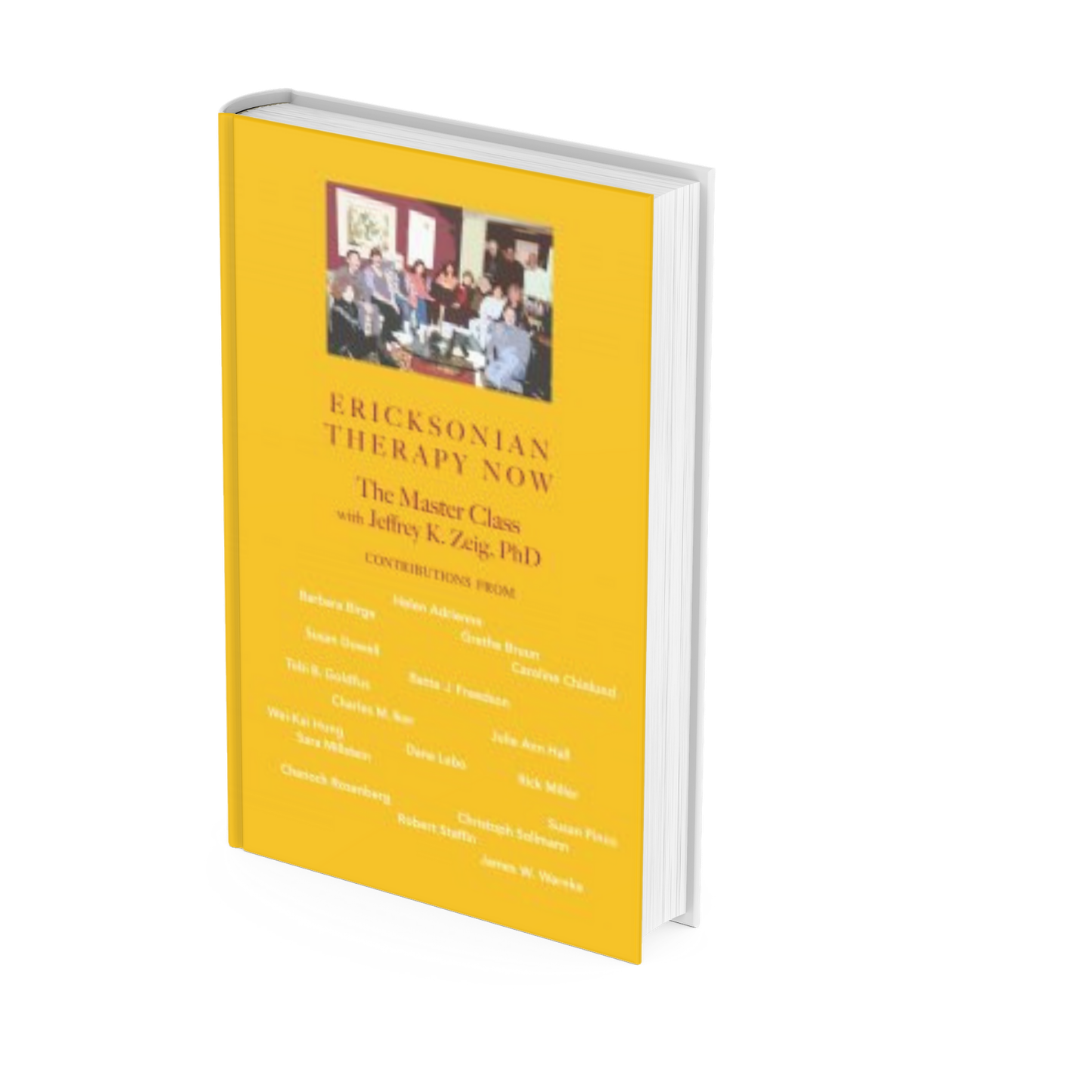
The Master Class with Jeffrey K. Zeig, PhD
by Jeffrey K. Zeig
Type: Hardcover
Milton Erickson was my mentor intermittently for more than six years; he was also an inspiration in creating the Master Class. At his essence, Erickson was experiential. He was the most radically experiential therapist to ever practice. Creating transformative experiences is a component in many schools of therapy, including rational emotive behavior therapy and cognitive behavior therapy, but for Erickson being experiential was not merely a component; it was most of his therapeutic work. Hypnosis is essentially an experiential technique. The subtext of hypnosis is this: “By living this experience, you can be different.” Hypnosis is not a means of providing information.
This book is an opportunity to study single-session therapies that are based in experiential methods. The learning from these methods is primarily stimulated by the client living the change, not by intellectual understanding of how to change. The participants declare what they are going to do differently and the sessions are designed to create experiences that foster the accomplishment of stated goals. Participants have solved complex problems and have made significant life changes. They have overcome writer’s block and then completed a book; they are happier in their jobs and relationships; they rebalance work and life; and they surmount childhood trauma.
The transcripts contained here offer opportunities to sit in on live interactions between therapist and client. An extraordinary adjunct to the transcripts are the participants’ — all stellar professionals themselves — notes on the sessions. They are able to articulate their understandings and impressions in such powerful ways that upon reading their perspectives I also took away something new.
Jeffrey K Zeig