

A Trip with My Father

By Allan Erickson
Estimated Reading Time: 4 minutes, 57 seconds
With comment by Betty Alice Erickson
Recently, I was in Gent, Belgium talking about my father’s early career work. I was shocked by the myths and misconceptions that seem to have been perpetuated about my father. I was stunned to discover that my father is often viewed as physically feeble by a large percentage of his followers. From the perceptions expressed, it seems that most of the people who are writing books and giving talks about my father met him in the 1970s when he was confined to a wheelchair and had changed his practice to align with his physical limitations. This perspective has clouded the true picture of how my father was when he was younger. I remember my father quite differently; he was a vigorous man. The following story sheds light on my view.
In about 1953, when I was twelve, there were some articles in the newspaper about a canyon in western Arizona with wild palm trees in it. It seems seeds had blown in from southern California and taken root in a canyon that was wet enough for their growth. I expressed an interest in seeing the trees. A while later, Dad said we would be going to see the canyon with one of his patients. It was not unusual for my father to integrate patients into family activities and lives, so this didn’t surprise me at all. Within a few days, my father and I were in this patient’s car on the way to Lost Palm Canyon. No one else was with us. The patient was driving, and I was in the back seat.
Even though it happened nearly 60 years ago, I remember several things about that three-hour drive from Phoenix. As soon as we started, my father looked at me and said that he and his patient were going to be discussing things, and I was not to listen. Now my father knew that you could not tell a twelve-year-old not to listen for three hours. Upon reflection and given the wisdom of years, what my father was doing was telling me that I was not to repeat what I heard. He knew that I was going to listen, but if I told anyone what I heard then I would have to admit I disobeyed my father by listening. For nearly 60 years, I told no one that for three hours my father and his patient discussed what a man should look for in choosing a wife.
The last part of the drive was over a dirt road for about seven miles. Then we parked the car by the side of the road. There was no path, and we had to walk more than a mile across a rock-strewn valley and up a gully leading to a cleft between two mountains. At one point, my father told me to grab the end of his cane. I did, and he pulled himself over a rather large rock. I remember thinking that I really had to hold on because I was the only one keeping my father from having a bad fall. Also, it was here that I understood, “Hey, my Dad is lame—I had not realized that before!” After about an hour, we were at the level of the trees, which we all admired. Then, of course, we had to scramble back to the car.
I do not remember much about the ride home except that I was quite tired from the activity I had done. Thus, you can see why I was shocked by the view that my father was physically feeble.
Comments from practicing therapist, Betty Alice Erickson, who also grew up about the same time as Allan—
Since Erickson was an expert with indirect messages and enjoyed using them, I am convinced of several things. First, he was employing the time-honored method of all parents—giving good information to someone in front of a child. In other words, he was talking to his patient while simultaneously giving good information to Allan. Allan even remembers various details. Furthermore, he sensed something else important was going on that he didn’t totally understand.
Secondly, I am certain that the event probably was used with the patient on many levels. One of Dad’s constant messages was to enjoy life— to put out the effort and find things to enjoy; that overall, you receive out of life exactly what you put into life. This trip was a perfect example.
Additionally, Allan’s recognition that his father was lame as he helped pull him with his cane is a sign of Erickson’s vibrant persona. Neither Allan nor I ever knew him without a cane. I remember realizing for the first time that my father was lame when he was unable to use the “bride’s walk” as he escorted me down the aisle at my wedding. He just smiled at me when I looked at him with surprise and said, “That’s right. I can’t.”
One of my jobs, as a little girl, was to rubber-band his foot to his bicycle pedals, so I certainly knew he was lame— even if I hadn’t noticed his cane, I knew. But, I never thought about his lameness as a disability because he treated it so naturally. He was rightfully amused at my wedding to discover that although I knew he needed a cane, it was so insignificant I’d forgotten the need. Similarly, Allan never consciously realized the impact of his disability until he hoisted him over the rock.
These events speak to Erickson’s dynamic aura and personal energy. He was always amused that adults sometimes thought his cane was affectation; although children always knew he needed it. Without considering Erickson’s energetic force of life, people who study him cannot totally understand his later work because his personal drive was the underlying spirit and directing force of his practice even as his health deteriorated.
This excerpt has been extracted from Volume 31, Issue No. 2 of The Milton H. Erickson Foundation Newsletter.
You may like…

by Brent B. Geary and Jeffrey K. Zeig
Type: Softcover
"The fascinating thing about Milton Erickson’s work is that his originality is not contained in any attempt to differ from others, but simply is a matter of his own pursuit of the new, within his own work.
— Margaret Mead
In these letters there are aspects of Erickson’s life that have never before been revealed publicly. Herein, we are privy to Erickson, the man, in a way that provides new insights into his awesome power as a clinician, a researcher, a theorist, and an individual.
As a reader, you will meet the luminaries with whom Erickson interacted, both in the field of psychiatry and in related disciplines. Sit in on Erickson as he consults on cases with renowned psychoanalysts, exchanges views with Gregory Bateson and Margaret Mead, and discusses research issues with Stanley Milgram. Read firsthand Erickson’s advice to patients, colleagues, and students.
But these letters offer more than a fascinating slice of history, more than an intriguing bit of biography, more than a glimpse of a giant’s legacy. Through these letters we have a portal to the future.
Erickson’s contributions to psychology have been described as encompassing five main streams – strategic psychotherapy, the Mental Research Institute, solution-focused therapy, the psychobiological approach of Ernest Rossi, and the Neo-Ericksonians, including Michael Yapko, Stephen Gilligan, and Carol and Stephen Lankton. The fields of individual, couples, and family psychotherapy continue to reverberate as a result of Erickson’s influence.
Current heirs continue to refine, experiment, and extend the heritage. And the upcoming generation will reach beyond present thinking. In Volume I of The Erickson Letters we gain access to the man and his work through his own words, unfiltered and unencumbered. The rich and vast intellect of a creative genius emerges – not to show us up, but to show us out of the prison of mediocrity.
In a man’s letters, his soul lies naked.
— Samuel Johnson
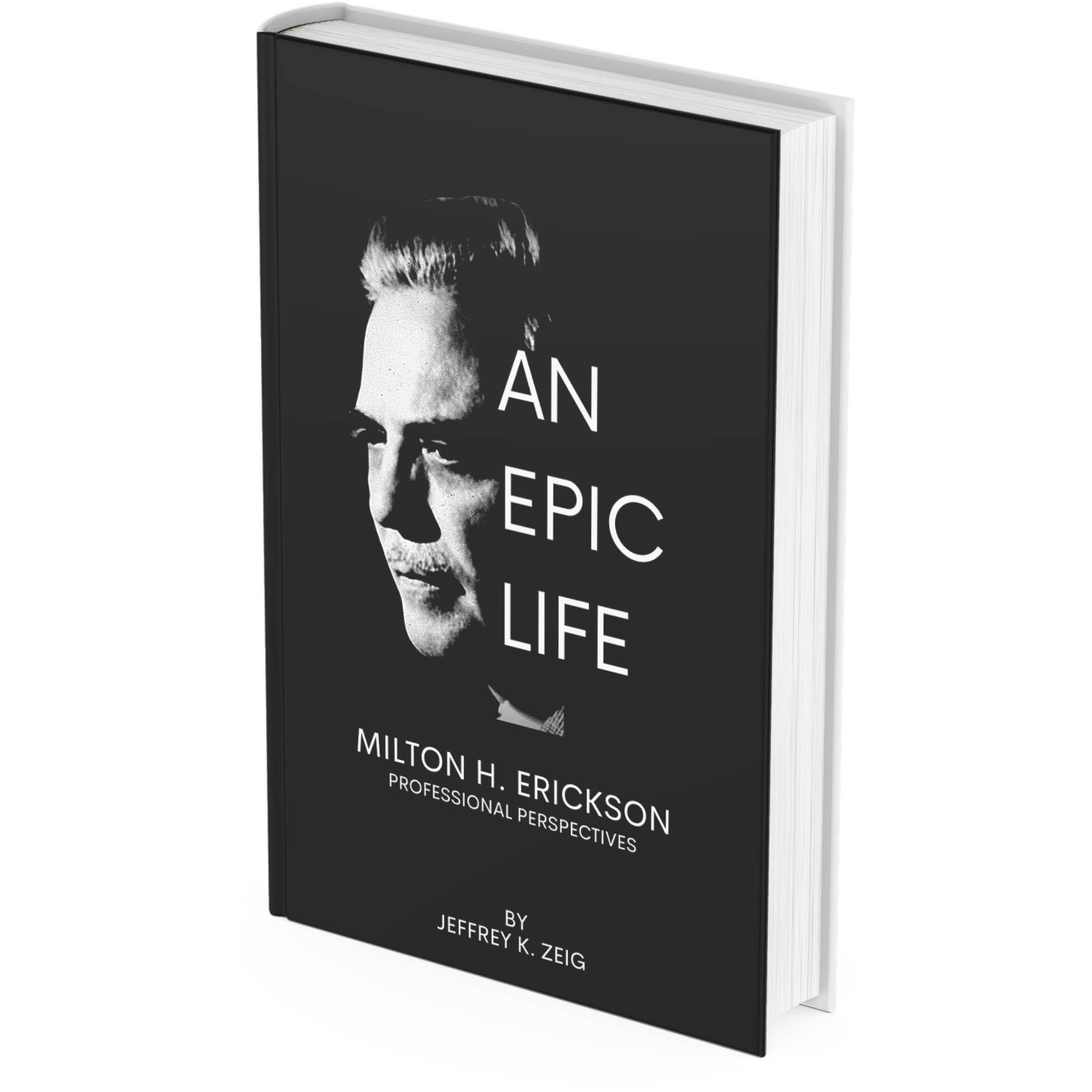
Professional Perspectives
by Jeffrey Zeig, PhD
An Epic Life is a biography written by many authors. Throughout his professional life, Milton H Erickson attracted a diversity of critics and supporters, and this book gives all a voice. Erickson was known to work with patients to elicit in them the innate ability to “connect the dots” to discover their adaptive potentials. Readers will delight in being able to connect the dots too, piecing together a portrait of an extraordinary and complex figure, as they look through the eyes of the men and women who met him at important junctures.
An Epic Life draws upon four decades of interviews with professionals who knew Erickson. The incisive perspectives are interlaced with commentary from Jeffrey Zeig to clarify and contextualize. The images of Erickson that emerge are congruent, divergent, myriad. In the end, readers gain unusual access to the man, his commitment, and his work. There is nothing simple in what is conveyed, and yet the impression it makes is coherent — and lasting.

Personal Perspectives
by Jeffrey Zeig
An Epic Life Vol. II is the second biography on Milton H. Erickson written by Jeffrey Zeig. The first volume features professional perspectives on Erickson and this book offers a personal lens, as seen through Erickson’s family, friends, neighbors, students, secretaries, and patients. The reader gains access into the dynamic personal world of Milton Erickson, who was a one-of-a-kind communicator of unparalleled brilliance.
Erickson was known to work with patients to elicit in them the innate ability to “connect the dots” to discover their adaptive potentials. Readers will delight in also being able to connect the dots, piecing together the professional aspects of Erickson in the first volume with the personal ones in this volume. For Erickson, the line between his professional life and personal life was blurred. He was doctor, teacher, friend, and neighbor all at the same time. Readers will see how his therapy methods carried over into his personal life. Or was it perhaps the other way around?
An Epic Life II draws upon decades of interviews with those who knew Erickson on a more personal level. The incisive perspectives are interlaced with commentary from Zeig to clarify and contextualize. The images of Erickson that emerge are congruent, divergent, and myriad. In the end, readers will have a more complete picture of the man, his commitment, and his work. There is nothing simple in what is conveyed, and yet the impression it makes is coherent – and lasting.
Zeig prepares us for this stimulating journey by providing a comprehensive history of Erickson’s lineage, and background on the many contexts mentioned in the book.
Erickson was one of the greatest psychotherapists of the 20th century and the father of modern hypnosis and brief therapy. His professional contributions continue to influence the field and its practitioners and his personal life is inspirational.
As we strive to evolve personally and professionally, we should do as Erickson did: Leave the world a better place.
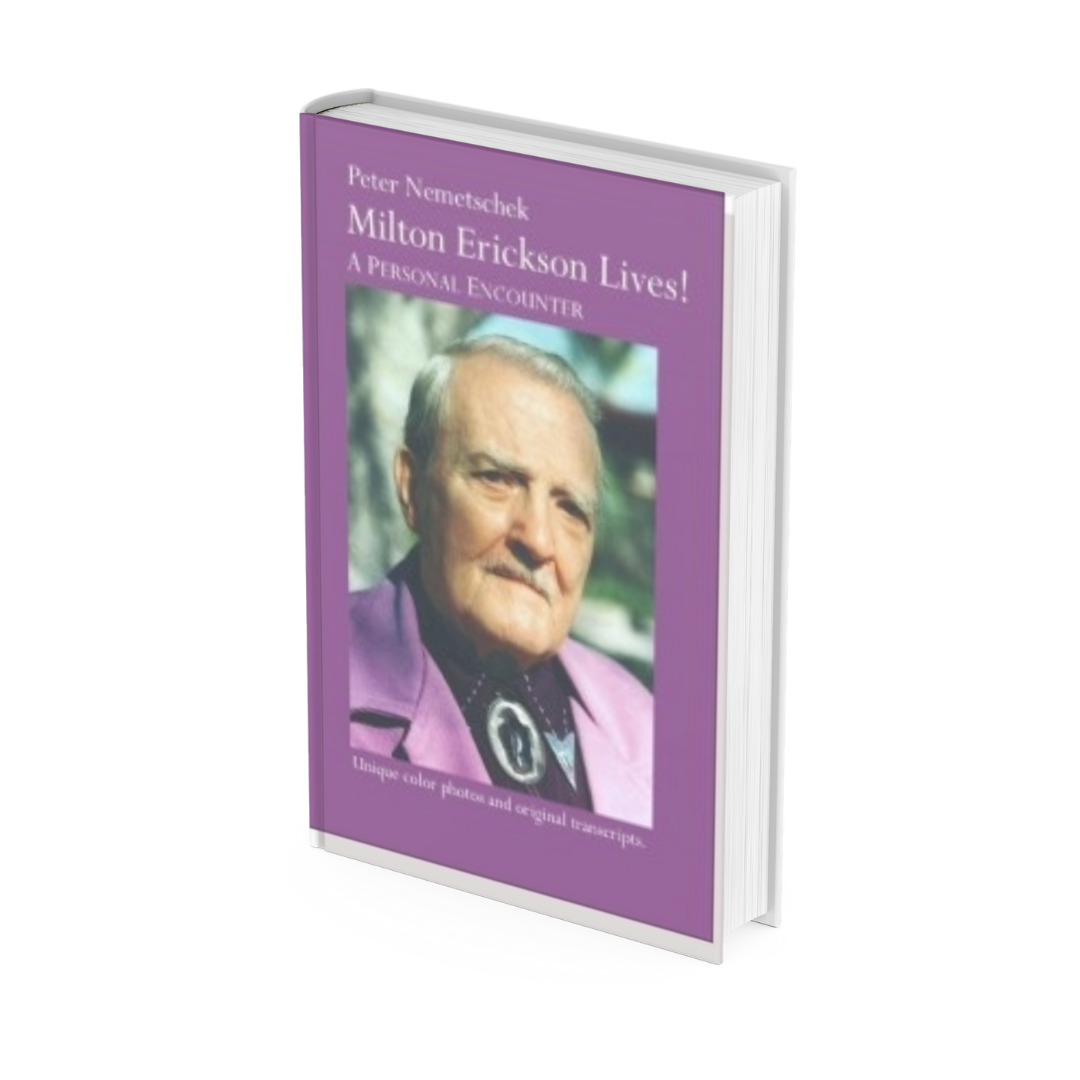
A Personal Encounter
by Peter Nemetschek
Type: Softcover
Milton H. Erickson Lives has the feel of an impressionist painting. In its details and broad strokes, the book focuses on an unusual man - from the perspective of an unusual ma. Original transcripts, rare photographs, and the special tone and palette on memory draw the reader into the vid experience of what is being described. It was an exciting moment for Milton H. Erickson and those who surrounded him, a moment of great clarity, intellectual explosion, a paradigm-shifting investigation-a moment that continues to reverberate powerfully beyond the parameters of that specific period.