

A Milk Bath

By Eric Greenleaf, Ph.D.
Estimated Reading Time: 3 minutes, 4 seconds
For two years, teachers from the Milton H. Erickson Institute of the San Francisco Bay Area have conducted masters degree classes in strategic family therapy and Ericksonian hypnosis at Universidad Autónoma Gabriel René Moreno (UAGRM), the largest Bolivian university. Recently, it was my turn to teach.
After the first class I conducted, two women, who were part of a group of six close friends who attended the courses, approached me.
One spoke for the other: “She is afraid to drink water, afraid to bathe or shower in water.” I replied, “I have little time to talk. I have a meeting in a few minutes.” I asked the spokeswoman, “What does she drink?” “Tea?” “No!” “Does she drink milk?” “Oh, yes!” I turned to the silent woman, “Here’s what I want you to do: When you go home today, take a bath in milk. Not a tubful of milk, just a sponge bath in milk. Tomorrow, tell me what happened.”
At the start of the next class, the woman with the water phobia came up to me smiling. “I’m not afraid to drink water anymore. When I get home today after class, I’ll take a nice, warm shower.”
Commentary
After working with that woman, I tried to understand what led to me to offer brief, effective therapy. It seems plausible that I used my intuition — picking up on social cues the woman gave me. She was obviously ashamed to approach me with what she considered a strange psychological problem. So as not to embarrass her, I did not direct my speech toward her, but rather to her spokeswoman and close friend. Her friend enthusiastically indicated that the woman hated tea but loved milk.
In saying that I had little time to talk, I had shared with the woman a sense of urgency, which may have moved both of us to act decisively. And, I banked on her unconscious knowledge of the sort of women who bathe in milk: actresses and other highly valued and beautiful women; proud women. My instruction to bathe in milk carried this cultural value to the shame-filled patient, as a sort of Doctor-Teacher’s orders, and as an experiment – could she make do with a modest amount of cleansing?
Intuition is a vectorial sense that leads us in a direction without conscious knowledge of the route to be taken. Dr. Erickson’s intuition, which left observers pleased and puzzled, can be understood as formed by the unselfconscious knowledge of oral traditions in public speech, cultural norms, social roles, and functioning human relationships.
To understand Ericksonian approaches, it helps to think of the basic functions of human experience. All our experiences are represented in the brain. These representations allow us to imitate each other, and to learn from each other. Imagined experience has the same neural sequence as lived experience.
Empathy helps us to imagine the pain and emotion of another person. The hypnotic relationship allows us to imagine the three-legged race we run with our patients, through the mysteries of life and death. Our unconscious minds represent the entire neurophysiology of the body, new learning, surprise, and the problematic and social relationships in our families and small social groups.
We access the unconscious with stories and dramatic interactions. One of my class exercises is to have students imagine their unconscious minds, then place an image of an insoluble problem of their own in the imagined unconscious of the other for a solution. As a patient of mine once said, with bright eyes, “I know what you’re doing when you do hypnosis: You’re telling stories where they belong.”
This excerpt has been extracted from Volume 40, Issue No. 1 of The Milton H. Erickson Foundation Newsletter.
You may also like…
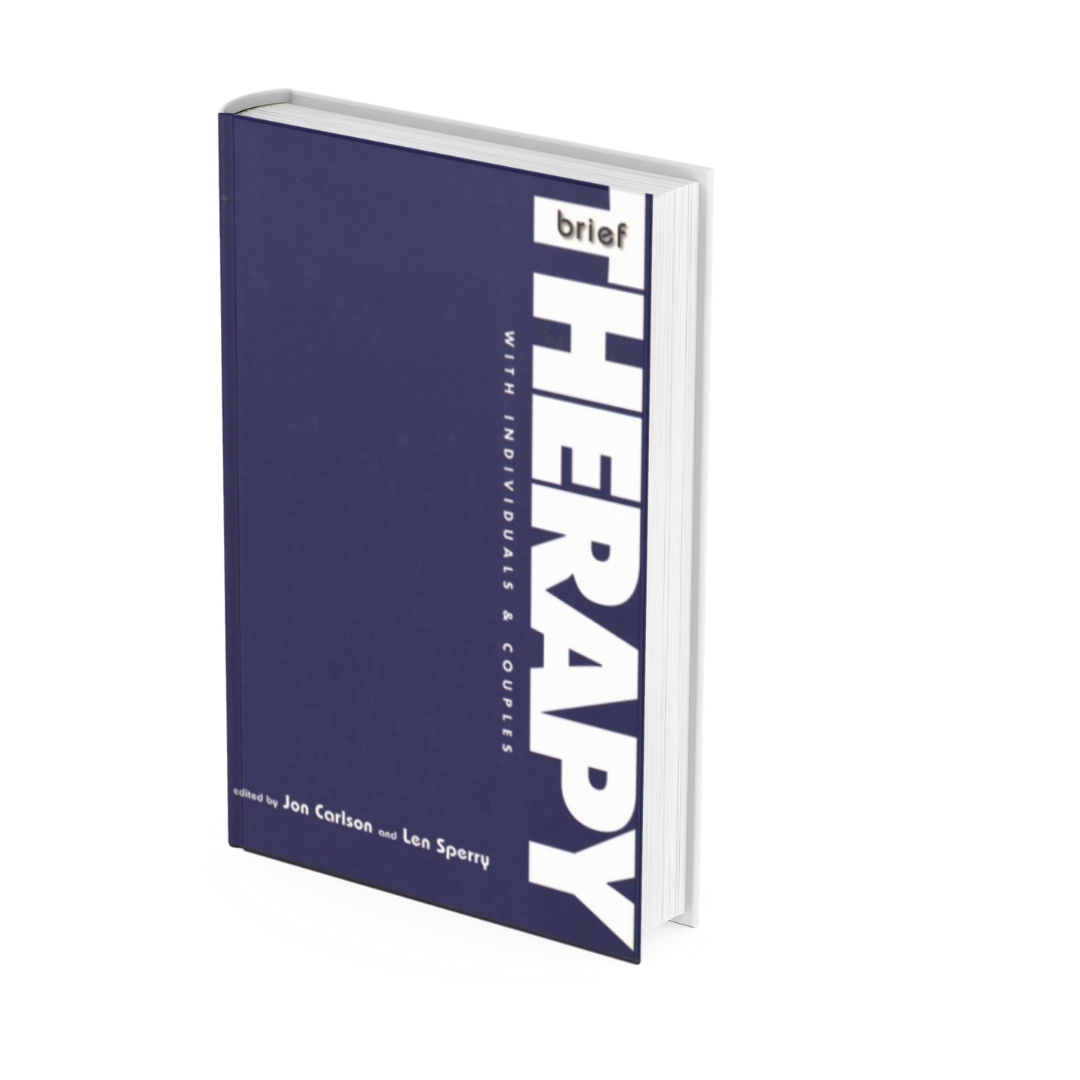
by Jon Carlson and Len Sperry
Type: Hardcover
More than 100 books on brief therapy have been published in the past decade. . . . Although the number of publications is remarkable, their clinical utility has generally not been all that remarkable. Ironically, some of the longest books on brief therapy do little more than ponderously review theories of [brief therapy], while the very short books say little more than that brief therapy has great promise and applicability. Few offer much information or guidance about actually doing brief therapy, about actually applying its stategies in day-to-day clinical practice with adults.
–From the Editors’ Introduction
Now, setting a new standard for publishing in the area of brief therapy, there’s Brief Therapy Strategies with Individuals and Couples, a sourcebook that brings together in a single place all the most effective strategies and interventions–across orientations–for time-effective treatment of individuals and couples. Each strategy is carefully described and then clearly illustrated with clinical case materials.
The chapter authors include 20 of today’s leaders in the field of brief therapy–Frank Dattilio, Michael Hoyt, Luciano L’Abate, Arnold Lazarus, Wade Luquet, Leigh McCullough, Scott Miller, and David Scharff among them.
Unique both in its scope and its clear clinical focus, Brief Therapy Strategies with Individuals and Couples will prove an invaluable resource for all clinicians seeking to maximize not just their clients’ time, but also their own. Readers across the field will benefit from Carlson and Sperry’s decision to gather and distill the best treatment strategies across orientations–cognitive-behavioral, multimodal, constructivist, Ericksonian, psychodynamic, psychoeducational, and pharmacological–into a single, well-organized, case-filled volume.
Critical Acclaim
This groundbreaking book addresses a major need of almost all practicing therapists: efficacious brief therapy. Representing a wide range of counseling perspectives, the contributors to the book explain, with the help of familiar clients, how therapy can be shortened using their particular approach. The value of this book is in its clarity and detail. Practitioners may select practices that are compatible with their own beliefs and immediately put them to use in their offices. If you are in practice, this is a book you should not miss.
–William Glasser, M.D.
Author of Reality Therapy in Action

by Robert Langs
Type: Hardcover
"Robert Langs continues his innovative legacy by extending his communicative approach to psychotherapy into a communicative dream therapy. … Langs has not only found a skillful way of translating and understanding the latent content of dreams, he also has found a way of understanding the manifest content of dreams … His prescribed protocol of treatment affords unusual self-authorization for patients to continue treatment on their own. This is a highly worthwhile book for all mental health professionals.
–James S. Grotstein, M.D.
Clinical Professor of Psychiatry, UCLA School of Medicine
Training and Supervising Analyst, Los Angeles Psychoanalytic Institute
This book, sweeping in its scope, demonstrates that dreams are components of the deep unknowable unconscious mind that is essential to human survival. Langs argues that communication is the uniquely human aspect of dreams. His argument incorporates classical Freudian psychoanalysis and modern information theory, neuroscience, anthropology, immunology, and neo-Darwinism. A communicated dream requires a listener. When the listener is a therapist, who can interpret and validate the deeply unconscious meanings, the vastly adaptive unconscious mind becomes more efficient. Freud’s Interpretation of Dreams was the dream book of this century. If Langs is correct, the book may become the “dream book” of the next. –James O. Raney, M.D.
Clinical Faculty, University of Washington School of Medicine, Seattle.
In this groundbreaking book, Dr. Robert Langs invites you into his world. With this invitation comes a new understanding of dreams and the insights they hold. The book offers an innovative method of attending to dreams effectively in psychotherapy, no matter what the therapist’s professional orientation or to what extent dreamwork is used.
Dr. Langs has designed this book as a practical guide to how to work with both the surface and the depths of dreams. Multileveled and multidimensional, dreams are arguably among the most profound – and most complex – communications. This discussion goes a long way toward clarifying fundamental modes of listening to and formulating patients’ material, as well as demonstrating ways to intervene, both of which will facilitate the therapeutic work of psychodynamic and cognitive psychotherapists alike.
A prolific contributor to the mental health literature, Dr. Langs’ ongoing exploration of the human psyche has led to stunning revelations throughout the years. With Dreams and Emotional Adaptation, he has turned a corner in his own investigation into the meanings and impact of dreamwork — proving himself once again to be an insightful, wholly enthusiastic student and a generous, altogether compelling teacher.